Registered Nurse CV Examples That Secure Interviews (2026)
Registered nurse CV examples for new grads, experienced RNs, and specialty roles globally. Explore how nurses present clinical skills, patient outcomes, and professional credentials — and use these examples to build a CV that works in 2026.
Updated Mar 5, 2026
Written by Artur Lopato
Healthcare employers globally receive hundreds of nursing CVs for each vacancy. Most are rejected within seconds — not due to lack of qualifications, but because CVs fail to demonstrate what hiring managers actually need to see.
A strong registered nurse CV goes beyond listing responsibilities. It demonstrates measurable patient impact, clinical competence, and evidence you can maintain standards in demanding healthcare environments.
Effective nursing CVs answer three critical questions immediately:
Are you properly registered? What patient outcomes have you achieved? Can you work safely under pressure?
Understanding International Nursing CV Standards
Nursing CVs differ significantly across countries, but certain elements remain universal: professional registration details, evidence-based practice examples, and quantified clinical achievements.
Strong nursing CVs demonstrate scope of practice clearly. They include patient-to-nurse ratios, improved clinical indicators, participation in quality improvement initiatives, and adherence to professional standards.
"A nursing CV should demonstrate clinical excellence and professional accountability — not just attendance at work."
If you're determining how to structure your nursing CV or which format meets international standards, beginning with a proven ATS-optimized CV template designed for healthcare professionals can help avoid formatting issues that prevent proper review.
Registered Nurse CV Examples by Experience and Specialization
Newly Qualified Registered Nurse CV
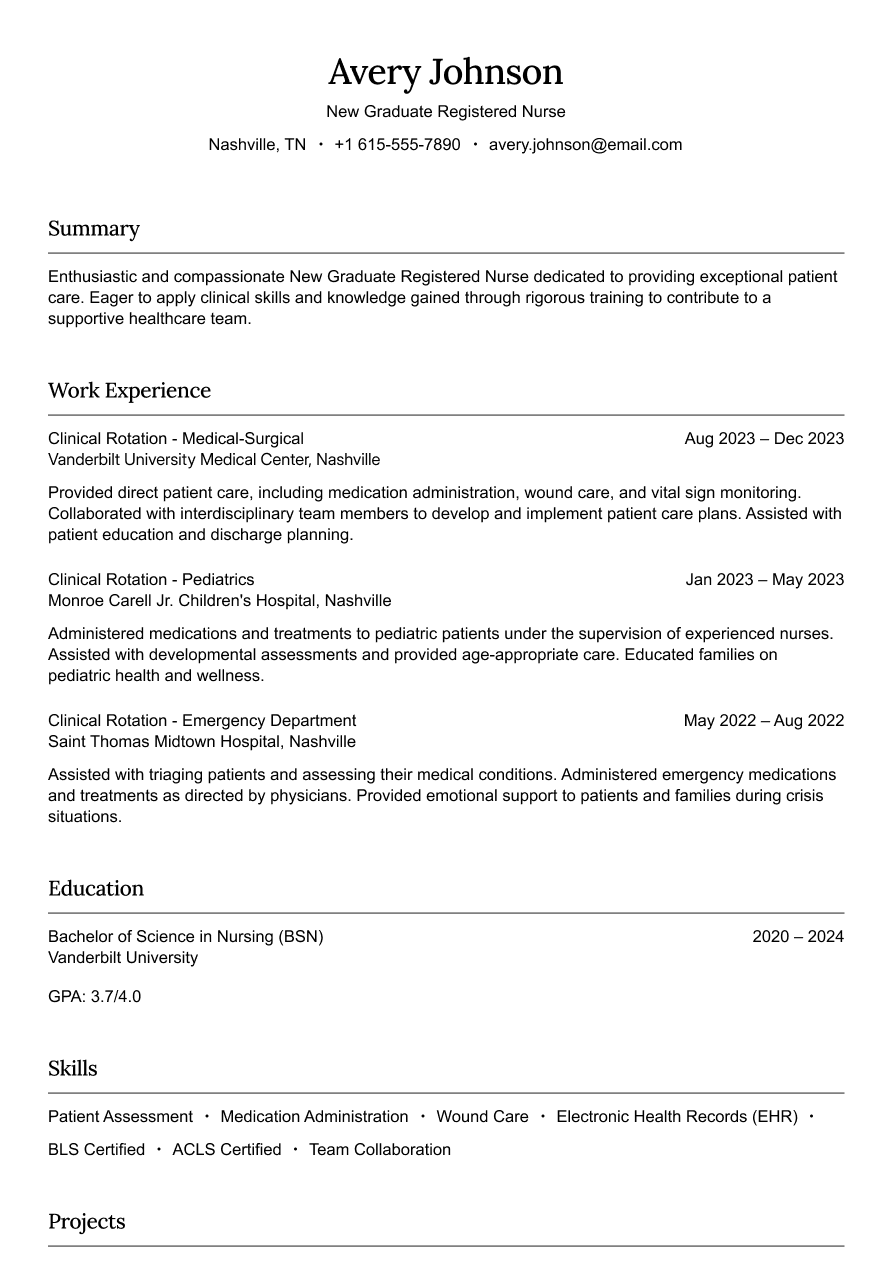
Structured for newly qualified nurses with limited post-registration experience. Emphasizes clinical placements, professional registration, and foundational competencies developed during training. Clean layout highlights education, essential certifications, and practical experience across varied clinical settings.
Intensive Care Unit Registered Nurse CV
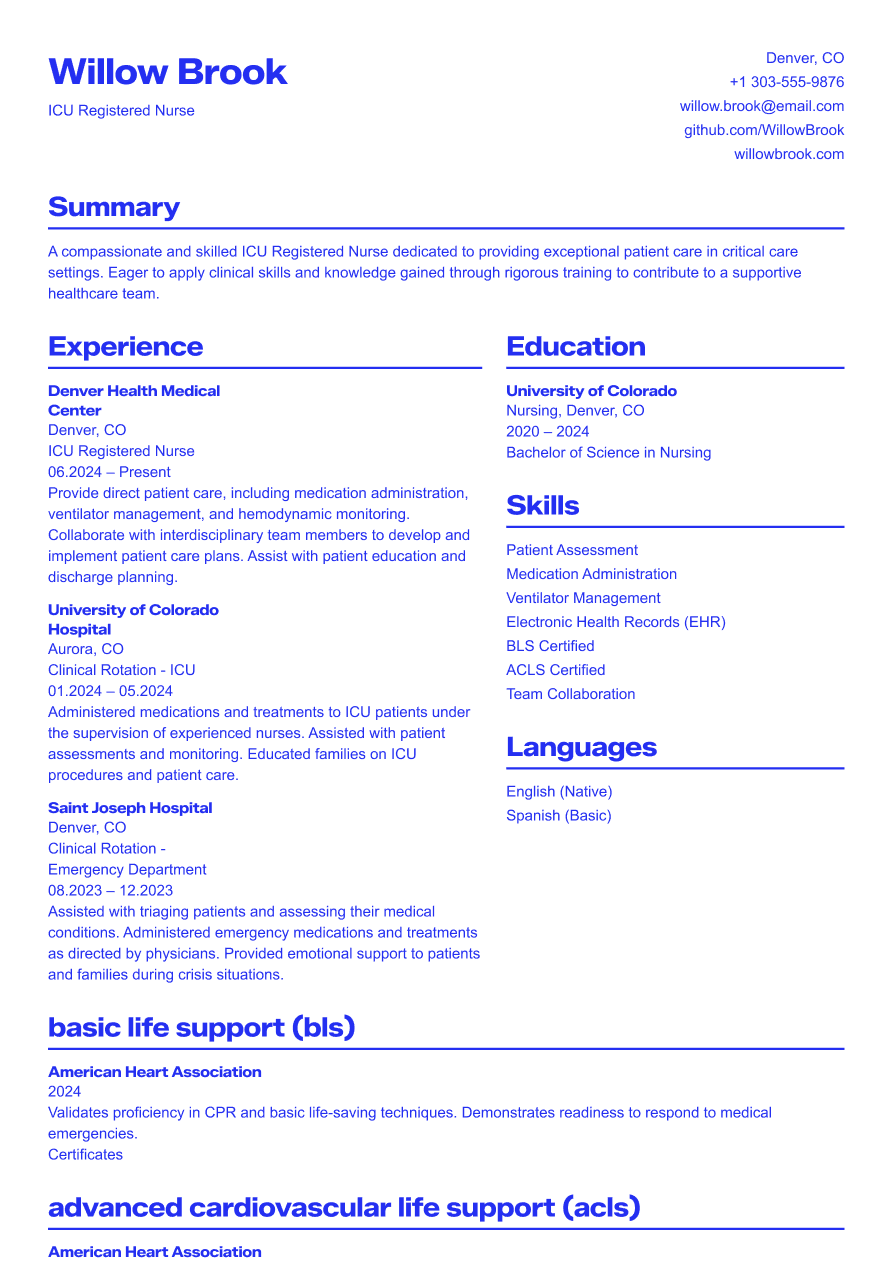
Centered on critical care competence and complex patient management. This example demonstrates proficiency with mechanical ventilation, invasive monitoring, and advanced life support.
Highlights quantified outcomes such as "Maintained 1:3 patient ratio in 20-bed intensive care unit" and "Contributed to 25% reduction in pressure ulcer incidence through enhanced positioning protocols." Competencies section emphasizes post-registration critical care qualifications, specialized equipment knowledge, and emergency response capabilities.
Experienced Registered Nurse CV
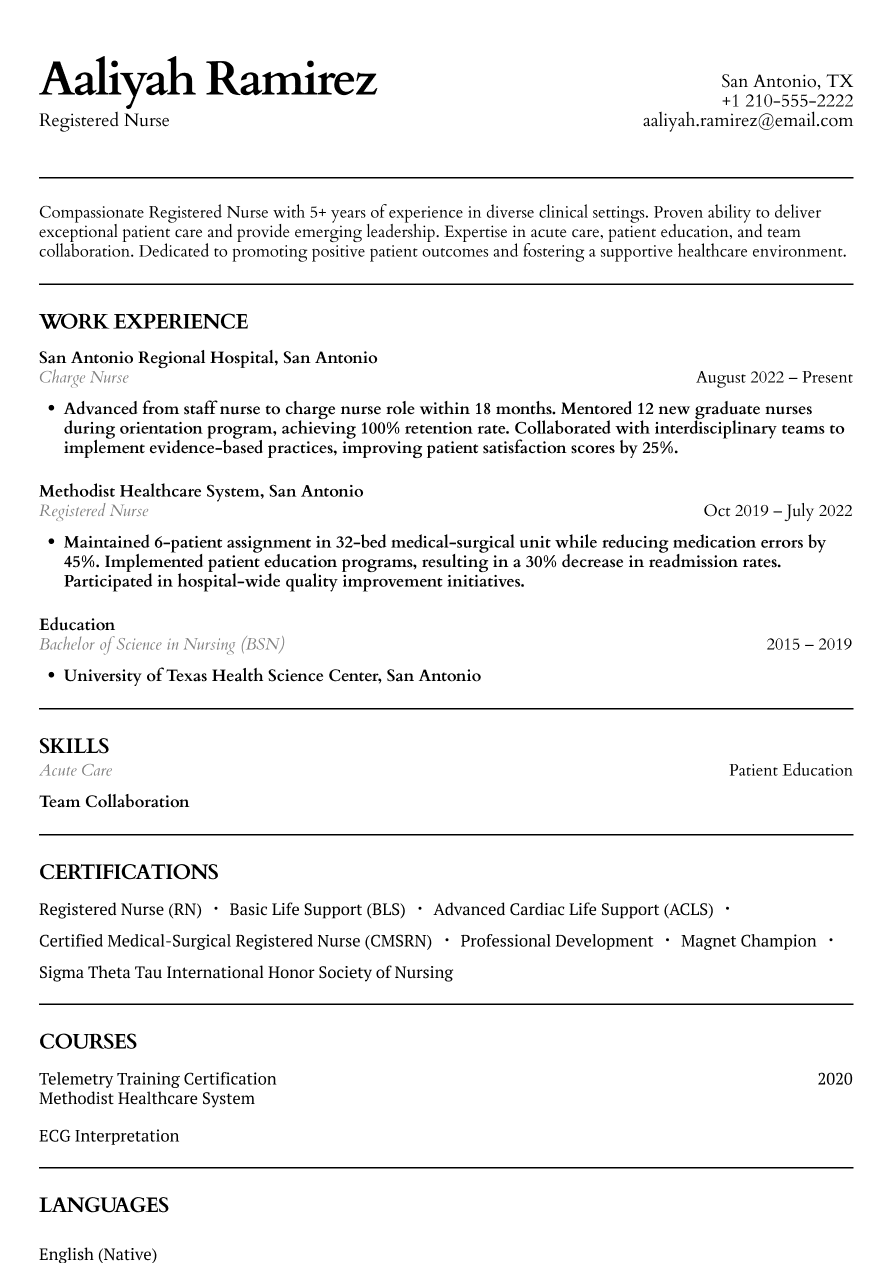
Comprehensive example for nurses with 3-6 years post-registration experience across diverse clinical settings. This CV balances clinical competence with developing leadership capabilities.
Demonstrates clear progression: "Advanced from band 5 to band 6 within 24 months" and "Supervised 10 nursing students during clinical placements, all achieving required competencies." Includes quantified patient outcomes such as "Managed complex caseload of 7 patients in 36-bed medical ward whilst contributing to 35% reduction in medication administration errors."
The employment history demonstrates adaptability across patient groups and increasing accountability. Competencies are organized by practice domain (assessment, clinical intervention, coordination of care) rather than generic statements. Professional standards are evident throughout, emphasizing accountability and evidence-based practice.
Accident & Emergency Registered Nurse CV
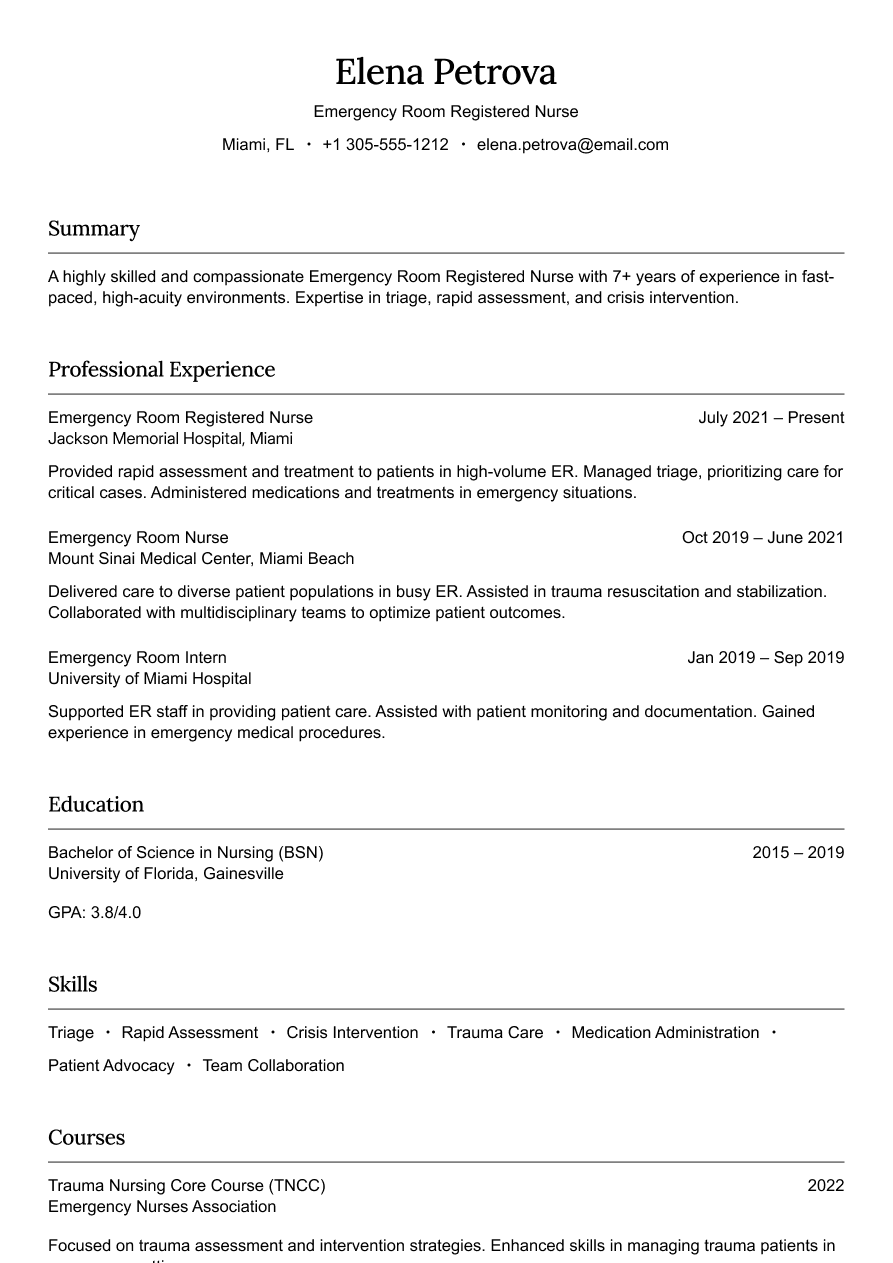
Structured for emergency department environments. This example emphasizes triage competence, rapid assessment capabilities, and ability to manage high-volume, high-acuity clinical areas. Highlights emergency nursing qualifications, trauma certifications, and clinical achievements in time-critical situations.
Paediatric Registered Nurse CV
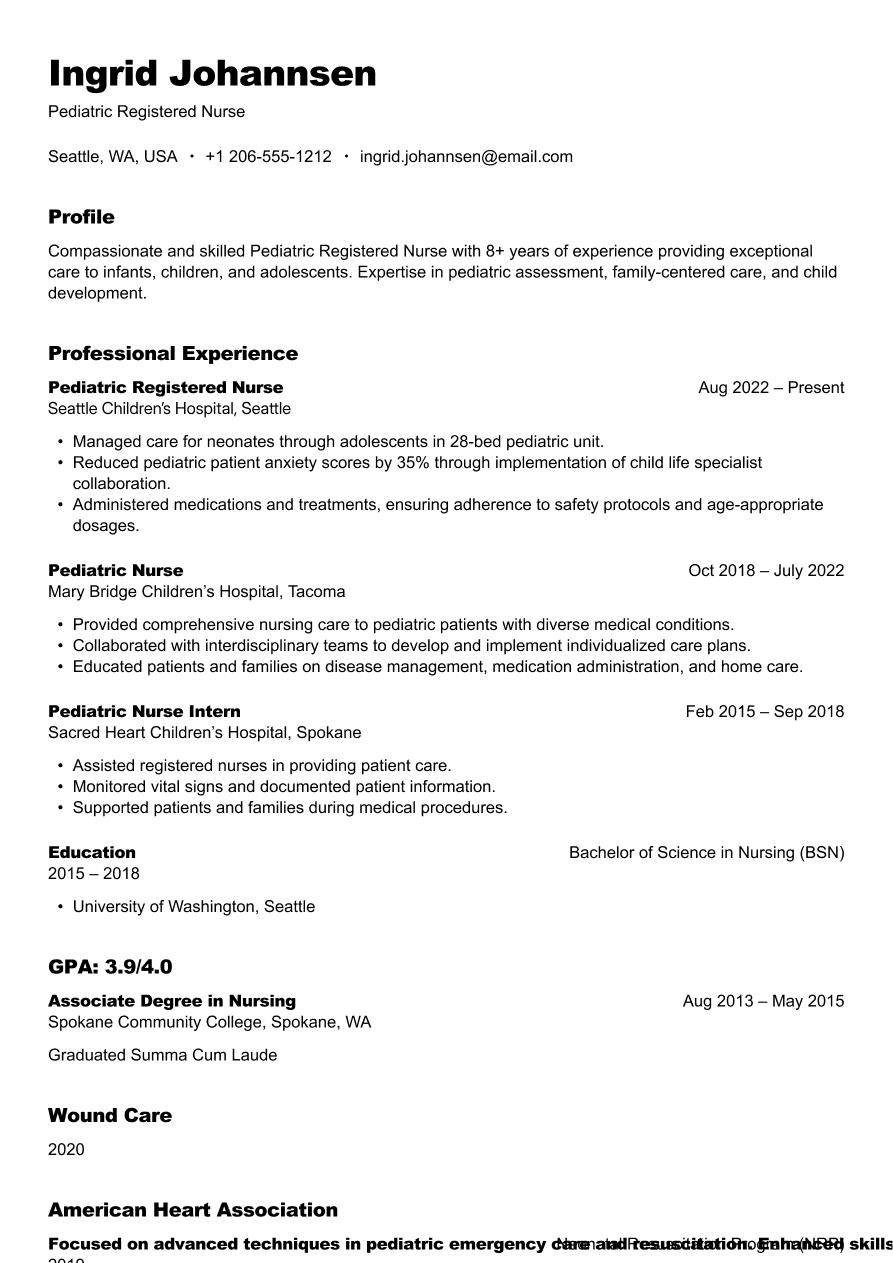
Specialized for nurses working with children and families. Demonstrates expertise in paediatric assessment, family-centered care, and developmental awareness. Includes outcomes such as "Contributed to 30% improvement in parental satisfaction scores through enhanced communication strategies" and "Provided care for neonates through adolescents in 24-bed children's ward." Paediatric life support qualification featured prominently.
Senior Registered Nurse CV
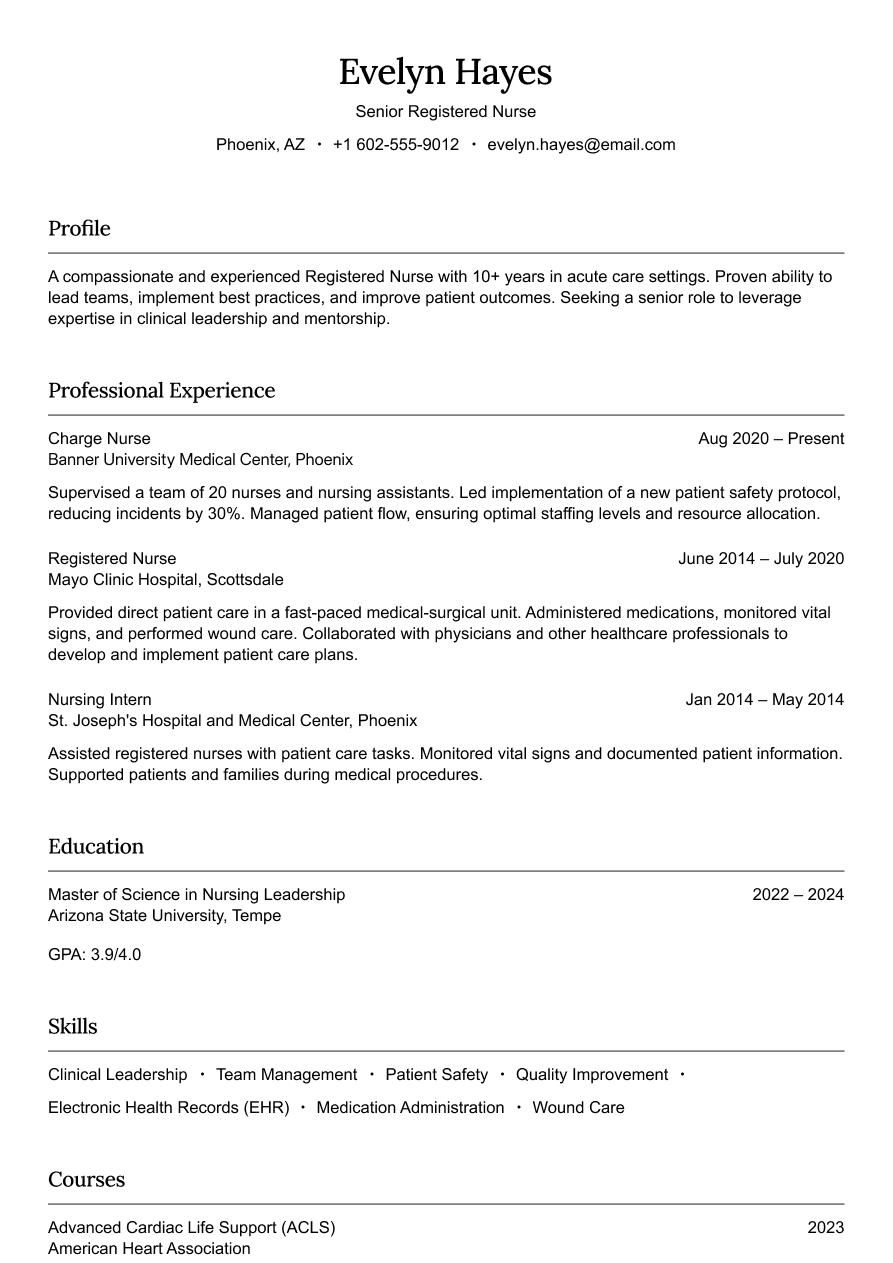
Structured for experienced nurses moving toward clinical leadership or specialist practice roles. This example emphasizes clinical expertise alongside supervisory responsibilities: "Coordinated team of 16 nurses and healthcare assistants" and "Led introduction of electronic patient record system across ward, improving documentation accuracy by 55%."
Demonstrates both direct care competence and service improvement capabilities. Shows engagement with professional governance, policy development, and clinical audit. Education section may include degree-level study or post-registration specialist qualifications demonstrating ongoing professional development.
Medical-Surgical Registered Nurse CV
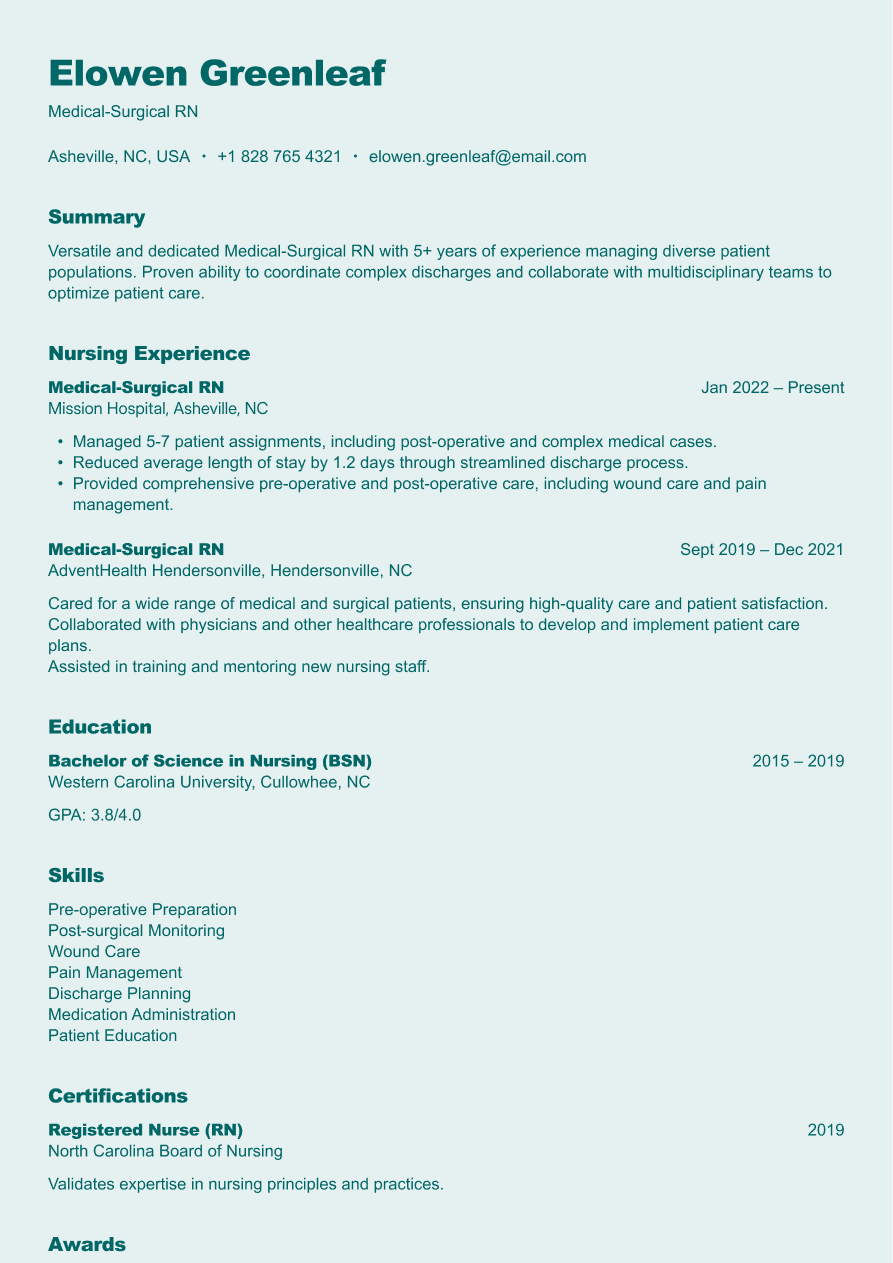
Highlights adaptability across medical and surgical patient groups. This CV demonstrates capability to manage varied clinical presentations, coordinate complex discharges, and collaborate with multidisciplinary teams.
Shows competence throughout the patient pathway: pre-operative assessment, post-surgical care, wound management, pain control, and discharge coordination. Includes outcomes such as "Contributed to 1.5-day reduction in average length of stay through enhanced discharge planning" and "Managed caseload of 6-8 patients including post-operative and acute medical presentations."
Nurse in Charge CV
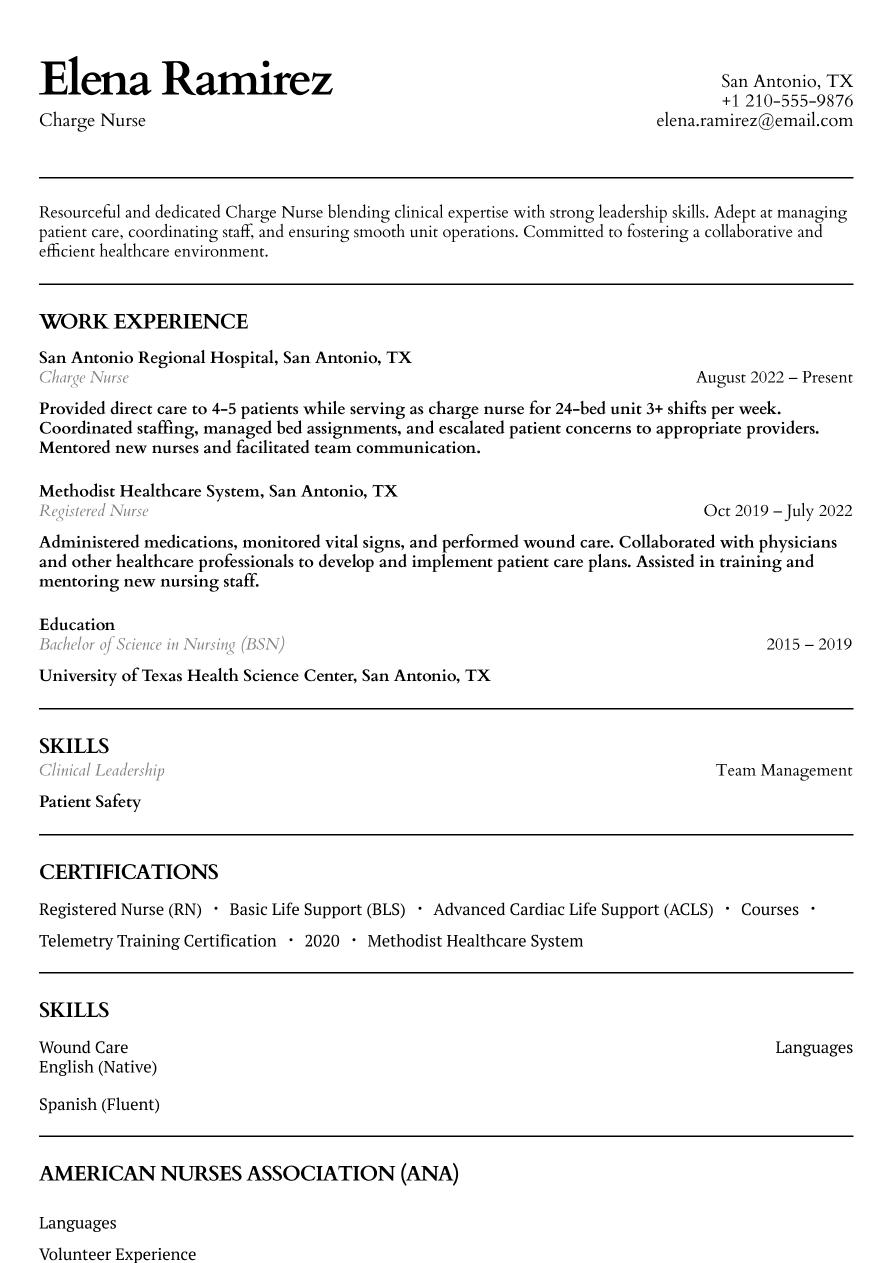
Balances clinical expertise with shift coordination responsibilities. This example demonstrates how nurses in charge manage both direct patient care and ward operations.
Shows dual role effectively: "Maintained clinical caseload of 4-5 patients whilst coordinating 28-bed ward 3+ shifts weekly" and "Managed staffing allocation, bed capacity, and clinical escalation pathways." Highlights decision-making under pressure, resource coordination, and mentorship capabilities alongside clinical competence.
Professional Registration and Credentials Globally
For registered nurses, professional registration isn't supplementary information — it's the primary credential employers verify first. Missing or ambiguous registration details result in immediate rejection.
Essential credentials vary by country but typically include:
Professional Registration: Nursing council, registration number, current status
Basic Life Support: Current certification from recognized provider
Specialty Qualifications: Post-registration certificates relevant to role
Academic Qualifications: Degree level, institution, year of completion
Format clarity matters significantly. Instead of abbreviations, write complete details: "Registered Nurse, Nursing and Midwifery Council (UK), PIN 123456A, renewed annually." This ensures compatibility with applicant tracking systems and removes ambiguity.
Demonstrating Clinical Competence Through Outcomes
The most common weakness in nursing CVs is describing tasks rather than achievements. "Delivered patient care" communicates nothing meaningful. "Maintained 5-patient caseload in 28-bed acute ward, contributing to 15% improvement in patient satisfaction scores" demonstrates tangible impact.
Effective approaches to evidencing clinical competence:
Reference specific clinical indicators (infection rates, pressure ulcer prevention, falls reduction)
Quantify scope of practice (patient numbers, acuity levels, shift patterns)
Highlight quality improvement participation (audits, protocols, safety initiatives)
Demonstrate continuing professional development (courses, conferences, certifications)
Even newly qualified nurses can provide evidence: "Completed 2,300 hours supervised practice across medical, surgical, and community placements" or "Participated in implementation of electronic patient records system during final year" demonstrates practical involvement beyond theoretical knowledge.
Key Nursing Skills That Demonstrate Competence
Skills sections fail when they become generic lists copied from job descriptions. Employers recognize this immediately. Effective skills sections show actual clinical capabilities you'd confidently use tomorrow.
Organize skills to reflect nursing practice areas:
Clinical Practice | Examples |
|---|---|
Patient assessment | Physical examination, vital signs monitoring, early warning scores |
Clinical procedures | Venepuncture, catheterization, wound care, medication administration |
Specialist knowledge | Cardiac monitoring, ventilator care, pediatric assessment |
Professional practice | Documentation, escalation protocols, safeguarding, health promotion |
Focus on skills relevant to the position you're pursuing. A CV for intensive care positions emphasizes critical care competencies; one for community nursing highlights patient education and chronic disease management.
Structuring Your Nursing CV for Different Healthcare Settings
Healthcare organizations worldwide need to review nursing CVs efficiently. Overly complex layouts, unconventional formats, or excessive design elements create barriers to assessment — regardless of how visually appealing they appear.
Effective nursing CVs employ:
Standard section organization (Registration, Employment, Education, Professional Development)
Clear typography compatible with digital systems
Prominent display of current registration status
Chronological employment history with clear progression
Utilizing a professional CV template designed for healthcare applications ensures your registration, clinical experience, and patient care achievements remain central — particularly important when applying across different specialties or healthcare systems.
Avoid: photographs (unless specifically requested), elaborate graphics, or non-standard formatting. These frequently interfere with electronic processing and make credential verification more difficult.
Registered Nurse CV FAQ
Q: Should I include my professional registration number on my CV?
Yes, absolutely. Include your regulatory body name, registration number (often called PIN), and renewal status. This enables immediate verification and demonstrates current fitness to practice. Example: "Registered Nurse, Nursing & Midwifery Council, PIN 12AB345C, renewed annually."
Q: How should newly qualified nurses present clinical placements?
Create a dedicated "Clinical Experience" or "Practice Placements" section. For each placement, include the specialty area, healthcare facility, hours completed, and specific competencies demonstrated. Example: "Acute Medical Ward - 450 hours: Medication management, complex wound care, patient assessment, and discharge planning for patients with multiple co-morbidities."
Q: What length should a nursing CV be?
Two pages is standard for most registered nurses, regardless of experience level. Newly qualified nurses should aim for two pages showcasing education and clinical placements. Experienced nurses may extend to three pages if including extensive post-registration qualifications, publications, or leadership roles, but ensure page one contains the most compelling information.
Q: Should I list post-registration courses and continuing professional development?
Yes. Create a "Professional Development" or "Continuing Education" section listing relevant courses, study days, and certifications completed since qualification. Include course title, provider, and date. This demonstrates commitment to maintaining professional competence and meeting revalidation requirements.
Q: How do I demonstrate leadership as a band 5 staff nurse?
Highlight mentorship roles (supporting students or newly qualified staff), participation in clinical governance activities (audit, policy development), representation on committees, or leading specific initiatives. Quantify when possible: "Mentored 6 student nurses during final placement, all achieving competency standards" or "Led implementation of new documentation system across 32-bed unit."