Executive CV Examples: From Search Firm Brief to Board Appointment
Executive CV examples for UK, European, and global board appointments — CEO, COO, CFO, and NED roles. See how international executives position for search firms.
Updated May 21, 2026
Written by Artur Lopato
The executive CV serves a different purpose than any other career document. It's not submitted through an application portal. It's used by search consultants at firms like Spencer Stuart, Heidrick & Struggles, and Egon Zehnder to brief boards — often reformatted, excerpted, and presented as part of a candidate summary long before you're contacted directly.
This means your CV needs to work at two levels simultaneously. It needs to be comprehensive enough for a search consultant to extract your value creation narrative. And it needs to be clear enough that a board committee member — who may have limited time and no sector background — can immediately understand what kind of executive you are and what mandate you've proven you can deliver.
The executive CV vs. the executive biography
At board and C-suite level, you often need two documents — and confusing them costs appointments.
Executive CV (3-5 pages)
The comprehensive career document. Used by search firms for candidate assessment, by nomination committees for director appointments, and by investors conducting management due diligence. Full career history, outcome-led bullets per role, board memberships, education, publications, and sector credentials.
Executive biography (1 page)
A narrative-driven summary used for speaking engagements, board pack introductions, investor presentations, and media appearances. Written in third person. Focuses on career highlights and current positioning — not full history. Most executives need this too, and many conflate it with the CV at cost.
The examples in Wensa's executive collection focus on the full CV format — the document that search firms and nomination committees actually evaluate. Start with our professional executive CV templates for a clean two-to-three-page foundation. If you're adapting a US-format resume for UK or European board processes, our CV vs resume guide covers the format differences and when each applies.
How executive CV conventions differ globally
UK and Ireland
UK executive CVs run 3-4 pages for experienced executives. They open with a personal profile or career statement, followed by a "Career Highlights" or "Key Achievements" section before the chronological history. Board memberships, governance roles, and non-executive directorships have their own section — they're not footnotes. The IoD (Institute of Directors) qualification or equivalent governance credential is included where held.
Continental Europe
DACH market executive CVs can run 4-6 pages and follow a highly structured format — company description, exact reporting line, governance committee memberships, and sometimes a personal statement of management philosophy. A professional photograph is standard in Germany, Austria, and Switzerland. Language competencies appear near the top for roles with international scope.
Middle East and APAC
Board and executive appointments in the UAE, Saudi Arabia, Singapore, and Hong Kong often involve sovereign wealth funds, family office ownership structures, or state-linked enterprises with specific governance expectations. Prior experience with these ownership structures is valuable and should be named explicitly — not inferred from company names that may not be recognized internationally.
Executive CV Examples by Role and Mandate
First-Time CEO CV
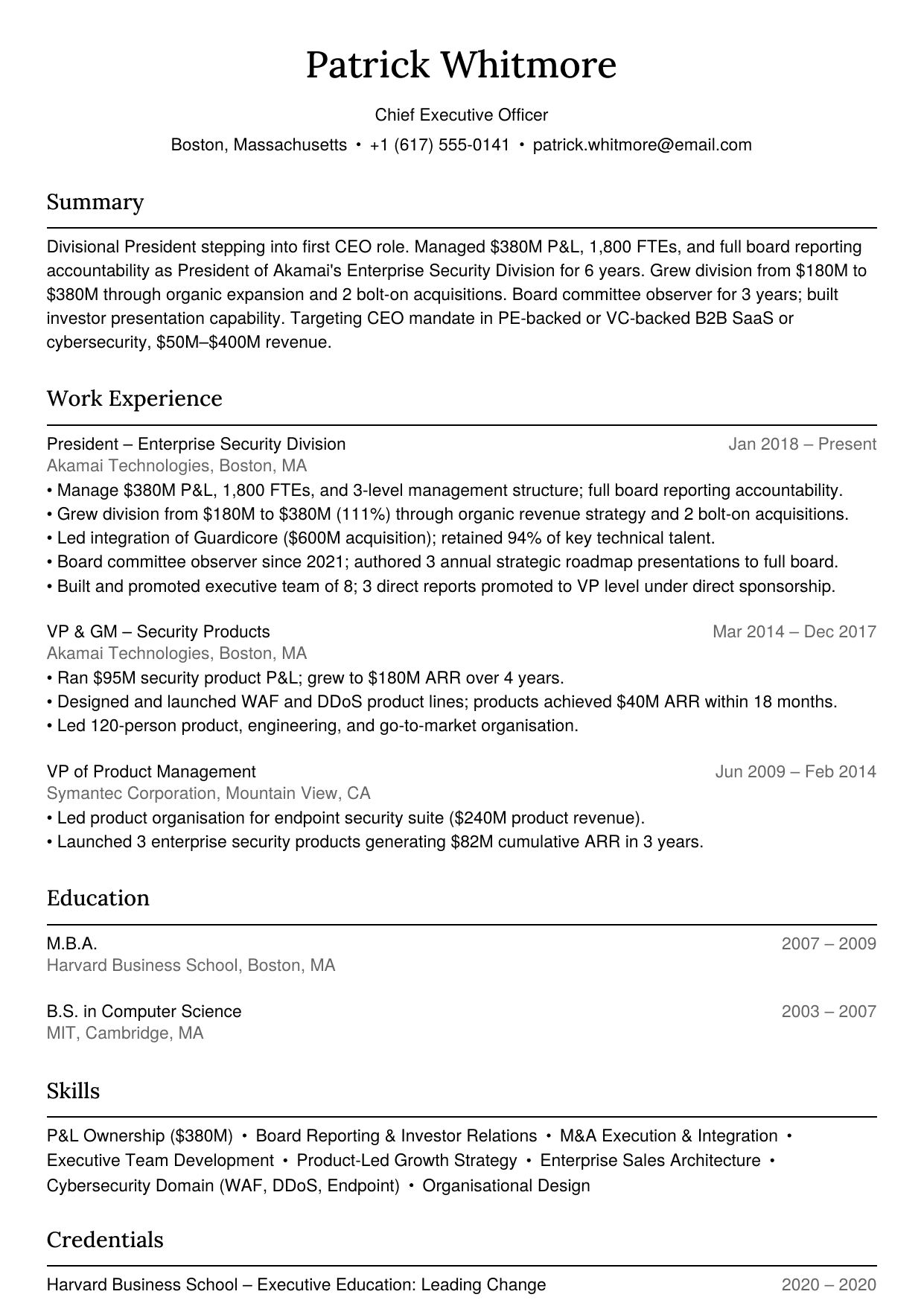
A first-CEO-role CV structured for UK and European search firms where the transition from MD or divisional VP to CEO requires explicit bridging of governance and commercial scope. Professional profile names the business archetype the candidate is targeting (PE-backed growth, owner-managed transition, corporate carve-out) and a headline commercial outcome from current tenure. Any board committee exposure, investor reporting, or NED advisory role is documented in its own section — even brief involvement counts at this transitional stage.
Growth CEO CV
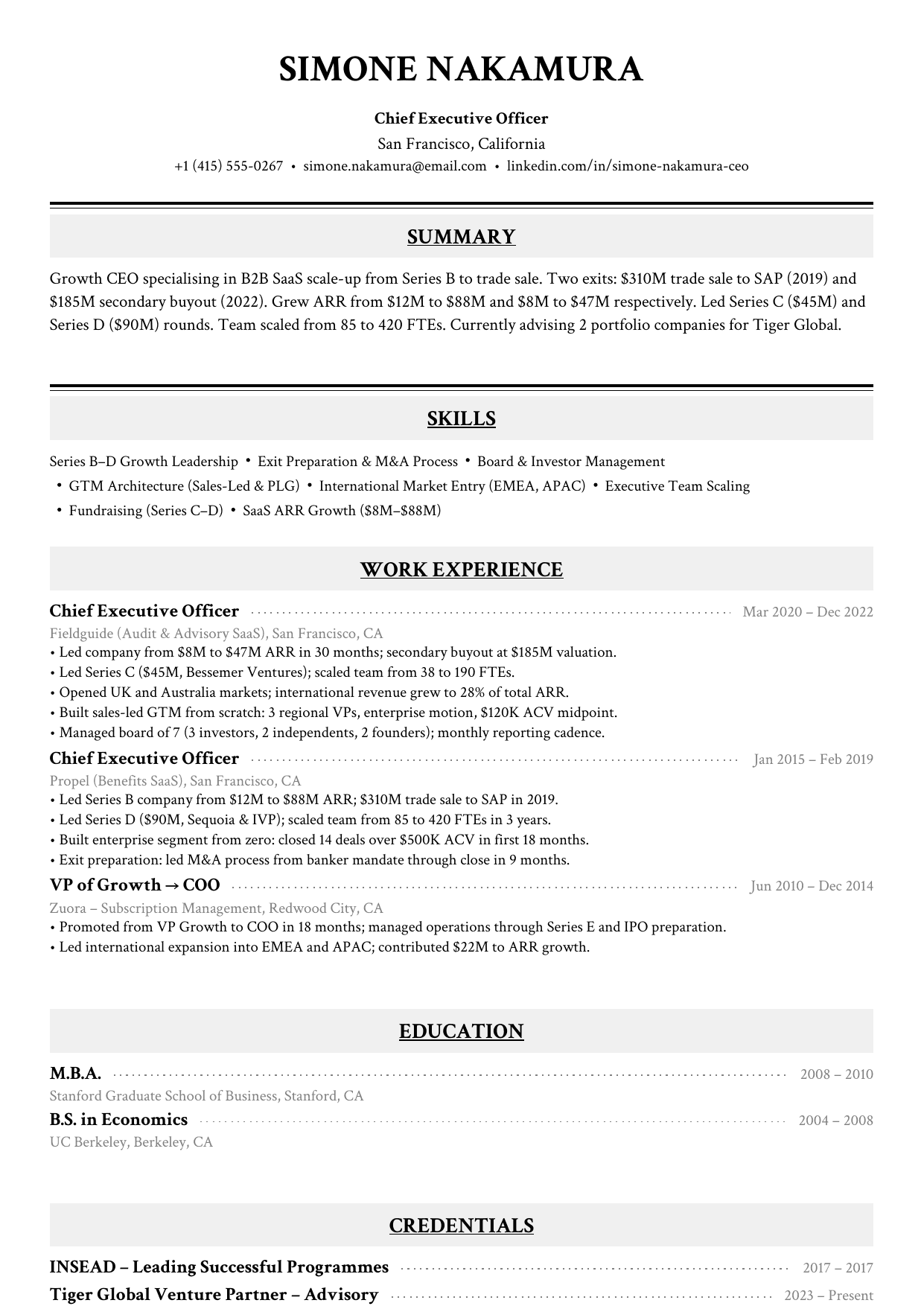
A growth CEO CV structured for European VC and PE investors who conduct management due diligence before backing or acquiring businesses. Professional profile leads with the growth stage specialism, a commercial headline (ARR trajectory or exit multiple), and the investor types the candidate has managed relationships with. For UK and European tech roles, GDPR compliance programme ownership and multi-jurisdiction expansion experience are included explicitly — they're hard requirements for international scale-up mandates that many growth CEO CVs leave implicit.
Turnaround CEO CV
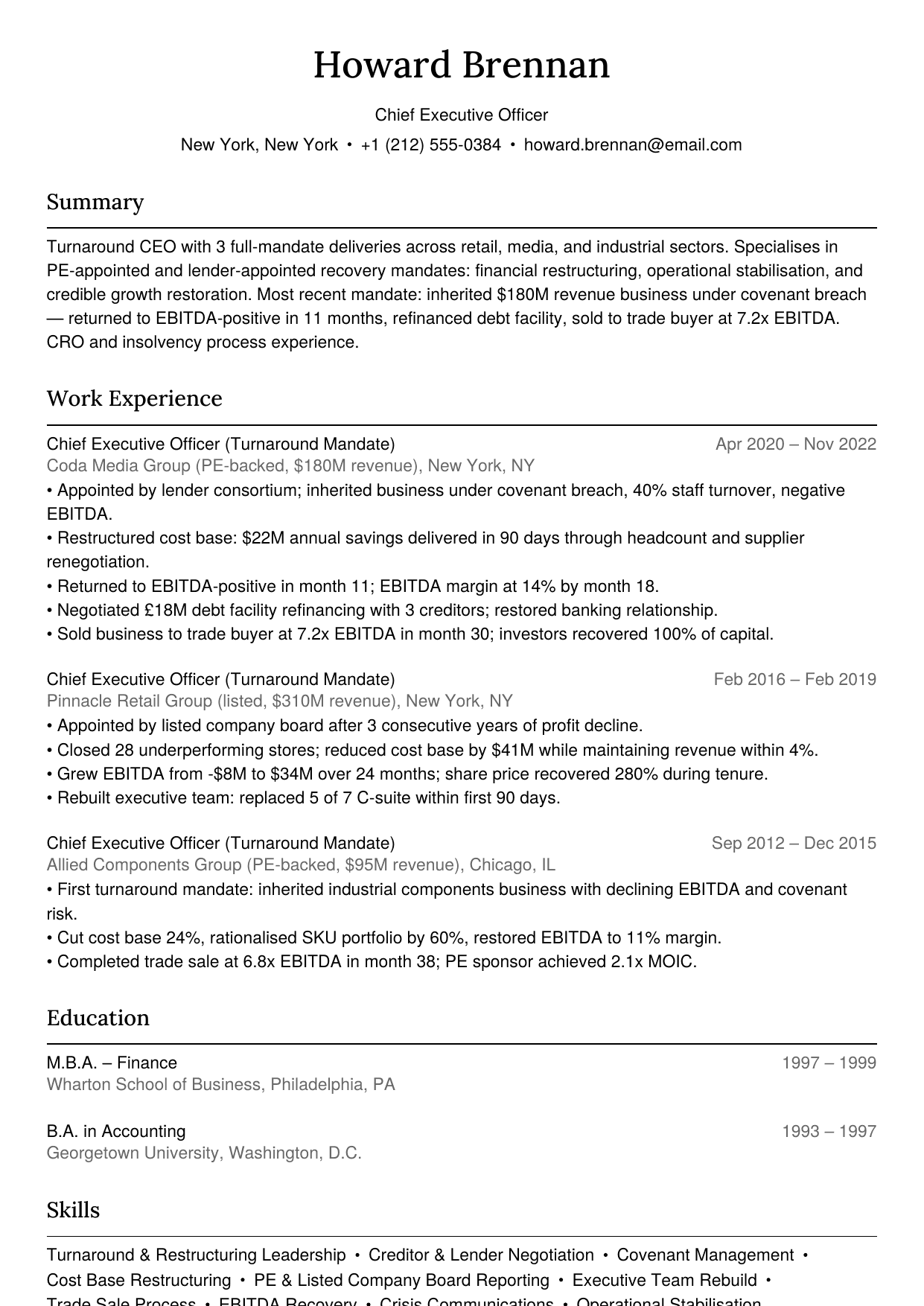
A turnaround CEO CV for UK and European private equity firms, listed company boards, and lender-appointed leadership searches. Professional profile explicitly names the turnaround specialisation: sector, distress type (financial, operational, structural), and the outcome delivered. Creditor negotiation, covenant management, and insolvency process experience are named where present — these are hard filters for bank-appointed and insolvency practitioner-referred CEO searches. A strong turnaround CEO CV also documents what the business looked like after tenure ended — sustained performance post-exit is the ultimate proof of a genuine turnaround.
Portfolio CEO CV
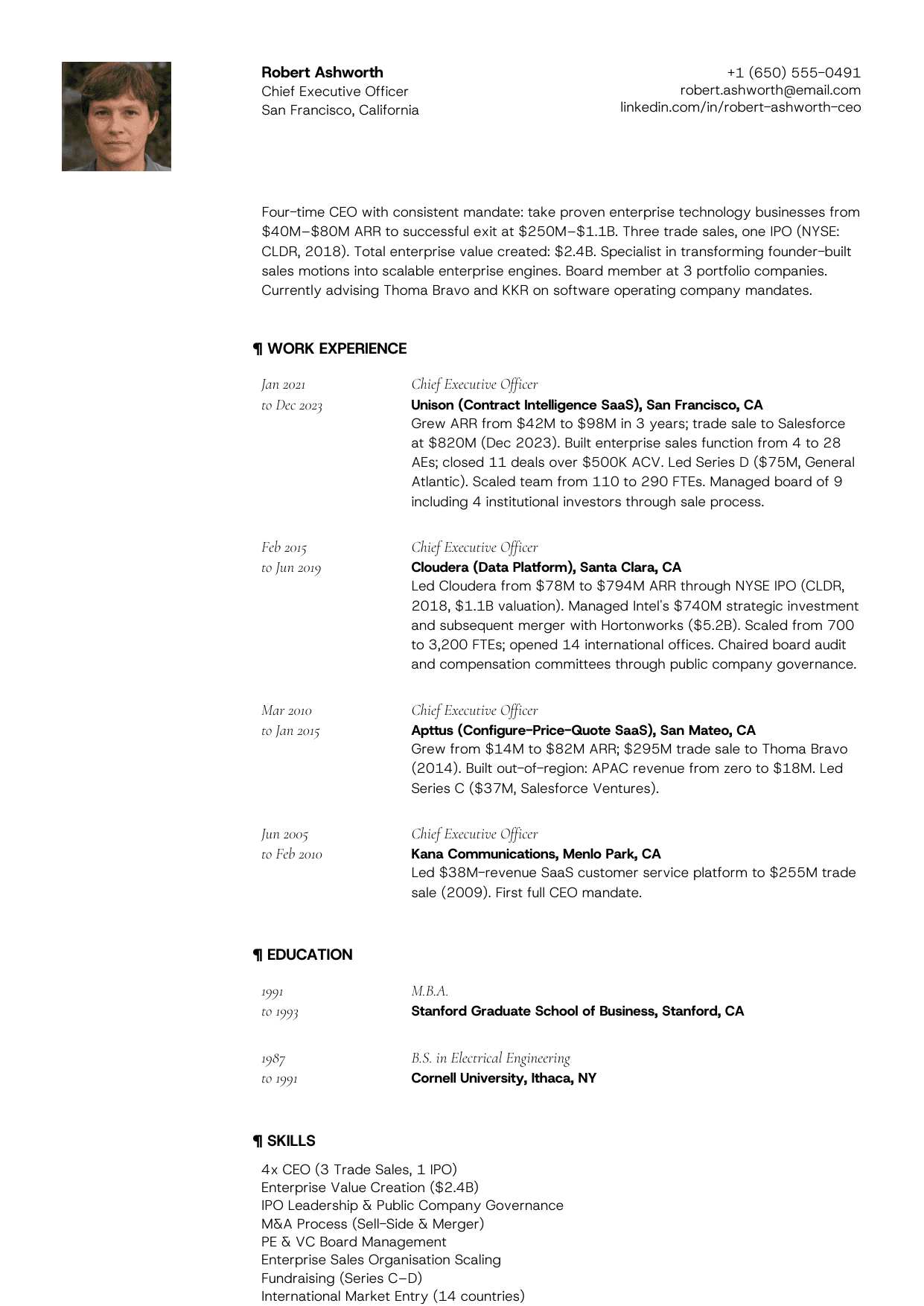
A portfolio CEO CV for UK and European candidates with multiple executive mandates across different sectors or company stages. The challenge is narrative coherence — ensuring the career reads as a purposeful arc rather than an opportunistic series of appointments. Professional profile (5-6 lines) does the heavy lifting: naming the mandate specialism, the company types, the consistent outcome pattern, and the current positioning. Each role is documented with ownership structure context — PE-backed, founder-led, listed, owner-managed — because search firms evaluating portfolio executives are specifically assessing mandate type breadth alongside depth.
Chief Operating Officer CV
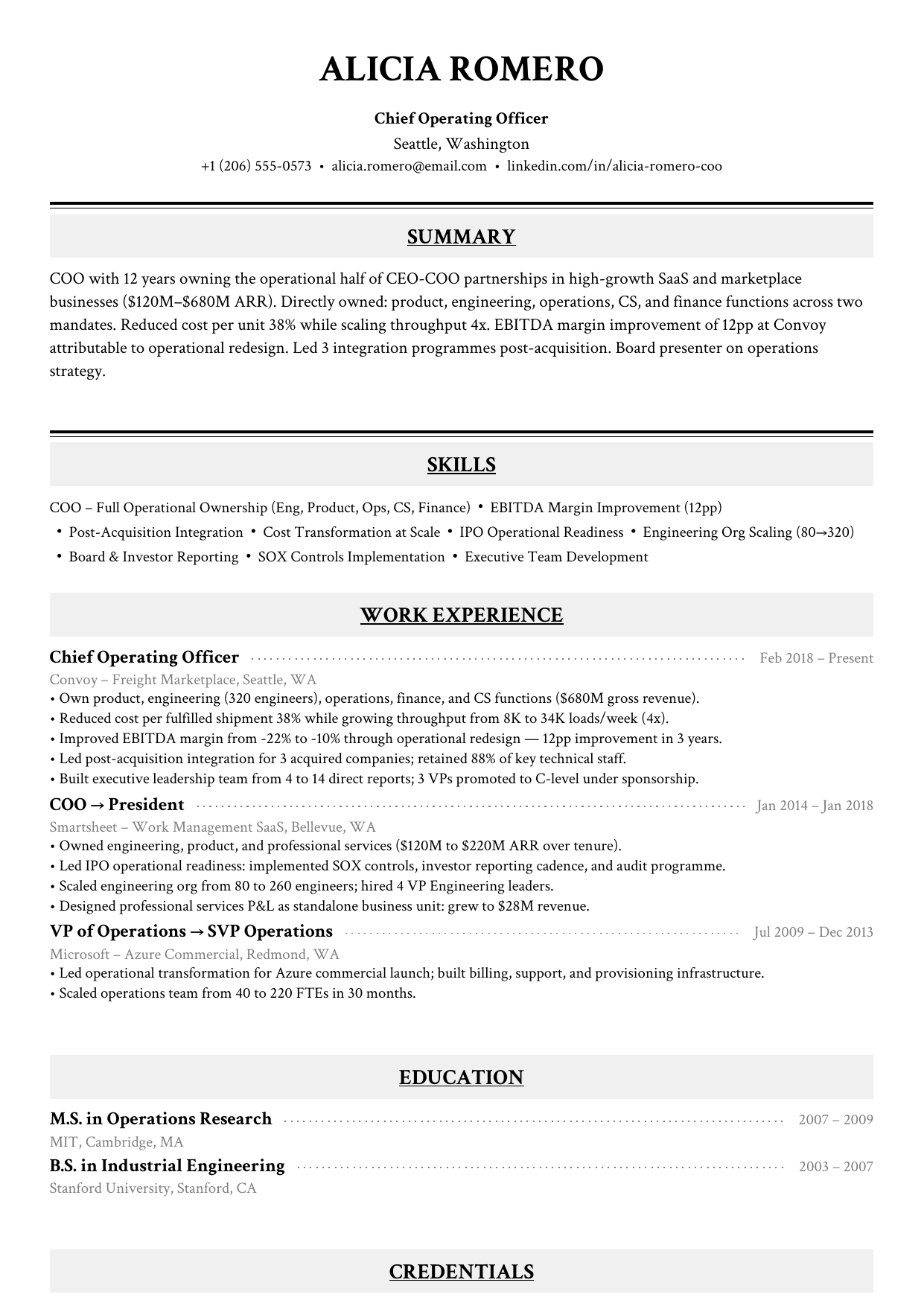
A COO CV built for UK and European companies where the role is often the operational half of a CEO-COO partnership. Professional profile distinguishes the COO's specific domain: operations, technology, people, and finance functions owned, versus those retained by the CEO. For PE-backed businesses, the COO's contribution to EBITDA margin improvement and operational due diligence preparation are named explicitly — they're the commercial outcomes that investors assess when evaluating whether the COO can step up to CEO.
Chief Financial Officer CV
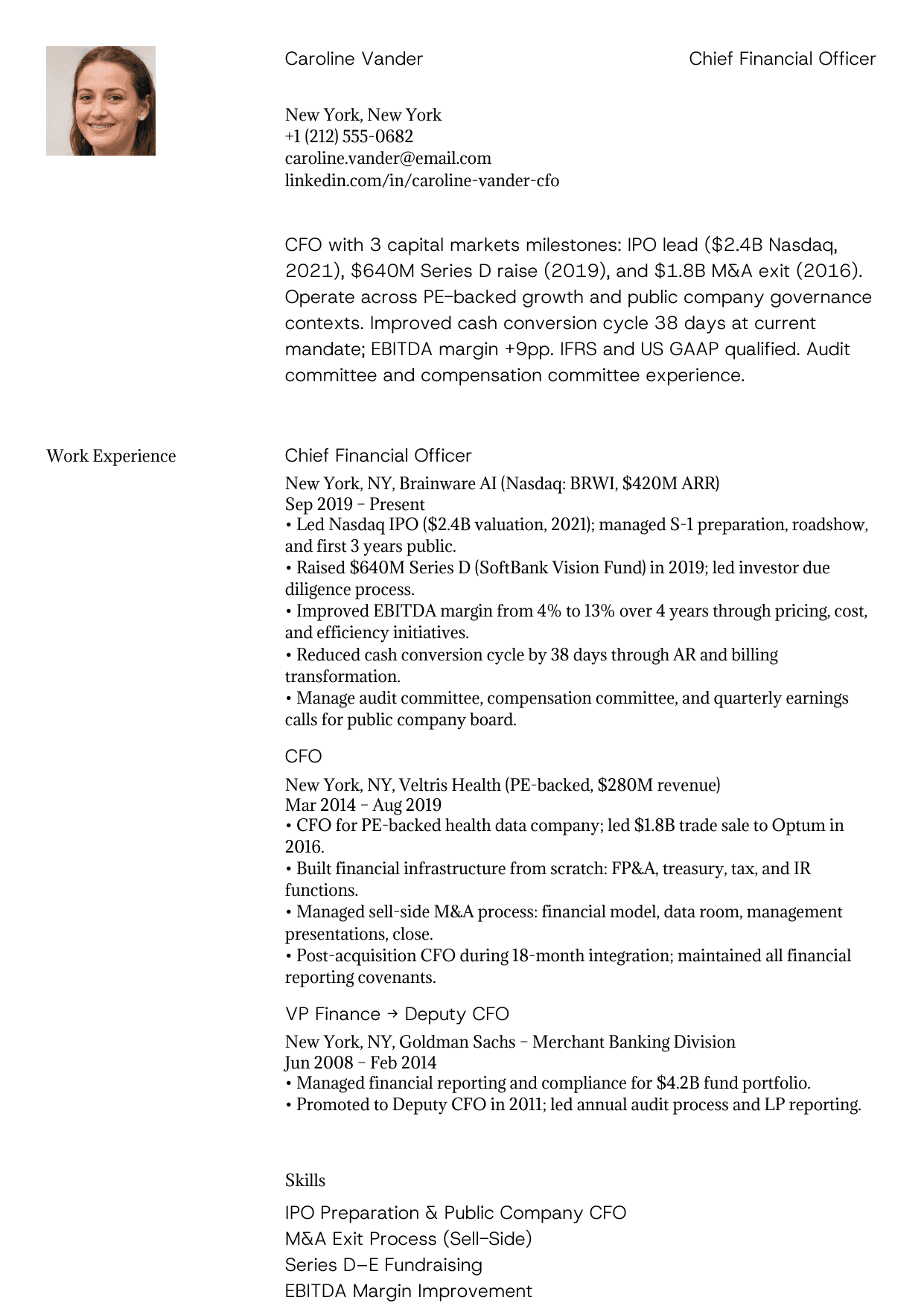
A CFO CV for UK and European listed companies, PE-backed businesses, and pre-IPO growth companies. Professional profile names the financial mandate type, the capital markets events navigated, and the regulatory environment operated in (FCA, PRA, PCAOB for dual-listed businesses). For European cross-border roles, IFRS versus UK GAAP versus US GAAP exposure is named explicitly — multi-standard financial reporting experience is a primary filter at CFO level for international businesses. Audit committee and remuneration committee relationships are documented in a dedicated governance section.
Non-Executive Director CV
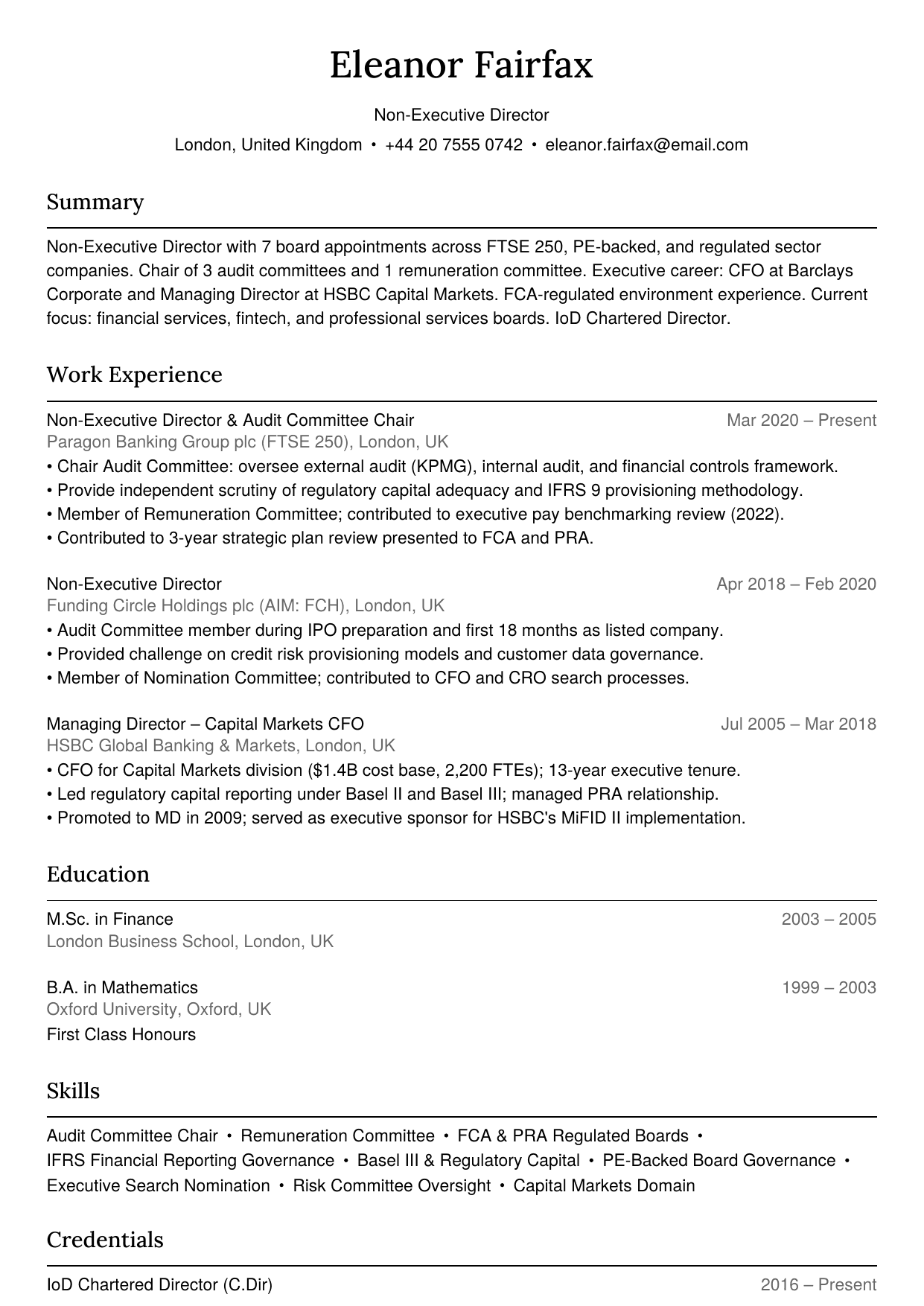
A NED CV for UK and European listed company boards, PE portfolio company boards, and public sector governance appointments. Structured around the reverse logic of an executive CV: current board roles first, then executive history as context. Each board appointment includes: company type and ownership structure, committee memberships, specific governance contribution, and tenure. For public sector and charity boards, the CV includes any public appointment process experience and regulatory body familiarity — these are distinct governance contexts that differ significantly from listed company board practice.
Transformation CEO CV
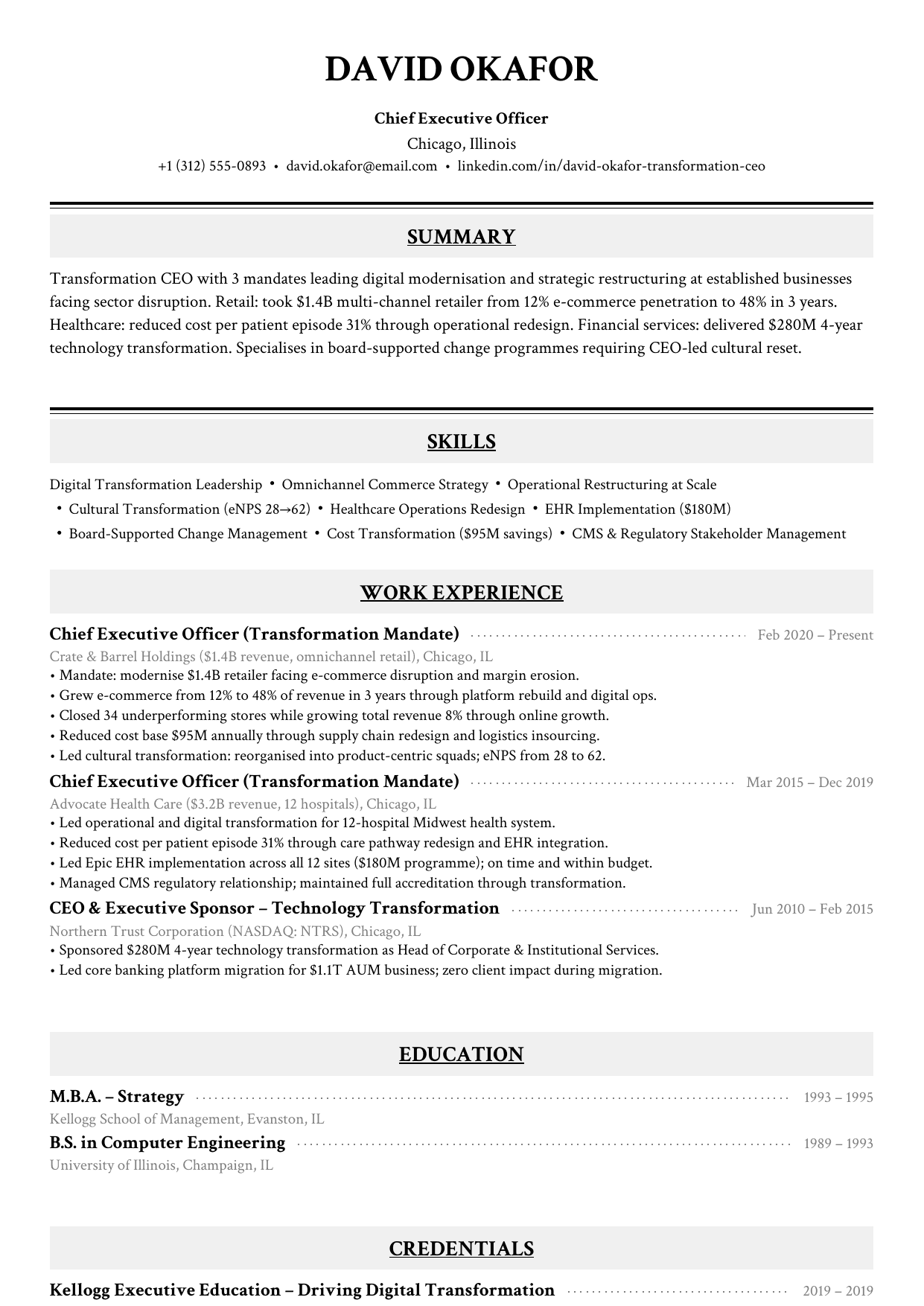
A transformation CEO CV for UK and European listed companies, large corporates, and public sector organisations undergoing structural change. Professional profile names the transformation type (digital, operational, strategic) and the sector context — transformation looks very different in retail than in healthcare or financial services. For public sector and regulated industry roles, stakeholder management at political and regulatory level is documented explicitly: minister relationships managed, regulator engagements led, or parliamentary scrutiny navigated. These are hard requirements for public-facing transformation mandates that private sector CVs rarely cover.
What Boards and Nomination Committees Look for in an Executive CV
Governance committees assess executive CVs differently from search firms. They're not just evaluating track record — they're assessing cultural fit, governance fluency, and whether the candidate's risk profile matches the board's current composition needs.
What They're Assessing | How to Show It |
|---|---|
Value creation narrative | Each role: what was the mandate, what did the business look like when you arrived, and what did you deliver. One headline metric per role minimum — revenue trajectory, EBITDA improvement, or market position gained. |
Governance and fiduciary record | Board reporting, audit committee involvement, regulatory proceedings navigated, shareholder or investor relationships managed. NED appointments and advisory board roles have their own section. |
Company and ownership context | For each role: ownership structure (PE-backed, listed, family, VC), revenue scale, employee count, and sector. Boards need this context to understand the complexity and accountability of each mandate. |
International and cross-cultural leadership | Languages spoken (with proficiency level), countries where you've held P&L accountability, and specific cross-border M&A or integration experience. Increasingly weighted at board level as companies operate globally. |
Thought leadership and public profile | Published articles, conference keynotes, industry body committee memberships, advisory roles. These signal sector authority that purely operational CVs lack. |
Pro tip: Add a "Board and Advisory Experience" section even if your roles have been executive rather than non-executive. Include board committees you've presented to, investor or owner groups you've managed relationships with, and any governance qualification held (IoD, INSEAD corporate governance programme). Nomination committees are buying governance fluency, not just operational track record.
The project manager CV examples and marketing manager CV examples show how the layer below C-suite positions for progression — useful context if you're preparing both an executive CV and development CVs for functional leadership team members.
Common Mistakes in International Executive CVs
Too short
A two-page executive CV signals a condensed application, not strategic discipline. At C-suite level, search firms need depth — full company context, outcome detail, governance record, education, and publications. Three to five pages is appropriate for senior executives with significant multi-role histories.
No career highlights section
UK and European executive CVs typically include a "Career Highlights" or "Key Achievements" block between the personal profile and the chronological experience. This is the 3-5 line section that search consultants excerpt for board briefings. Without it, the most important signal is buried in the middle of the document.
Governance experience buried or absent
Board reporting, NED roles, governance committee involvement, and investor relationship management are C-suite credentials — not footnotes to the operational history. They deserve a dedicated section, listed with the same specificity as executive roles: company name, ownership structure, committee, and your specific contribution.
Company names without context
At executive level, the assumption is that company names speak for themselves. They don't — especially internationally. "CEO, Meridian Group" tells a search consultant in Singapore nothing. "CEO, Meridian Group (PE-backed logistics business, £85M revenue, 1,200 employees across UK and Benelux)" tells them everything they need to assess relevance.
Missing thought leadership or public profile
Conference keynotes, published articles, advisory board memberships, and industry body roles signal sector authority that operational track records alone don't convey. Include them in a dedicated section — they're disproportionately valued by boards assessing candidates for externally-facing leadership roles.
Pro tip: Keep a "master" executive CV at full length (5+ pages) and maintain a condensed 3-page version for initial search firm submission. Search consultants will ask for the full version at the appropriate stage. Never submit the 5-page version as your opening document.
Our CV examples library covers roles across the management hierarchy — useful context for executives building or reviewing CVs for their direct leadership teams alongside their own. For visual and formatting guidance at senior level, our ATS-optimised CV templates provide a clean baseline that works across all major search firm platforms.
Executive CV FAQs
How long should a CEO or C-suite CV be?
Three to five pages for experienced executives. Two pages is too short at this level — search firms need depth. Five pages is the practical maximum before the document becomes unwieldy. Maintain a condensed 3-page version for initial submissions and a full version for due diligence processes.
Should I include a photo on an executive CV?
In Germany, Austria, and Switzerland — yes, it's standard. In the UK, Ireland, and most Northern European markets — generally not, though exceptions exist for public-facing roles. For Middle East and most APAC markets, a professional photograph is common. When submitting to an international search firm, ask their preference — most have a house style.
What's the difference between an executive CV and a board biography?
An executive CV is the comprehensive career document — 3-5 pages, full history, used by search firms and nomination committees. A board biography is a 1-page narrative summary used for board packs, speaking engagements, and investor presentations. Both are written in different registers for different audiences. You need both at C-suite level.
How do I handle confidential company data in an executive CV?
Translate absolute figures into relative outcomes: percentage improvements, sector quartile positioning, or capital allocation decisions that demonstrate strategic judgment. "Declined 8 low-fit acquisition targets, redeploying capital to organic R&D that doubled pipeline velocity" proves discipline without disclosing financials. For NDA-sensitive roles, confirm with legal counsel what can be shared before finalising the document.