Accountant Resume Examples That Get Interviews in 2026
Real accountant resume examples for staff, senior, tax, audit, and cost roles — at every career level. See how accountants turn technical expertise and compliance work into resumes that land interviews.
Updated Mar 20, 2026
Written by Artur Lopato
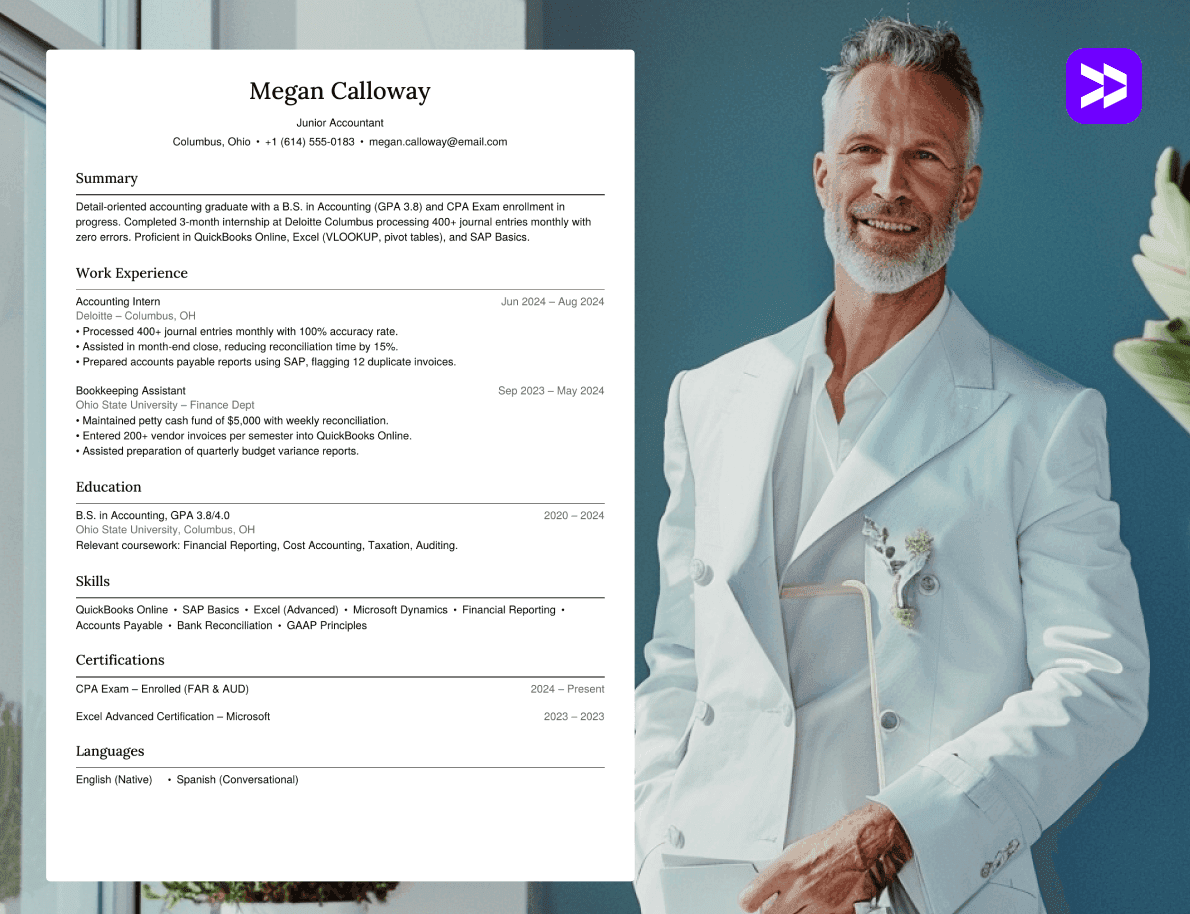
Accounting resumes have a structural problem that most candidates don't recognize until they've missed several interviews. The work itself — reconciliations, journal entries, financial statements, audit support — looks nearly identical on paper across candidates at the same level. When every resume lists the same tasks, the credential and the numbers become the only differentiators. And most accounting resumes bury both.
The resume that gets the interview leads with its biggest signal first: CPA licensure if you have it, the scale of what you've managed if you don't, and a specific outcome that shows your work meant something to the business — not just that you performed it accurately.
How the CPA changes your resume strategy entirely
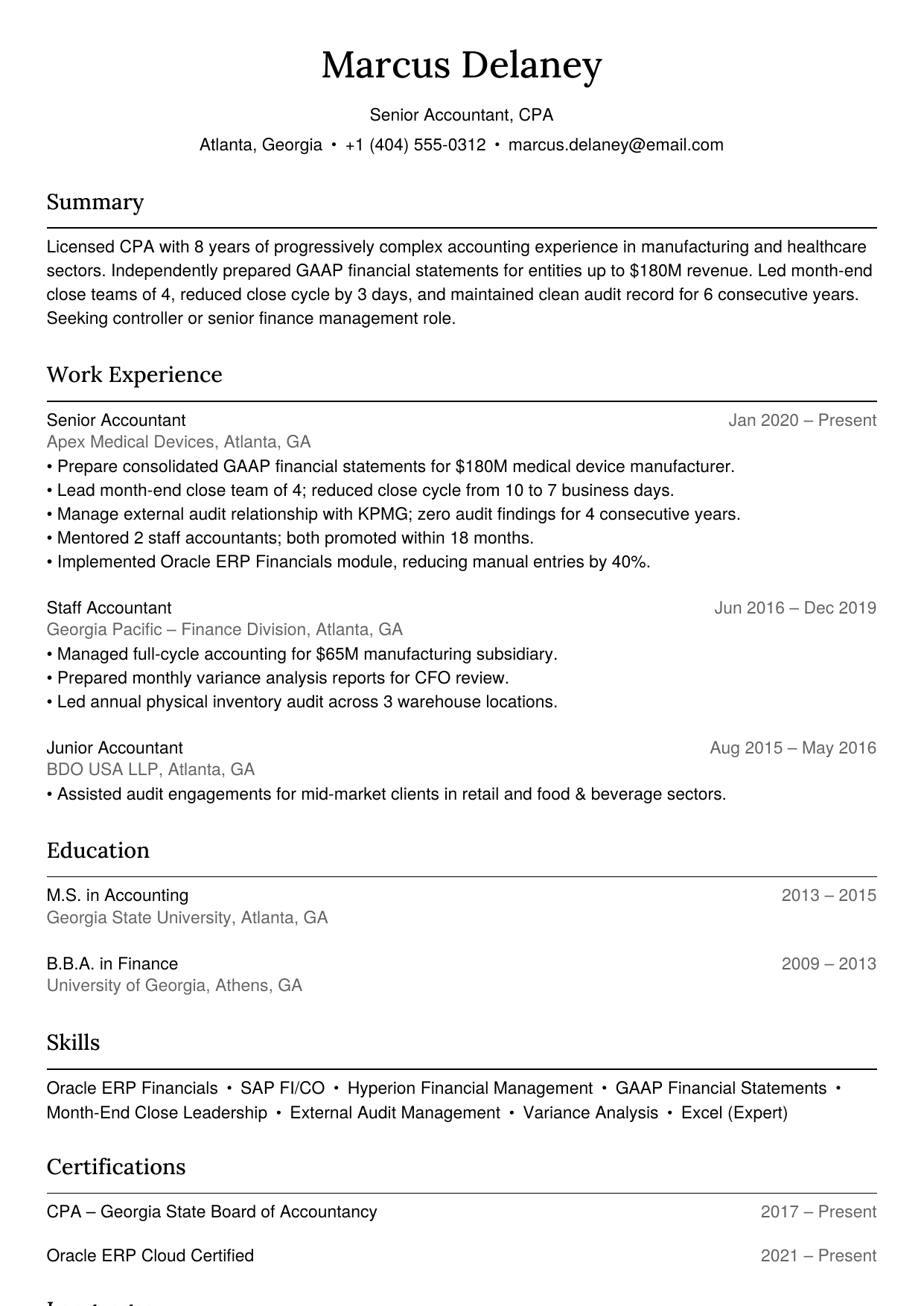
The CPA credential is a binary filter in US accounting hiring. For public accounting firms and for most senior-level corporate roles, it separates candidates into two pools before anyone reads an experience bullet. If you're CPA-licensed, that fact belongs in your resume header or directly beneath your name — not in an education section at the bottom of page two.
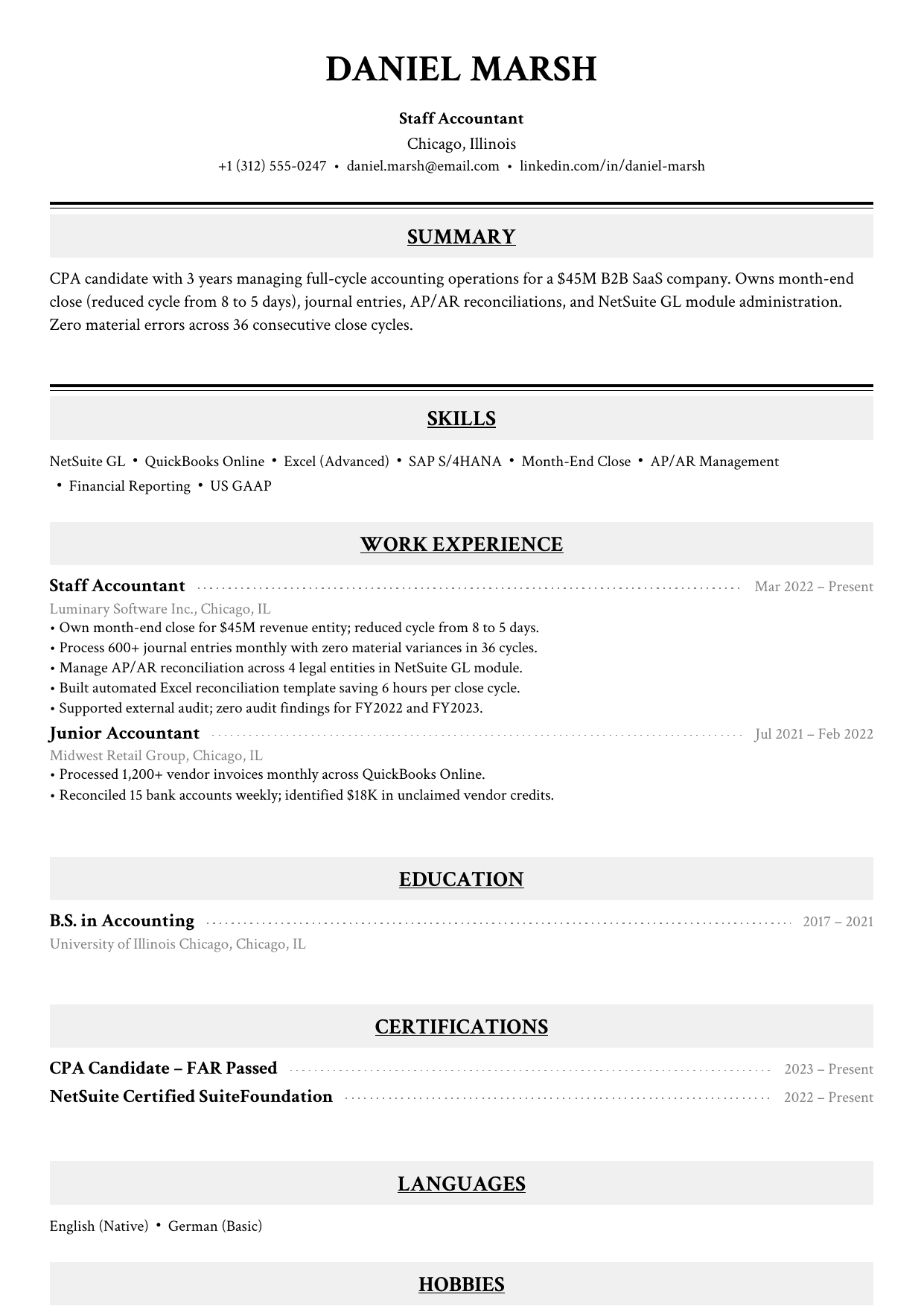
If you're CPA-eligible but not yet licensed, say so explicitly: "CPA Candidate — passed all four sections, license pending" or "CPA Exam: 3/4 sections passed" carries real weight and prevents the resume from being screened out as uncredentialed. Silence on your exam status is read as failure. Hiring managers fill the gap pessimistically.
If you're a staff accountant without a CPA in progress, the credential gap needs to be compensated elsewhere: depth of software experience, scale of transactions managed, and specificity of financial outcomes become more important — not less.
Big 4, mid-tier, public accounting, and industry: four different resumes
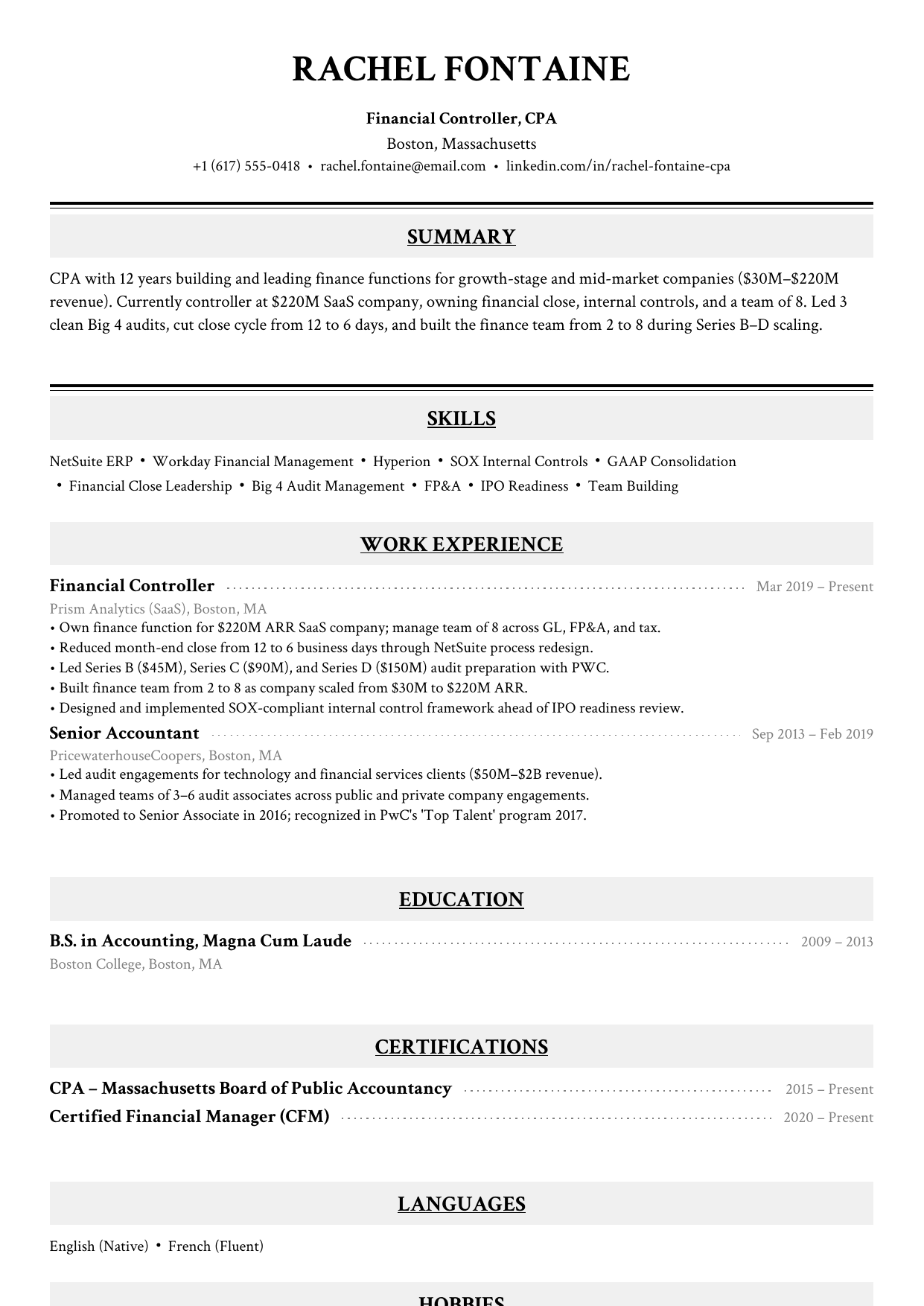
The same work history positioned differently lands completely different roles. A candidate moving from Big 4 to industry needs to translate "engagement team" into "business impact" and downplay the audit mechanics that an internal finance team doesn't care about. A candidate moving from industry to public accounting needs to surface the complexity, regulatory exposure, and technical depth they've built — because public firms are buying that credentialing, not just execution.
Mid-tier public accounting firms (Grant Thornton, BDO, RSM, Crowe) hire for a different profile than Big 4: they want broad technical exposure, client relationship experience, and early leadership — not just the compliance execution that Big 4 staff roles emphasize. Your resume should reflect which type of environment you're targeting, not just where you've been. Start with our accounting resume templates already formatted for credential-forward layouts, and read our resume writing guide before you tailor for a specific role.
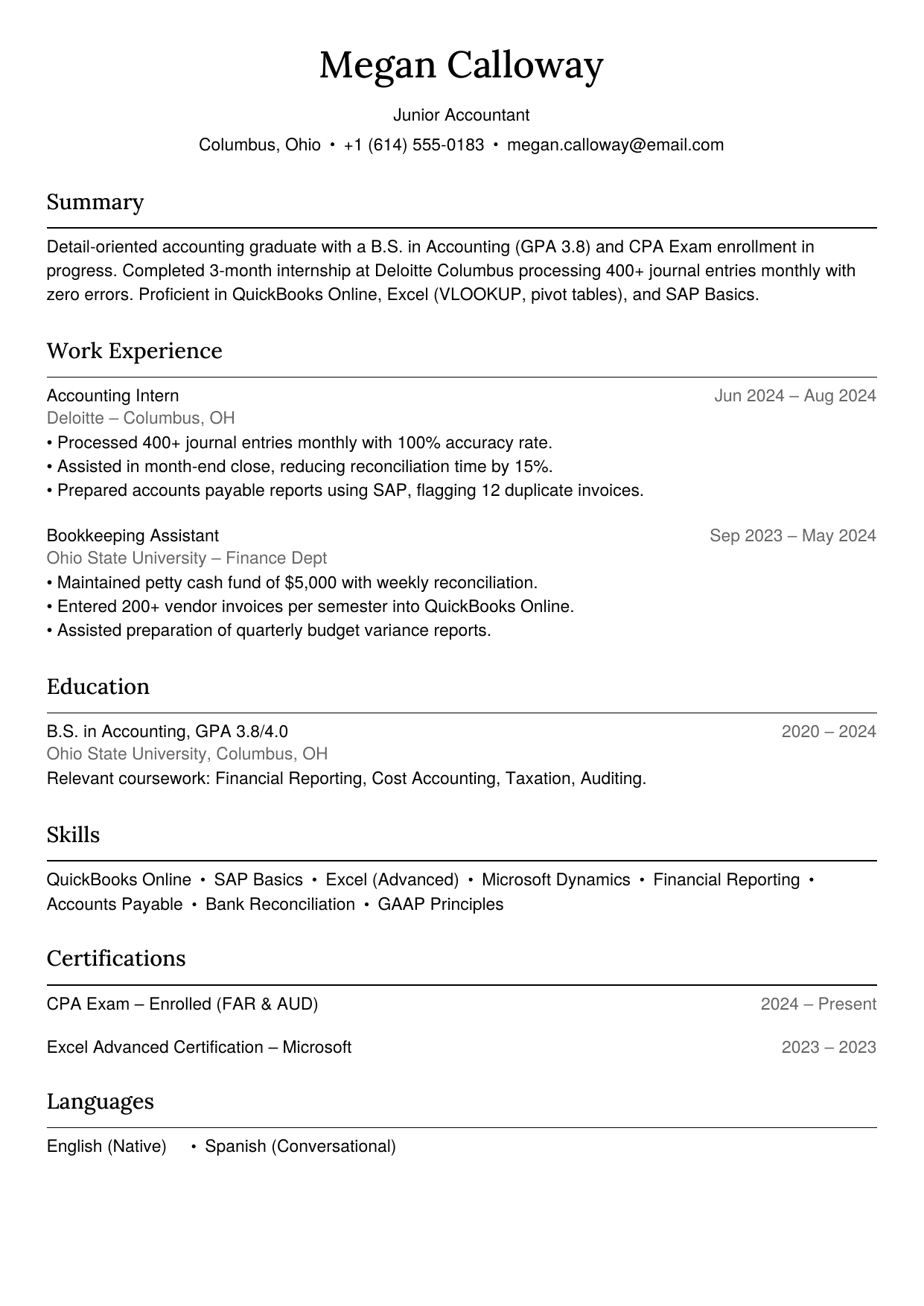
Accountant Resume Examples by Role and Specialization
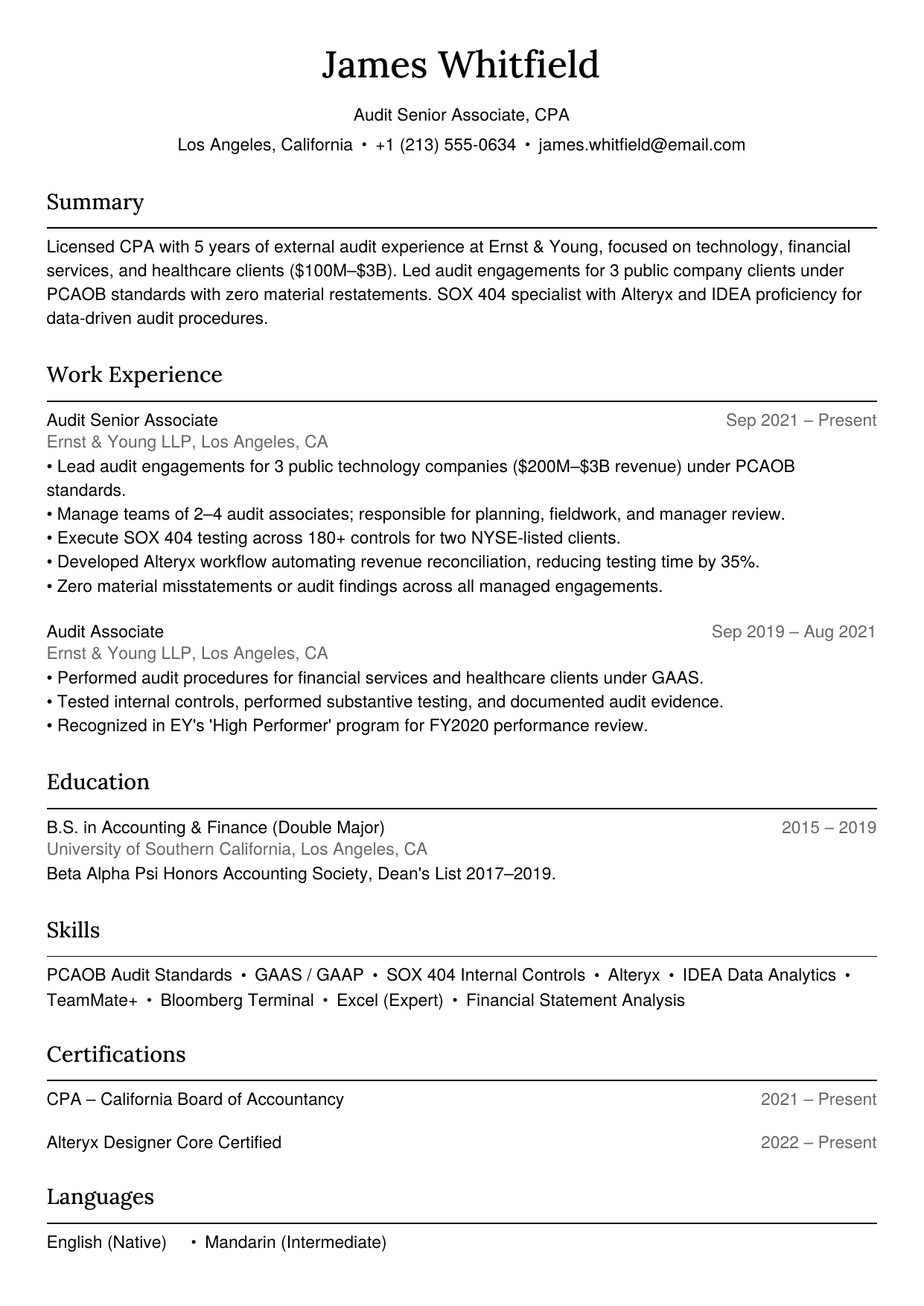
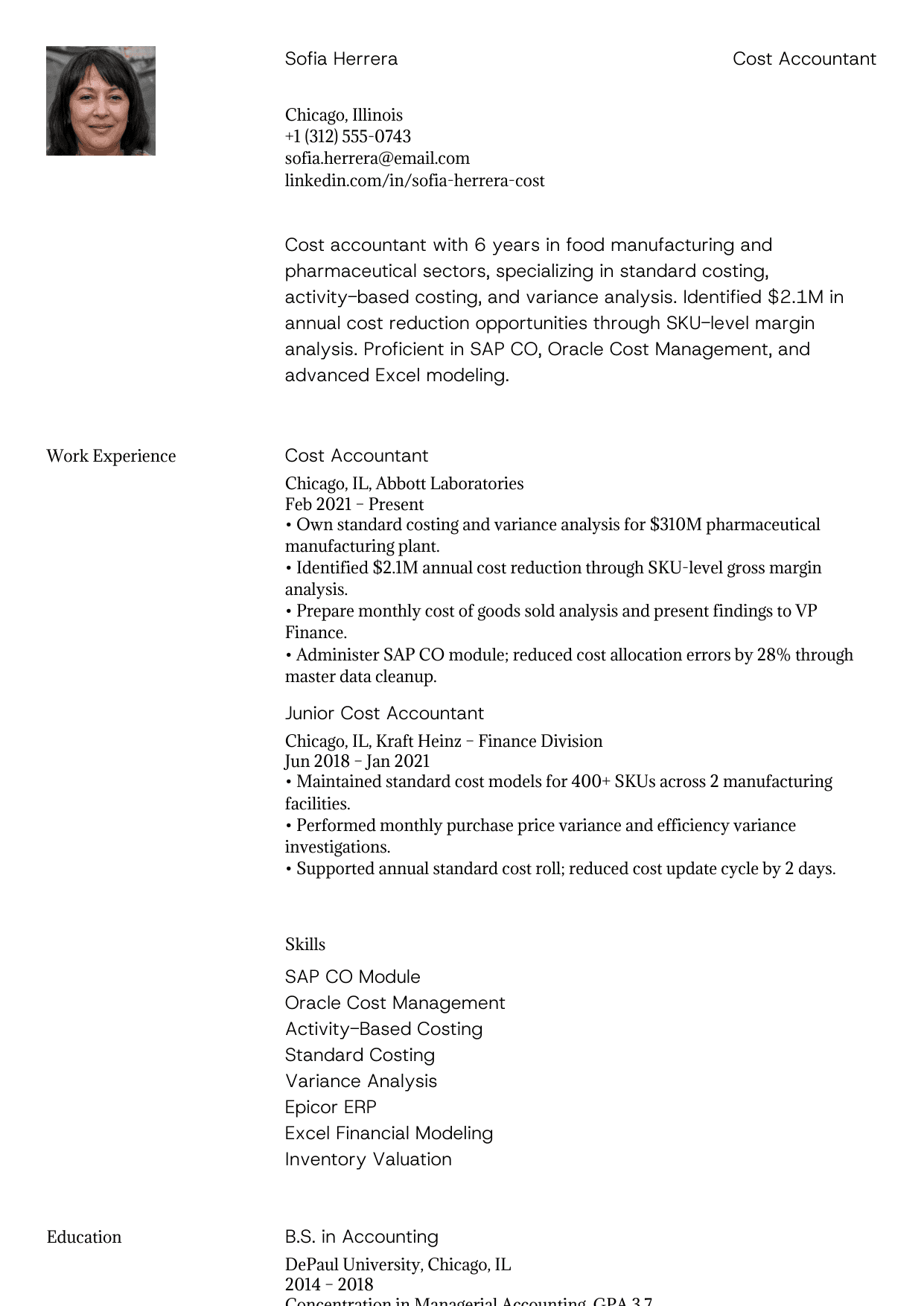
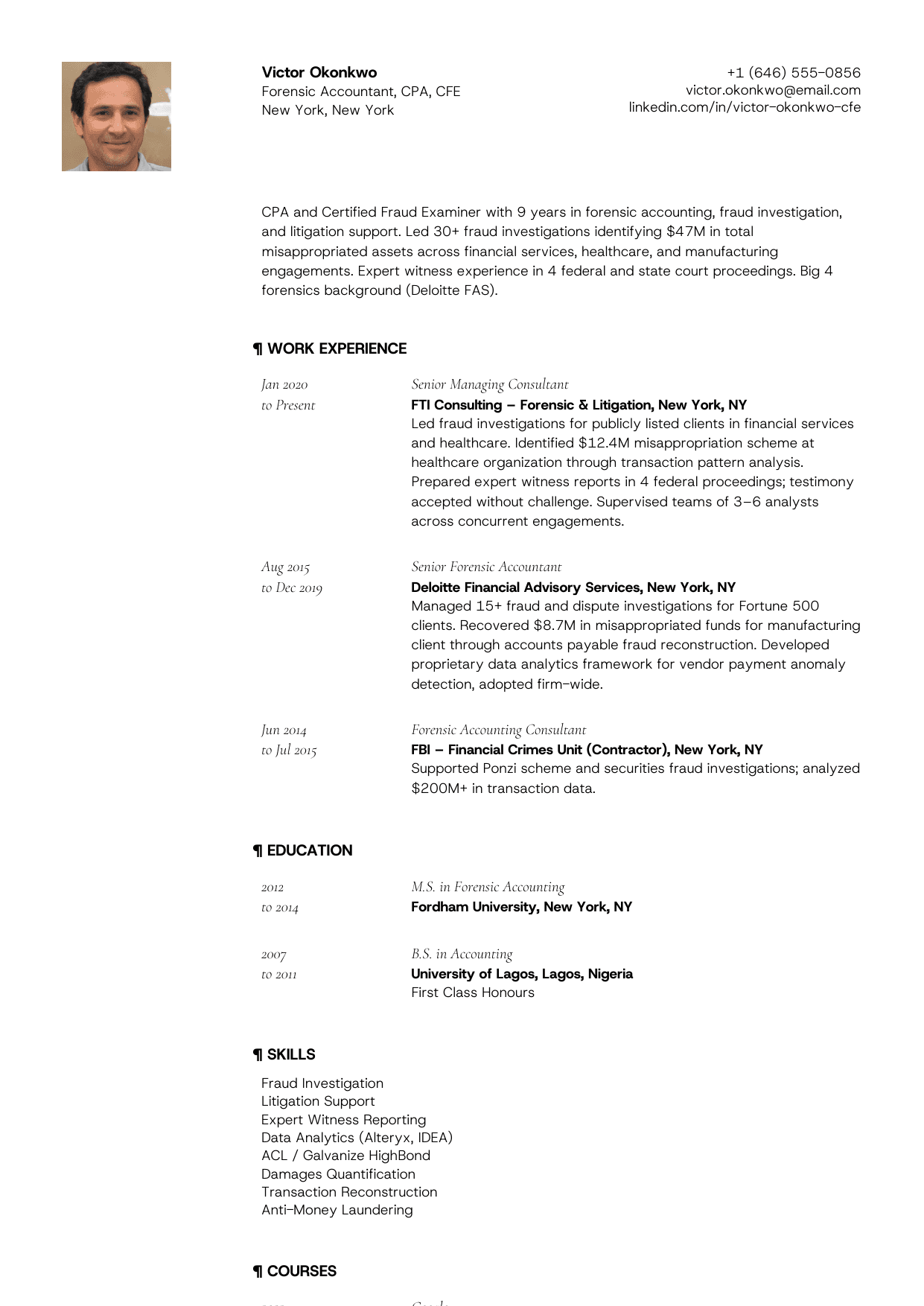
How to Quantify Accounting Work on a Resume
Accounting is the original numbers profession — yet most accounting resumes are written without a single figure in the experience section. The irony isn't lost on hiring managers. Here's how to find and frame the metrics that make an accounting resume credible:
What You Did | How to Say It With Impact |
|---|---|
Processed accounts payable invoices | "Processed 500+ AP invoices monthly with 99.8% accuracy; reduced duplicate payment errors by 35%" |
Assisted with month-end close | "Contributed to month-end close cycle reduction from 8 days to 5 days by automating 4 recurring journal entries in NetSuite" |
Prepared financial statements | "Prepared monthly GAAP financial statements for 3 operating entities with combined revenue of $42M; zero material restatements in 4 years" |
Managed budgeting process | "Led annual budgeting for $18M cost center; forecast variance held within 3% across 3 consecutive fiscal years" |
Supported external audit | "Coordinated external audit fieldwork for 12-person engagement team; no material weaknesses identified for second consecutive year" |
The numbers that matter most in accounting resumes fall into four categories: scale (transaction volumes, entity count, revenue size managed), accuracy (error rates, restatement history, audit findings), efficiency (close cycle time, process automation, hours saved), and compliance outcomes (clean audits, zero regulatory findings, SOX compliance maintained). If you can find one metric from each category across your experience, your resume will read differently from 90% of your competition.
For sensitive figures — revenue, payroll totals, client data — use ranges or percentages. "Managed payroll for a workforce of 800+ employees" is specific without disclosing exact compensation data. "Reduced audit preparation time by 40%" is meaningful without revealing the firm's internal processes.
ATS Keywords That Accountant Resumes Need in 2026
Accounting job postings are among the most keyword-specific in any profession — because the technical vocabulary of the field is precise and consistent. ATS systems at large employers, staffing agencies, and Big 4 firms are calibrated to filter hard on these terms. Here's the breakdown by role type:
Role Type | Essential Keywords |
|---|---|
General / Staff Accountant | GAAP, journal entries, general ledger, reconciliation, month-end close, accounts payable, accounts receivable, financial statements |
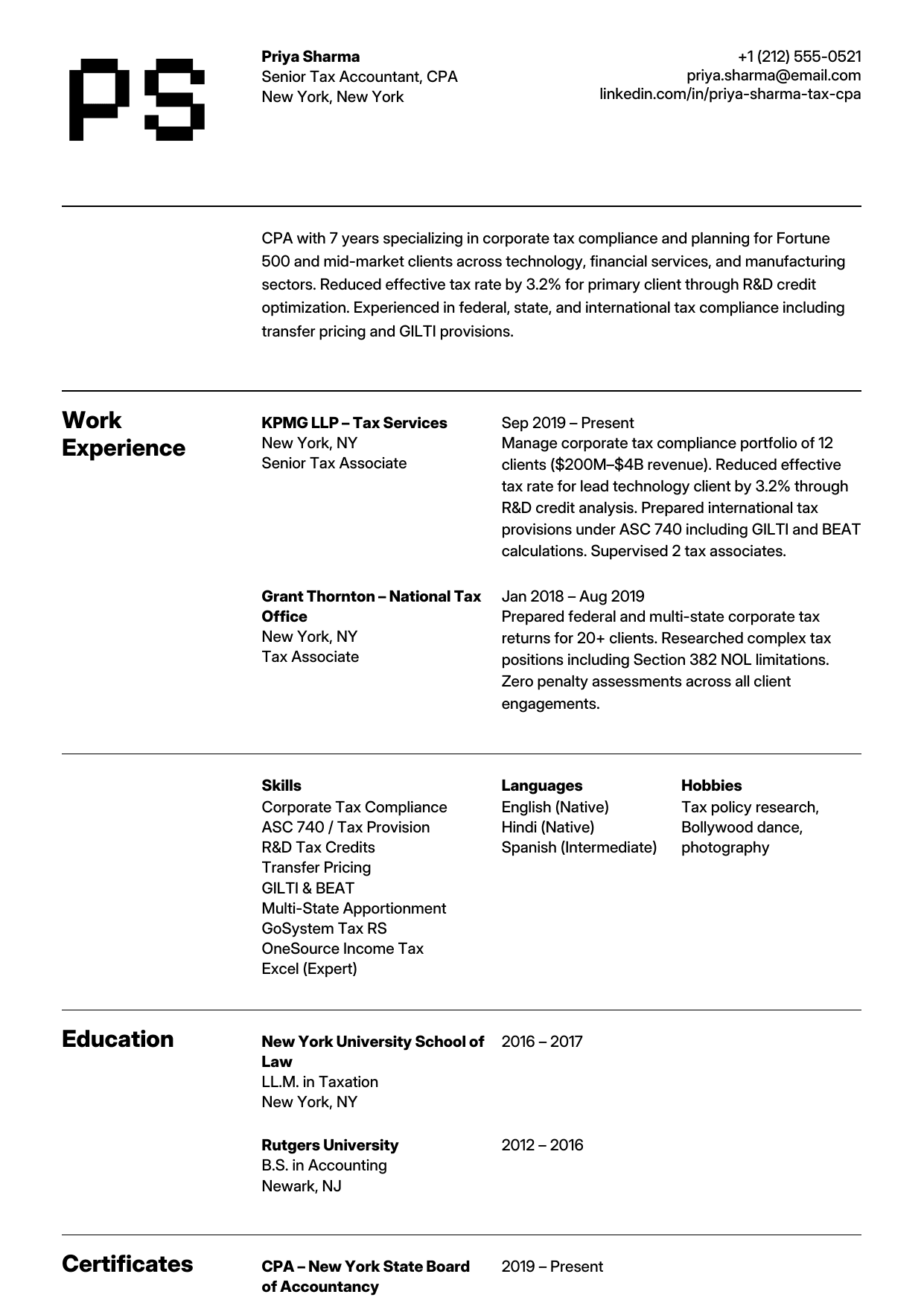
Tax Accountant | tax compliance, tax planning, federal and state returns, ASC 740, deferred tax, tax provision, IRS, 1040 / 1120 / 1065 returns |
Audit / Assurance | internal controls, SOX compliance, risk assessment, substantive testing, PCAOB, materiality, audit findings, working papers |
Cost Accountant | cost variance, standard costing, COGS, inventory valuation, manufacturing overhead, absorption costing, cost allocation |
Corporate / Senior | financial reporting, FP&A, forecasting, variance analysis, consolidations, intercompany, ERP, Workday, Oracle, SAP |
Software (all levels) | QuickBooks, NetSuite, SAP, Oracle, Workday, Microsoft Dynamics, Sage, Xero, BlackLine, Concur |
One keyword category that most accounting resumes miss entirely: technology fluency signals. In 2026, employers are actively screening for Excel advanced skills (pivot tables, VLOOKUP, Power Query, macros), ERP implementation involvement, and automation tools (RPA, Power Automate, Python for finance). These don't just pass ATS — they signal that you're ahead of the automation curve rather than threatened by it. Browse the full resume examples library to see how accountants in different specializations weight these keywords by role level.
The Tax Season Hiring Window: When and How to Job Search in Accounting
Accounting has one of the most predictable hiring calendars of any profession — and ignoring it is one of the most common reasons qualified candidates miss roles they would have gotten with better timing.
The US accounting hiring cycle runs in two distinct waves:
January to March (pre-tax season): Corporate accounting teams build headcount ahead of year-end reporting and Q1 close. Public accounting firms fill staff and senior associate positions before busy season peaks. This is the highest-volume hiring window for accounting roles at all levels — and the most competitive.
May to August (post-tax season): Public accounting firms promote internally and backfill the vacancies created. Mid-size and regional firms that overstretched in busy season look to add capacity. This window has lower volume but also lower competition — candidates who apply in June often face a faster-moving, less-crowded process than those who applied in February.
The worst time to start refreshing your resume is April — when you're exhausted from busy season and every firm has already made its hiring decisions. The best time is November to December: update your resume with the current year's results before they fade, and enter January already positioned rather than scrambling.
"The candidates who consistently get the roles they want in public accounting are the ones who treat their own job search with the same planning discipline they bring to a client engagement."
For those targeting industry roles — corporate accounting, FP&A, controller-track positions — hiring is less seasonal but still follows budget cycles. Companies often open headcount in Q1 (new fiscal year budgets) and Q3 (mid-year adjustments). Our professional resume templates are built to move fast when your window opens.
Accountant Resume FAQs
Should I put my CPA credential in the resume header?
Yes — if you're licensed, your name should appear as "Jane Smith, CPA" in your header. This is standard accounting practice and immediately signals your credential status before the recruiter reads anything else. If you're a CPA candidate with all four sections passed but not yet licensed, note "CPA Candidate" with your exam status either in the header or directly below your name. Don't leave it to inference — hiring managers won't assume you're in progress.
How long should an accountant resume be?
One page for candidates with fewer than 5 years of experience; two pages for senior accountants, managers, controllers, and those with diverse specializations across multiple roles. Unlike some fields where a two-page resume signals poor editing, accounting hiring managers expect two pages from experienced candidates with multiple client engagements, software implementations, or functional areas to document. The rule: every line needs to earn its space. If your second page is three half-empty bullets from a job you left in 2018, cut it.
What accounting software should I list on my resume?
Name everything you've used with meaningful exposure — don't pad with tools you've only touched once. Core systems worth listing: QuickBooks (Online and Desktop are distinct credentials), NetSuite, SAP (specify the module: FI, CO, FICO), Oracle Financials, Workday Financials, Microsoft Dynamics, Sage Intacct, Xero. For audit and close management: BlackLine, FloQast, Trintech. For Excel, be specific: "Advanced Excel including Power Query, pivot tables, XLOOKUP, and VBA macros" says far more than "Microsoft Office."
Do I need a different resume for public accounting vs. industry accounting?
Significantly different framing, yes. For public accounting, emphasize engagement breadth, client industry variety, technical standards mastery (GAAP, PCAOB, ASC topics), and hours managed — public firms are buying technical depth and professional development trajectory. For industry accounting, emphasize business impact, close efficiency, cross-functional collaboration, and systems ownership — corporate teams want someone who makes the finance function run better, not just someone who can apply standards correctly. The underlying experience may be identical; the resume positioning should not be.