Business Analyst Resume Examples That Prove Impact, Not Just Process
8 business analyst resume examples across IT, agile, healthcare, and finance verticals. See how top BAs turn requirements and process work into resumes that land interviews.
Updated Mar 24, 2026
Written by Artur Lopato
"Business Analyst" is one of the most inconsistently defined job titles in corporate hiring. The same two words describe someone writing SQL queries at a fintech firm, someone mapping BPMN processes at a logistics company, someone facilitating stakeholder workshops at a consultancy, and someone writing user stories on a product team. That ambiguity is useful at work — BAs adapt to their environment. On a resume, it's a liability.
Hiring managers can't assess a resume that leaves them guessing which kind of BA they're reading about. Your resume needs to resolve the ambiguity the job title creates — not repeat it. That means naming your domain (IT, finance, healthcare, operations), your methodology (Agile, waterfall, Six Sigma), and your stakeholder level within the first three lines.
The "so what" test every BA resume bullet should pass
Business analysis work — requirements gathering, process mapping, gap analysis, stakeholder interviews — is easy to describe and hard to differentiate. Every BA has done all of those things. The question that separates strong resume bullets from forgettable ones is simple: so what happened because of it?
"Gathered requirements from 14 stakeholders across 3 departments" describes a task. "Gathered requirements from 14 stakeholders across 3 departments, identifying a $400K process duplication eliminated in Q3" passes the test. The analysis is the method. The outcome is the resume.
Requirements gathered → process changed → outcome measured. That's the story arc every strong BA resume tells.
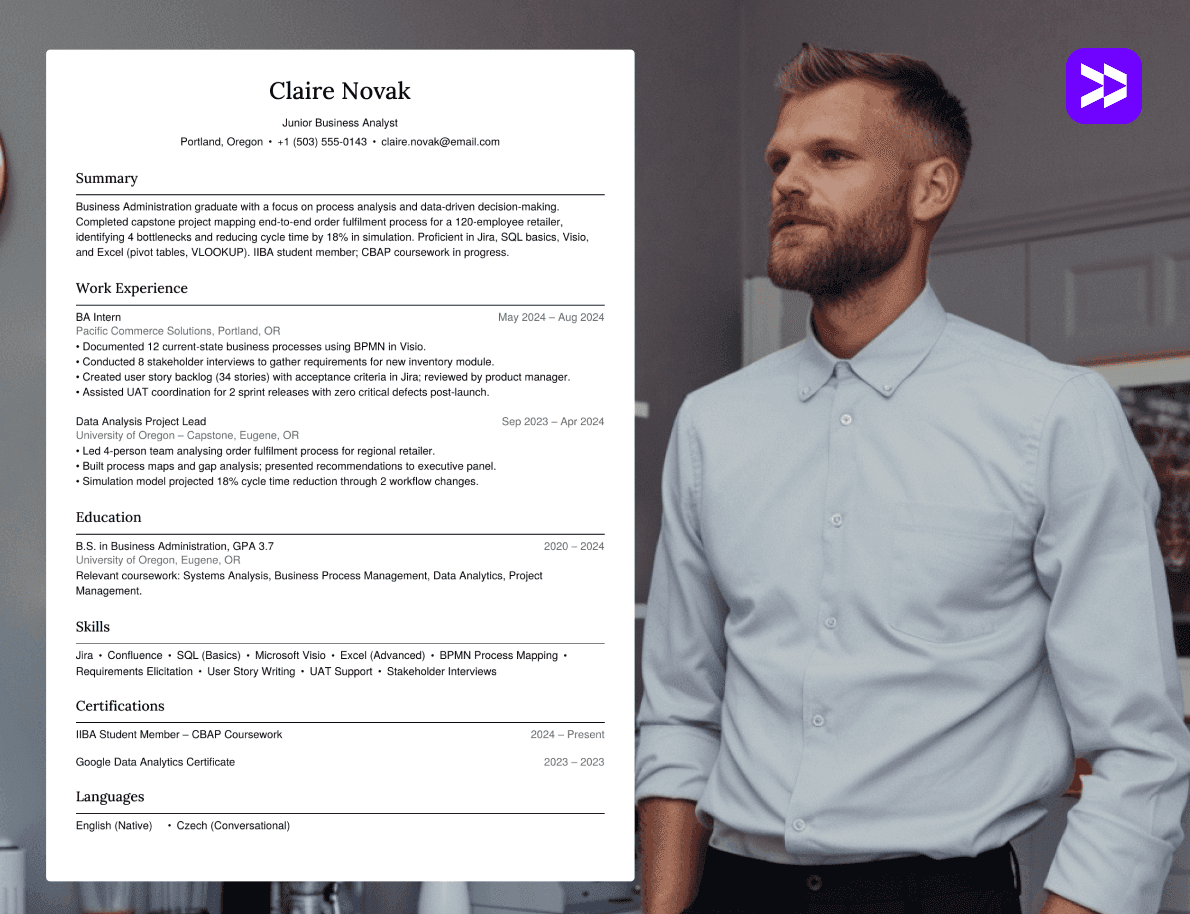
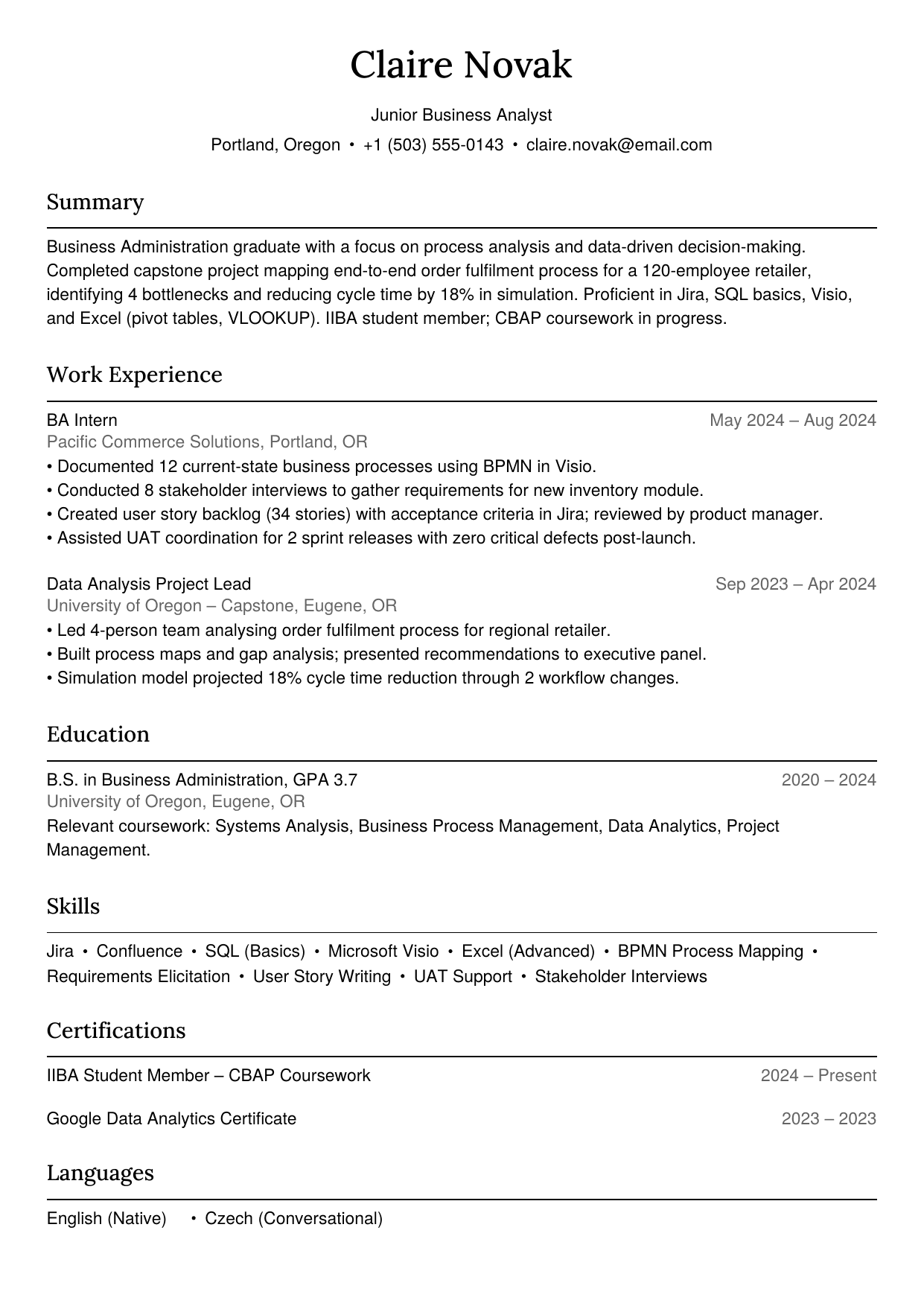
For entry-level candidates, the principle holds even without formal BA titles. Internships, capstone projects, and process improvement work in other roles all count — when they're framed around the change made, not the task completed. Wensa's 8 business analyst examples below cover every major BA type and career stage. Start with a business analyst resume template already structured for this role, and read our resume writing guide before you build.
Business Analyst Resume Examples by Role and Industry
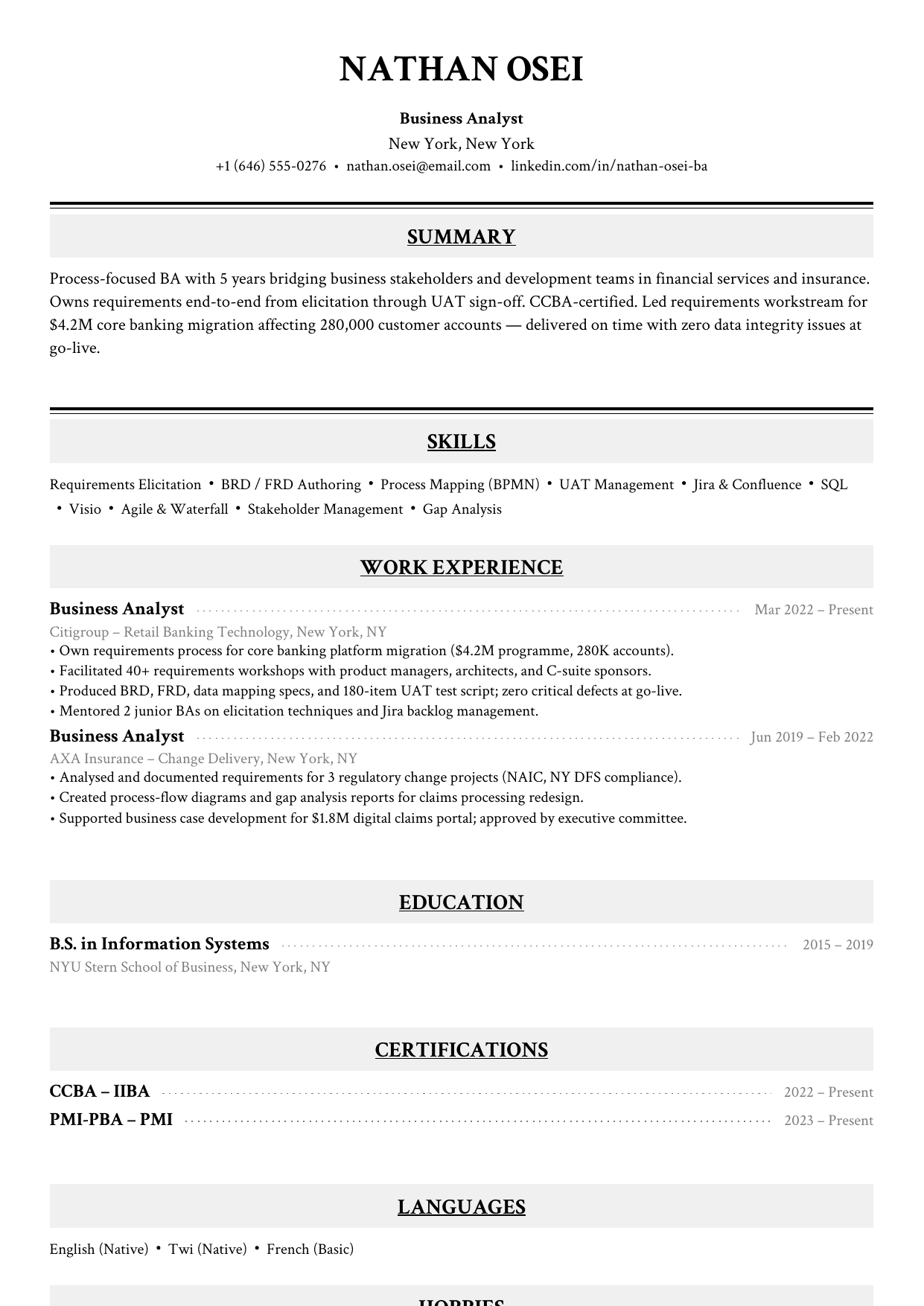
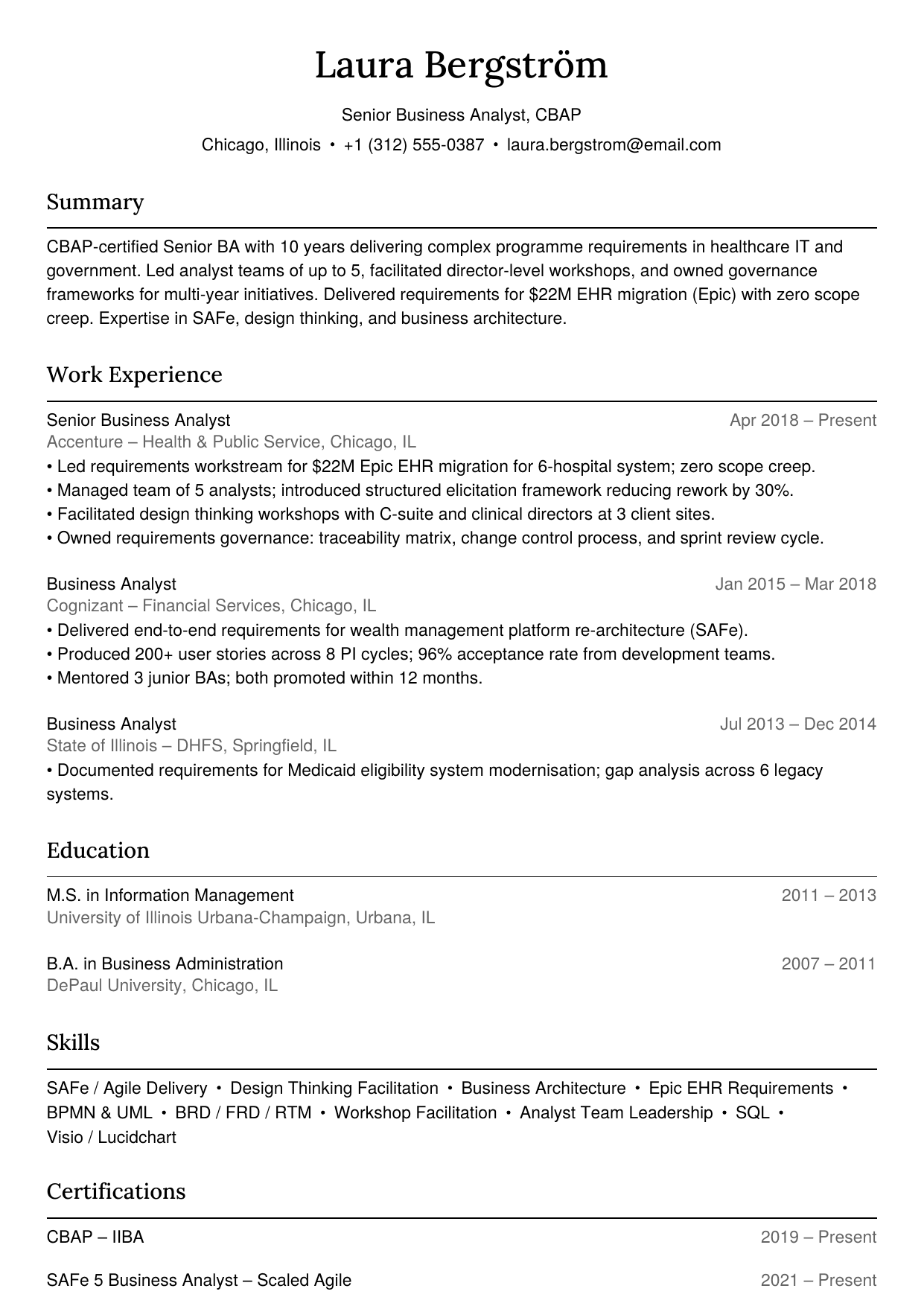
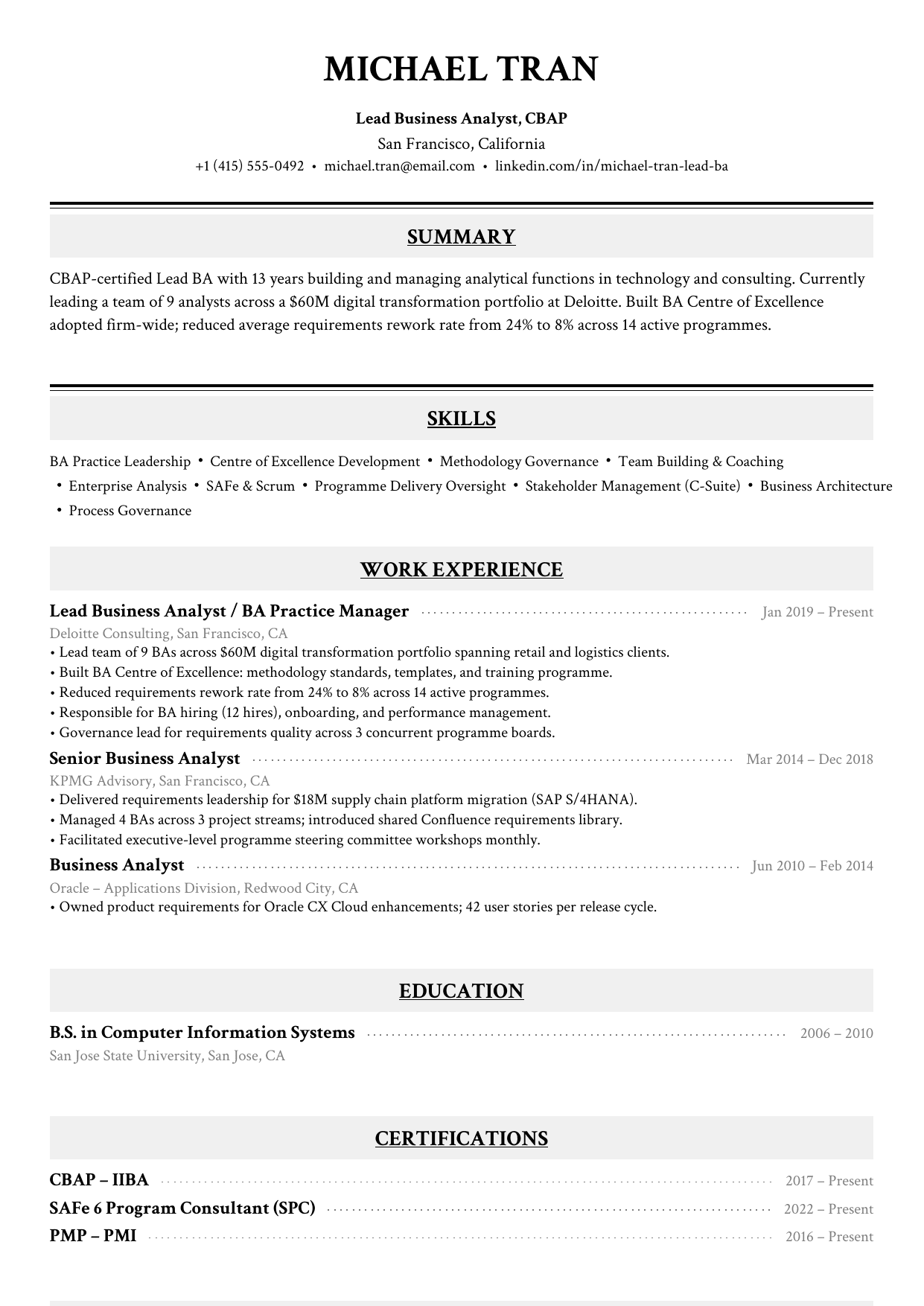
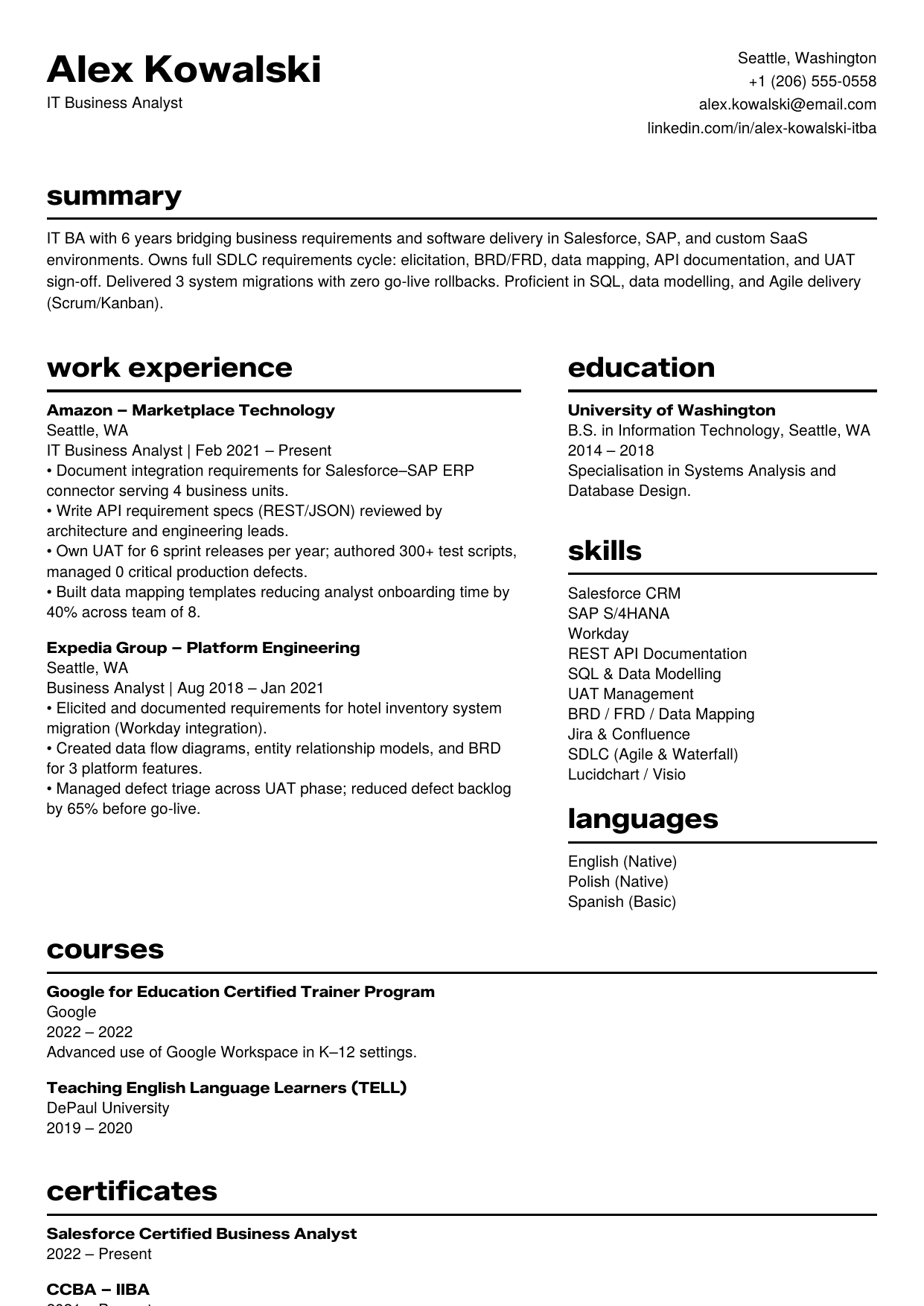
How to Position Your Resume When "Business Analyst" Means Different Things to Different Employers
Before a recruiter reads a single bullet point, they're asking: what kind of BA is this? If your resume doesn't answer that quickly, it gets sorted into the unclear pile — which, in a stack of 200 applications, means it doesn't get sorted at all.
Here's how the positioning changes depending on the type of role you're targeting:
BA Type | Lead With | Key Terms to Include |
|---|---|---|
IT / Systems BA | Technical environment and systems worked with | systems analysis, solution design, UAT, SQL, API requirements, SDLC, data mapping |
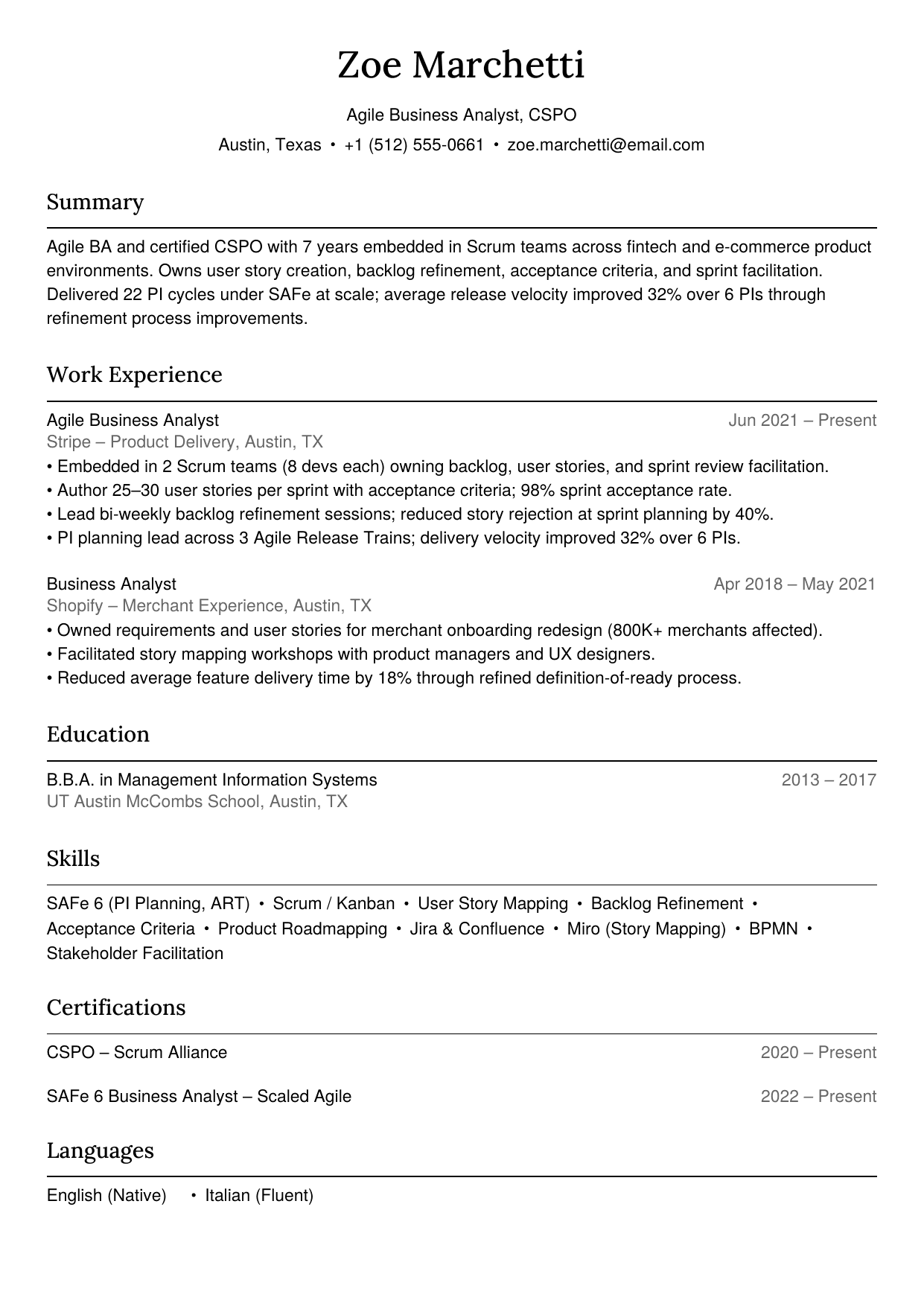
Agile / Product BA | Sprint work, story writing, and team collaboration model | user stories, backlog refinement, acceptance criteria, Jira, Scrum, sprint planning, product roadmap |
Process / Operations BA | Process scope and efficiency outcomes | process mapping, BPMN, Six Sigma, Lean, root cause analysis, as-is/to-be, workflow optimization |
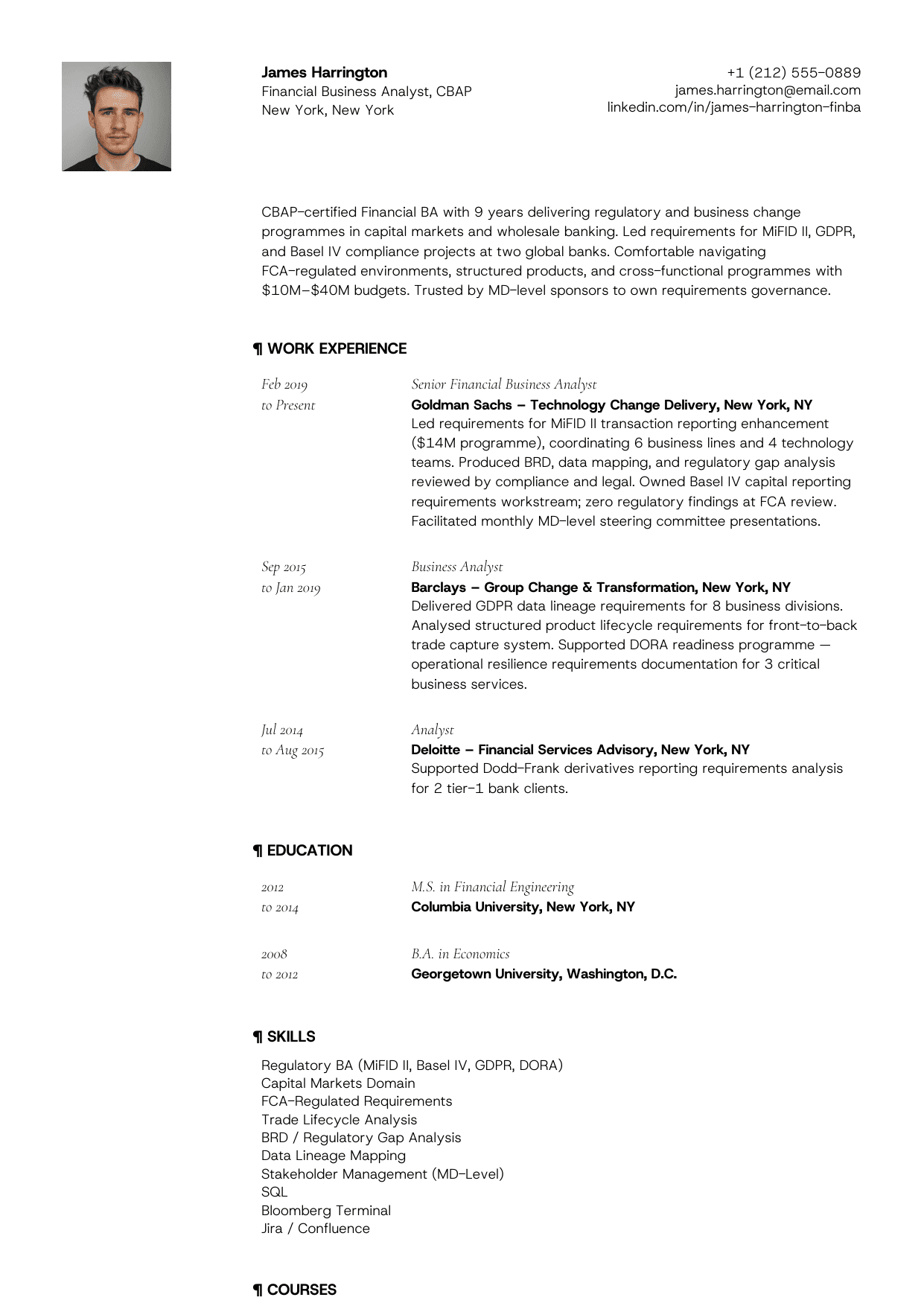
Financial / Risk BA | Regulatory context and business domain | financial modeling, risk analysis, variance analysis, regulatory compliance, reconciliation, P&L |
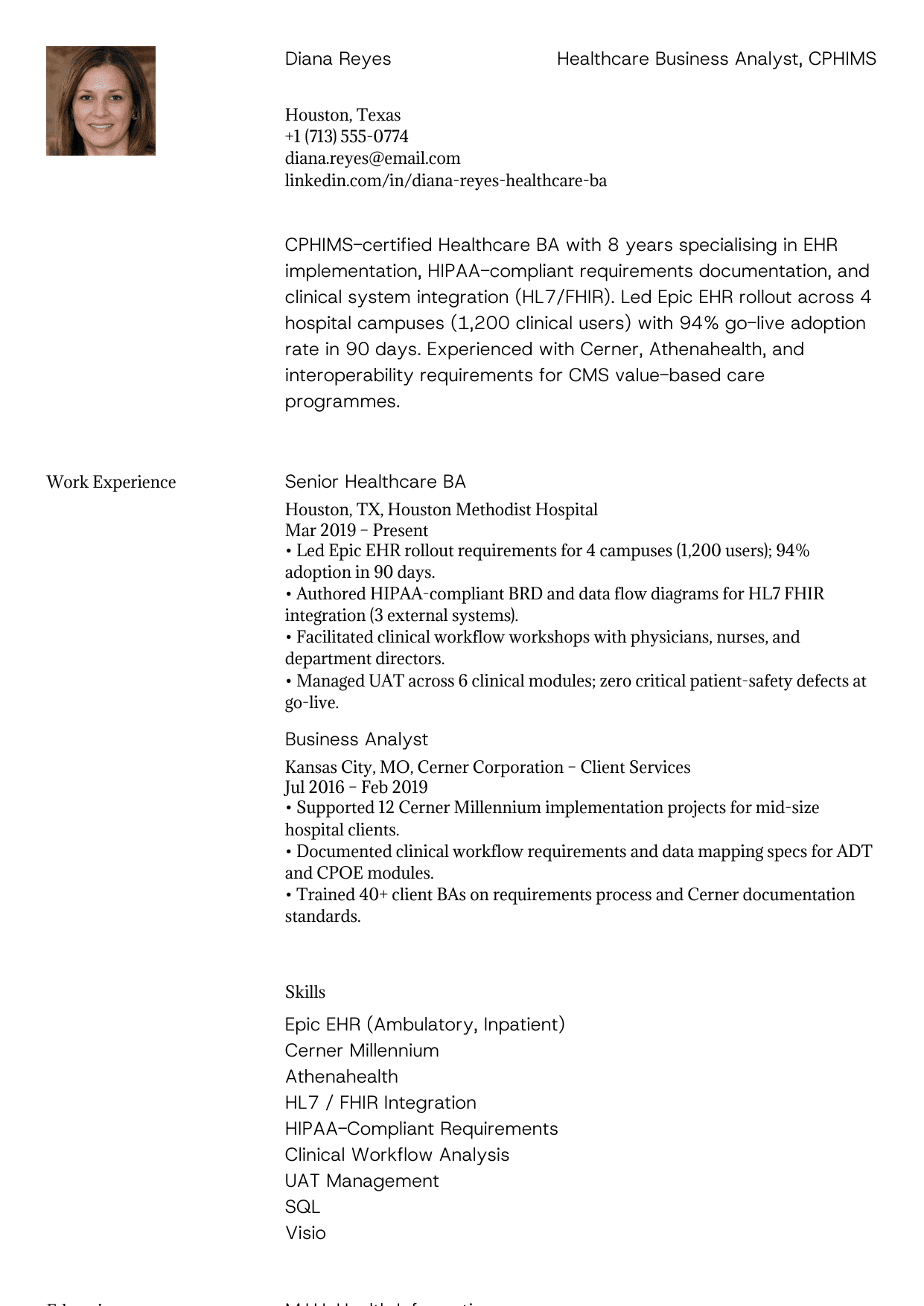
Healthcare BA | Clinical system or compliance domain | EHR/EMR, HL7, HIPAA, clinical workflows, interoperability, care coordination, ICD-10 |
One decision point that trips up many candidates: whether to use a combination resume format (skills section first, then work history) or straight reverse-chronological. For BAs with 5+ years of experience, reverse-chronological with a strong summary works well. For career changers or candidates moving between BA types — say, from process BA to product BA — a combination format that front-loads transferable competencies often performs better. The format choice is a positioning decision, not just a layout preference.
BA Certifications: Which Ones Actually Move the Needle
BA certifications are more varied — and more unequally weighted — than in most other fields. Knowing which ones signal real expertise versus which ones are easy paper credentials is half the battle.
CBAP (Certified Business Analysis Professional) — the gold standard for experienced BAs. Issued by IIBA, requires 7,500 hours of BA experience before you can apply. If you hold it, it belongs near the top of your resume. ATS systems at major consulting firms and enterprises are explicitly calibrated to find it.
CCBA (Certification of Capability in Business Analysis) — the mid-level IIBA credential, requires 3,750 hours. Signals professional commitment for candidates not yet eligible for CBAP. Worth including prominently if you hold it.
PMI-PBA (Professional in Business Analysis) — PMI's BA credential, weighted toward project and program environments. Particularly valued at organizations that run PMO-heavy delivery models. If your target companies use PMI frameworks, this outperforms CBAP in direct relevance.
Agile and Scrum credentials — CSPO (Certified Scrum Product Owner) and PSPO carry real weight for product-adjacent BA roles. SAFe BA certification matters in large enterprise Agile environments. These sit in a dedicated certifications section alongside IIBA credentials.
Domain-specific credentials — CPHIMS for healthcare IT, Six Sigma Green or Black Belt for process roles, Salesforce or ServiceNow certifications for CRM/ITSM BA work. These niche credentials often outperform general BA certifications for the specific roles they target — they signal domain fluency, not just analytical methodology.
Credentials that took 7,500 hours to earn deserve a visible section — not a footnote at the bottom of page two. Browse the full resume examples library to see how BAs in different specializations position certifications relative to their experience section.
ATS Keywords That Business Analyst Resumes Need in 2026
BA job postings run some of the highest keyword specificity rates in corporate hiring — because the role touches systems, methodologies, and stakeholder layers simultaneously. Here's the keyword profile that passes ATS at enterprise and consulting employers:
Category | Keywords to Include |
|---|---|
Methodologies | Agile, Scrum, Waterfall, Kanban, SAFe, Six Sigma, Lean, SDLC, BPM |
Core BA competencies | requirements gathering, gap analysis, process mapping, use cases, user stories, acceptance criteria, stakeholder management, UAT, business case development |
Tools and platforms | Jira, Confluence, Visio, Lucidchart, SQL, Tableau, Power BI, Salesforce, ServiceNow, BPMN |
Collaboration and delivery | cross-functional, sprint planning, backlog refinement, change management, solution design, business process improvement |
Documentation | BRD, FRD, SRS, process documentation, data flow diagrams, workflow analysis, executive reporting |
Two keyword patterns that matter more in 2026 than in previous years: first, AI and automation fluency — BAs involved in RPA implementations, AI-readiness assessments, or intelligent automation projects are flagged as higher-value by enterprise ATS systems. If you've contributed to any automation initiative, name it. Second, data literacy terms — SQL proficiency, dashboard design, and data-driven requirements now appear in the majority of mid-to-senior BA postings, blurring the line between BA and data analyst. If you can query a database or build a Power BI report, say so. Our professional resume templates are pre-structured for the combination layout that works best for BA roles at this keyword density.
Business Analyst Resume FAQs
How long should a business analyst resume be?
One page for analysts with fewer than 5 years of experience; two pages for senior BAs, those with multiple domain specializations, or candidates who have led large-scale implementations. The temptation for BAs is to over-document — requirements documents, process maps, and project histories can fill pages quickly. Resist it. Your strongest result, your domain, and your methodology should all be visible before the fold on page one.
Should I include all the projects I've worked on?
No — include the projects where your analysis visibly changed something. A BA resume that lists every initiative touched reads like a project log, not a performance record. Select 3-5 projects per role where you can answer the "so what" question clearly: what changed, what was the scale, what was the outcome? Depth on fewer projects outperforms breadth across many.
What's the difference between a BA resume and a PM resume?
More than most candidates realize — and getting this wrong costs interviews. A PM resume leads with delivery ownership: timeline, budget, team, project outcome. A BA resume leads with analytical contribution: the insight surfaced, the requirement clarified, the process improved. If you've played both roles (which many BAs have), frame the resume for the specific role you're applying to. Submitting a PM-style resume for a BA role signals you want to move away from analysis — which may not be the message you intend.
Do I need a technical skills section if I'm not an IT BA?
Yes, but calibrated to your context. Every BA resume benefits from a tools section — even process and operations BAs use Visio, Lucidchart, Excel, and Confluence. For non-IT BAs, the tools section appears further down the page and runs shorter. What matters more for process-side BAs is the methodology section: Lean, Six Sigma, Agile, or BPM credentials signal analytical rigour to hiring managers who don't expect deep technical fluency.