Data Analyst Resume Examples That Get Interviews in 2026

Real data analyst resume examples from entry-level to senior, covering business intelligence, healthcare, marketing, and financial analytics. See how top candidates turn tools and datasets into resumes that land interviews.

Updated Mar 18, 2026

Written by Artur Lopato

Data analyst resume example on a clean textured background

There's a version of the data analyst resume that reads like a software inventory: SQL, Python, Tableau, Power BI, Excel, R. It lists every tool the candidate has touched and calls that a skills section. It doesn't land interviews — because every other data analyst resume looks exactly the same.

The resumes that get callbacks are built around a different principle: what changed because of your analysis? A hiring manager at a fintech company or a healthcare system doesn't need to know that you can run a SQL query. They need to know that your SQL query identified a $2.3M revenue leak in the billing pipeline — or that your churn model reduced customer attrition by 18 points. The tool is the method. The impact is the resume.

Why data analyst hiring has gotten more competitive in 2026

The number of people calling themselves data analysts has grown dramatically in the last four years, driven by the explosion of bootcamps, online certifications, and self-taught technical skills. That's raised the floor — nearly every candidate now has SQL and basic Python on their resume — and compressed the differentiation space into a narrower band: business context, stakeholder communication, and documented impact.

Companies aren't just hiring for technical execution anymore. They're hiring analysts who can frame the right question before running the query, present findings in a way that moves a decision, and work effectively with non-technical stakeholders who won't read a Jupyter notebook. Your resume needs to show all three dimensions — not just the technical one.

Projects count — even if they're personal

For entry-level and career-changing candidates, the absence of formal work experience doesn't have to mean an absence of evidence. Kaggle projects, GitHub repositories, capstone analyses, and even well-documented freelance datasets all demonstrate analytical thinking when they're presented correctly: what was the question, what data did you use, what did you find, and what would someone do differently because of it?

The mistake is listing a project without context — "Built a Python model to analyze Airbnb data" says almost nothing. "Built a regression model in Python identifying the top three pricing factors driving 5-star reviews in NYC Airbnb listings; presented findings as an interactive Tableau dashboard" shows the full loop from question to insight to communication. That's what recruiters actually read. Start with a proven data analyst resume template already structured for technical roles, and review our resume writing guide before you begin.

Data Analyst Resume Examples by Role and Specialization
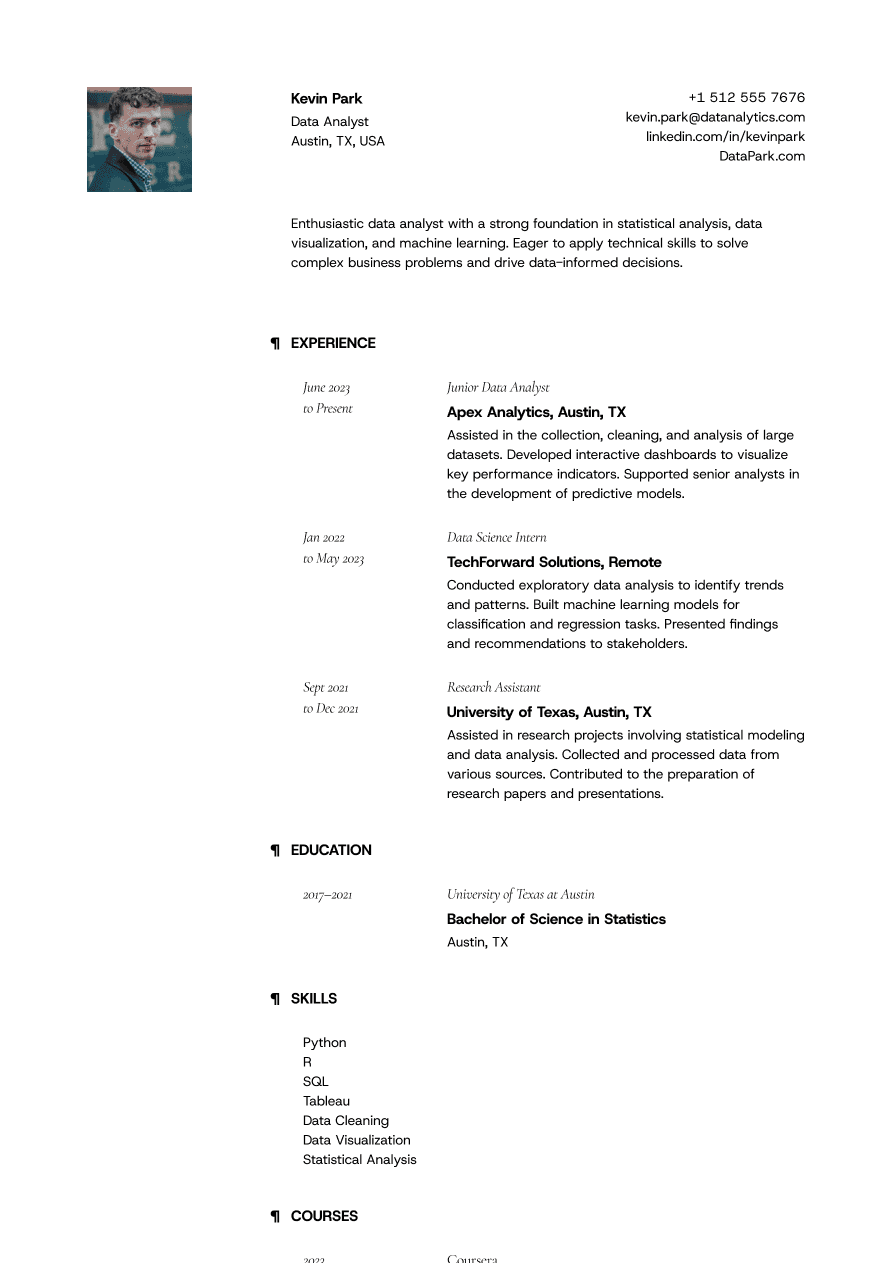
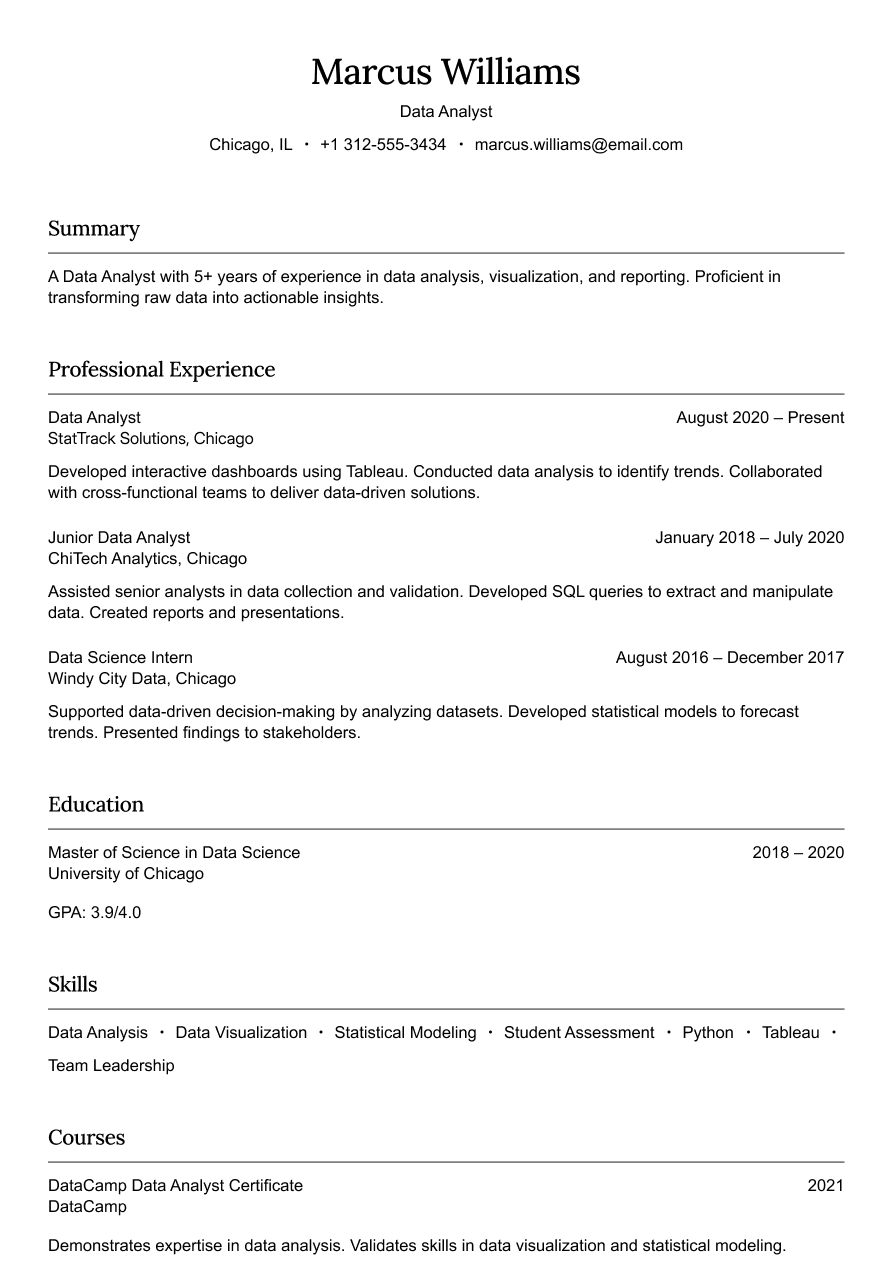
Entry-Level Data Analyst Resume

Built for recent graduates and career changers entering analytics for the first time. Rather than apologizing for limited work experience, this resume leads with a focused summary and a dedicated projects section — each project framed as a business question answered, not a technical exercise completed. SQL, Python, and Tableau appear in a clean technical skills block, and certifications (Google Data Analytics, Tableau Desktop Specialist) occupy a visible position near the top where hiring managers can find them quickly.

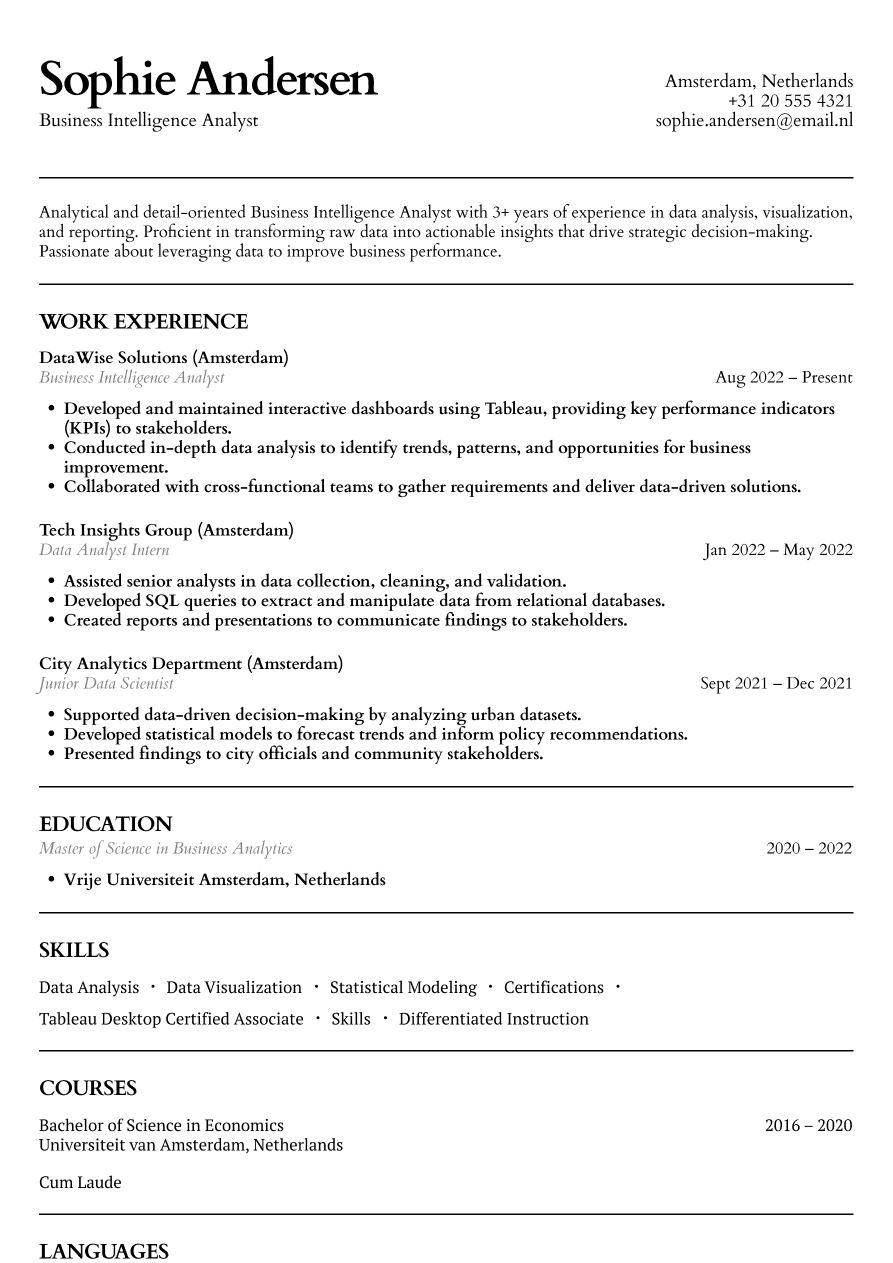
Business Intelligence Analyst Resume

Specialized for analysts who live in dashboards, data models, and self-serve reporting infrastructure. This BI-focused resume leads with the scale of the reporting environments managed — dashboards built, business users served, report refresh cadence — and ties each tool (Tableau, Power BI, Looker, dbt) to a specific business outcome. ETL pipeline ownership, semantic layer development, and executive reporting cadences all appear as achievements, not responsibilities.

  • Demonstrates Snowflake, BigQuery, or Redshift experience alongside visualization tools

  • Shows self-serve analytics adoption metrics: teams onboarded, manual reporting hours eliminated

  • Includes data governance and documentation contributions for ATS keyword coverage

Mid-Level Data Analyst Resume

A two-page example for analysts with 4-7 years of experience who have moved beyond execution into analysis ownership — defining the questions, not just answering them. The resume summary anchors on the candidate's domain specialization and a top-line impact figure, and the experience section shows a clear progression: from supporting analysis to owning the data strategy for a product line, business unit, or customer segment.

The technical skills section at mid-level goes beyond the basics — Python and SQL are assumed, so the differentiators are cloud infrastructure (Snowflake, dbt, Airflow), experimentation frameworks (A/B testing, Bayesian inference), and machine learning fundamentals applied in a business context. Each skill that appears in the skills section is backed by a real use case in the experience section above it.

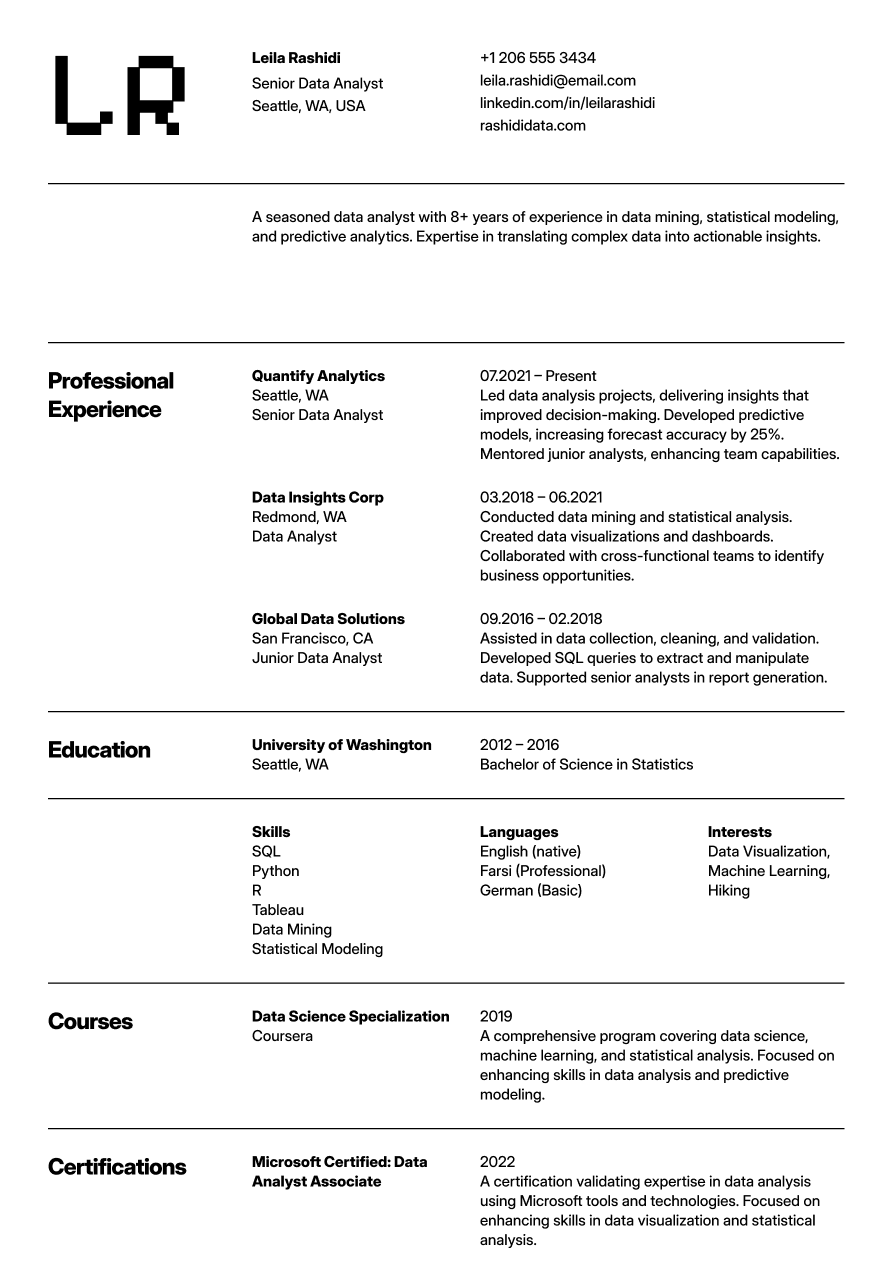
Senior Data Analyst Resume

Built for analysts with 8+ years of experience who are the analytical decision-makers in their organization — not just contributors to a team. The resume summary at this level positions the candidate by the scale of the problems they've solved: revenue influenced, datasets owned, teams informed, or organizational decisions shifted by their analysis. Individual technical skills recede slightly in emphasis; strategic analytical thinking and cross-functional influence come forward.

"At senior level, I'm not hiring for SQL — I'm hiring for the analyst who can tell me which problem to solve before we write a single query. Their resume should show that instinct."

Skills section leads with domain expertise and methodological sophistication (causal inference, time-series forecasting, experiment design) before listing tools. Leadership signals — mentoring junior analysts, defining team standards, leading analytical reviews — appear throughout the experience section.

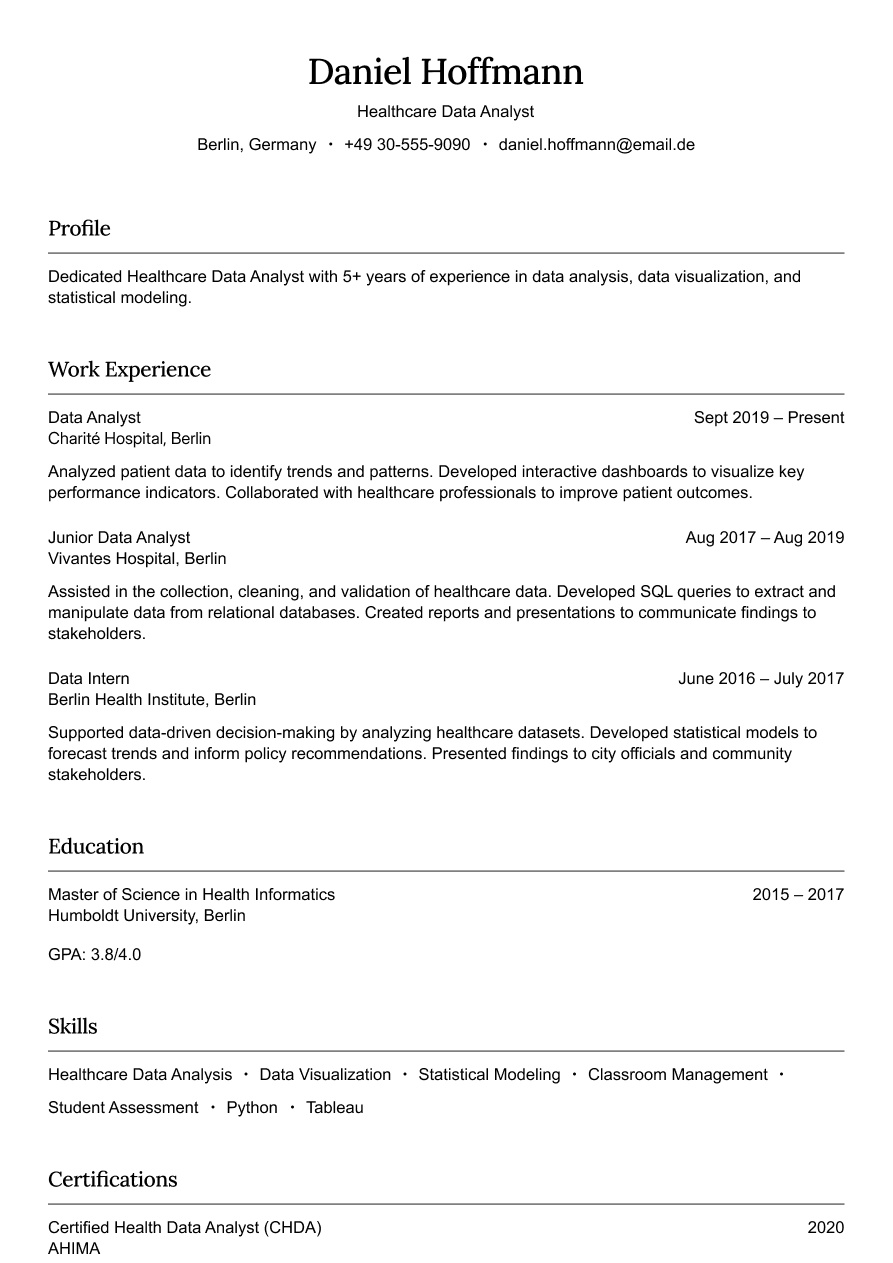
Healthcare Data Analyst Resume

Healthcare analytics is one of the most compliance-sensitive and outcome-critical analyst specializations — and the resume reflects that. This example leads with domain credentials (EHR/EMR experience, HIPAA compliance, clinical data familiarity) before the technical stack, because healthcare employers screen for domain fit before tool fit. Outcomes are framed around patient care metrics, operational efficiency, and cost reduction rather than general business KPIs.

  • Names specific EHR systems: Epic, Cerner, Athenahealth, eClinicalWorks

  • Shows HIPAA-compliant data handling experience prominently — a hard filter at most healthcare employers

  • Includes clinical outcome metrics: readmission rates, length-of-stay analysis, population health cohorts

Marketing Data Analyst Resume

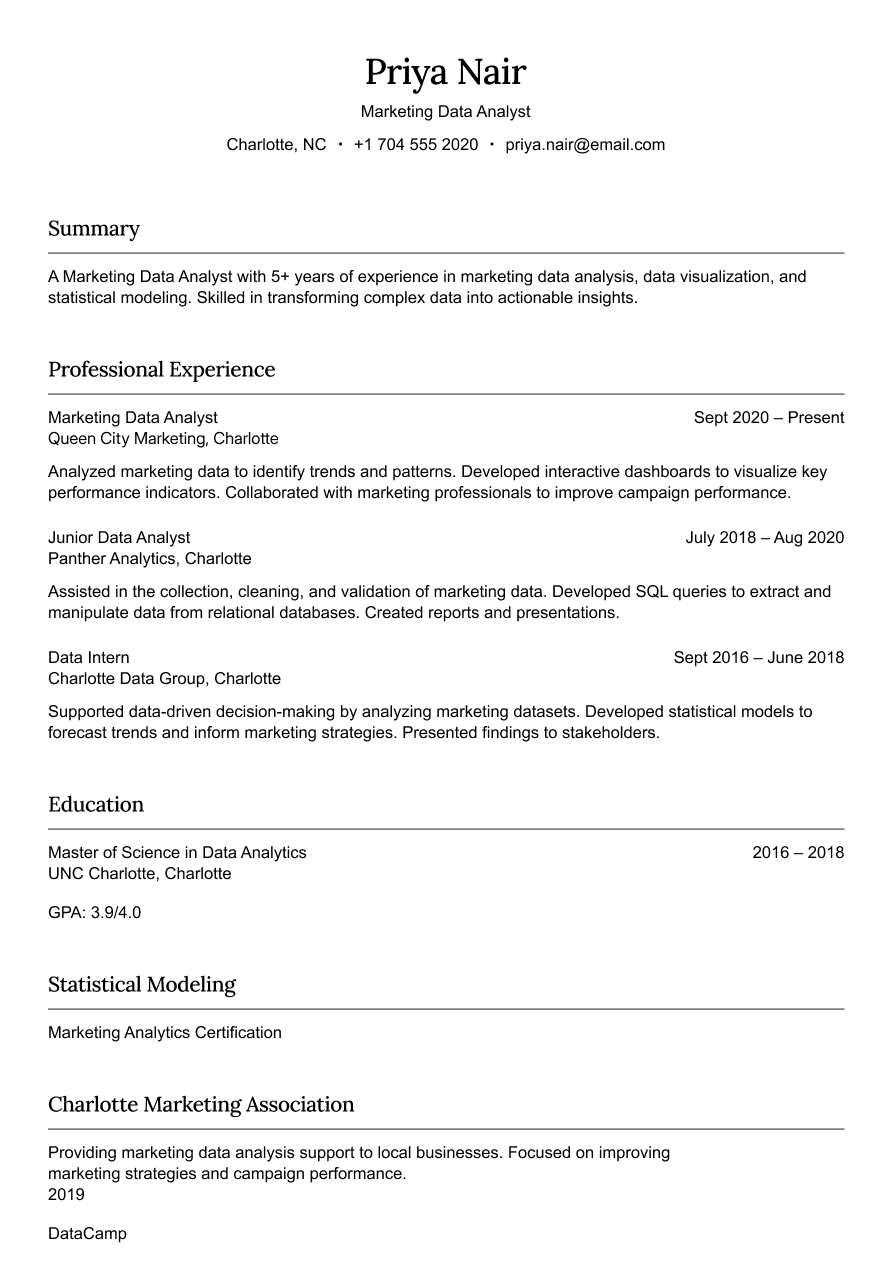
The intersection of analytics and marketing is where the resume split between "technical" and "business" matters most — and where most marketing analysts undersell one side or the other. This example balances both: GA4, Mixpanel, and attribution modeling tools appear in the skills section, while the experience section leads with the marketing decisions those tools informed. Campaign ROI, channel attribution, customer segmentation, and LTV modeling appear as business outcomes, not just technical exercises.

Financial Data Analyst Resume

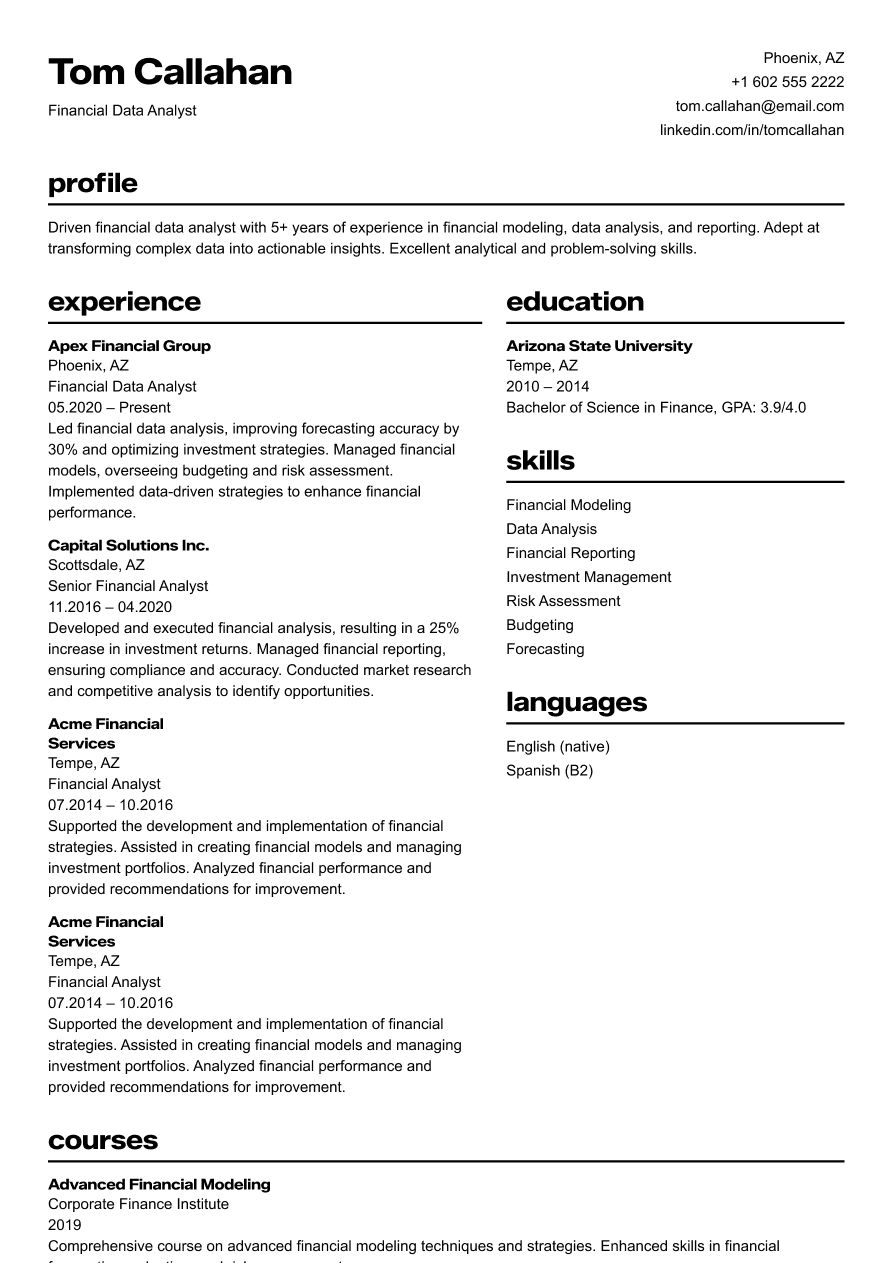
Financial analytics demands a resume that bridges statistical depth with commercial fluency — showing that the candidate can run a regression model on loan performance data and then explain what it means to a credit committee. This example leads with domain credentials (financial modeling, variance analysis, regulatory reporting) before the technical stack, and structures the experience section around revenue impact, risk reduction, and cost efficiency outcomes tied to specific analyses.

The skills section names financial domain tools alongside analytical ones: Bloomberg Terminal, FactSet, Alteryx, and advanced Excel (VBA, Power Query) appear alongside Python and SQL — because financial employers weight domain tool familiarity heavily and often use it as a first-pass ATS filter.

Product Data Analyst Resume

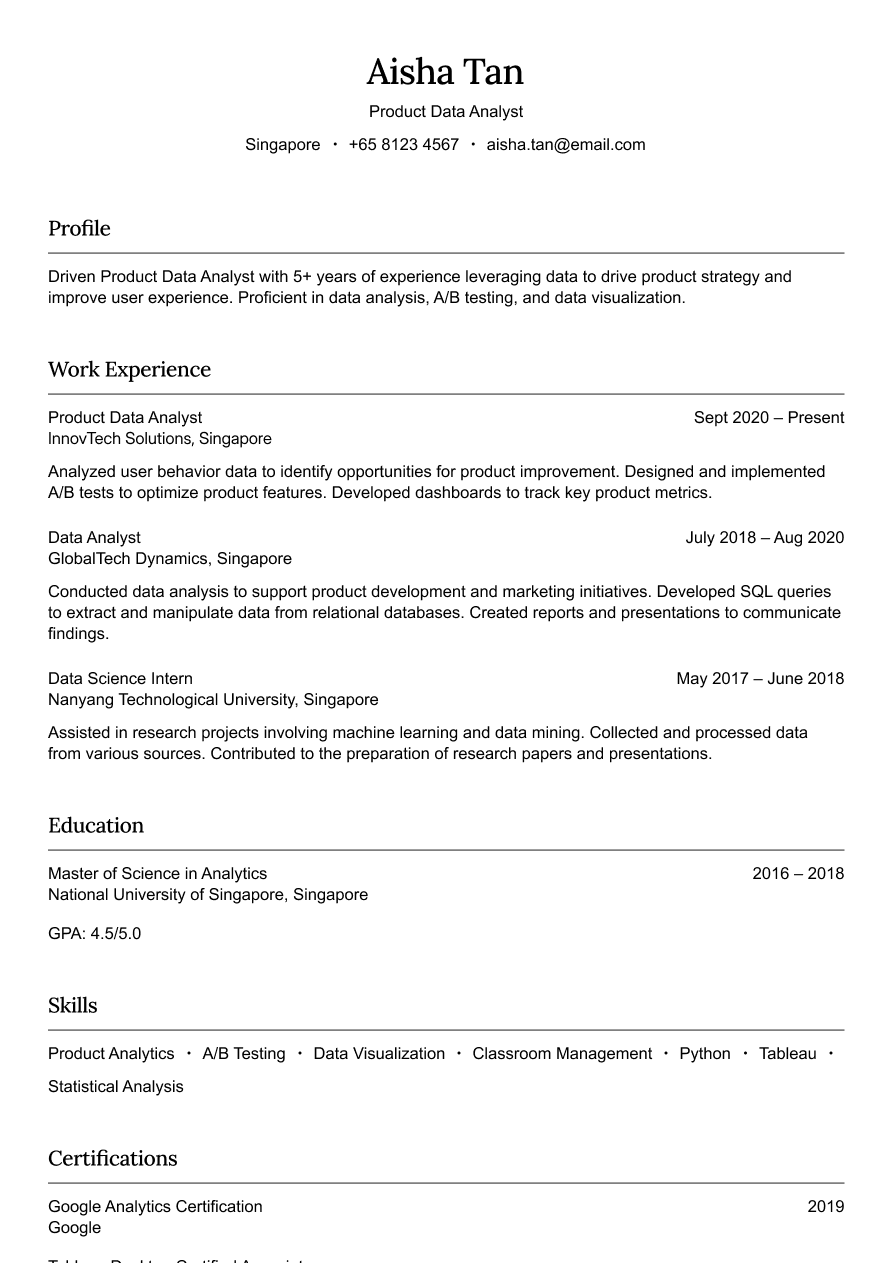
Product analytics sits at the intersection of data science, UX research, and product management — and the resume needs to show all three dimensions without losing the analytical core. This example leads with the product metrics the candidate owns (DAU, retention, activation, feature adoption) and builds backward to the tools (Amplitude, Mixpanel, Looker, SQL) and methods (funnel analysis, cohort retention, A/B experiment design) that generated the insights. Particularly strong for candidates targeting SaaS, mobile app, or platform companies where product instrumentation and user behaviour analysis are central to the role.

Entry-Level Data Analyst Resume

Built for recent graduates and career changers entering analytics for the first time. Rather than apologizing for limited work experience, this resume leads with a focused summary and a dedicated projects section — each project framed as a business question answered, not a technical exercise completed. SQL, Python, and Tableau appear in a clean technical skills block, and certifications (Google Data Analytics, Tableau Desktop Specialist) occupy a visible position near the top where hiring managers can find them quickly.

Business Intelligence Analyst Resume

Specialized for analysts who live in dashboards, data models, and self-serve reporting infrastructure. This BI-focused resume leads with the scale of the reporting environments managed — dashboards built, business users served, report refresh cadence — and ties each tool (Tableau, Power BI, Looker, dbt) to a specific business outcome. ETL pipeline ownership, semantic layer development, and executive reporting cadences all appear as achievements, not responsibilities.

  • Demonstrates Snowflake, BigQuery, or Redshift experience alongside visualization tools

  • Shows self-serve analytics adoption metrics: teams onboarded, manual reporting hours eliminated

  • Includes data governance and documentation contributions for ATS keyword coverage

Mid-Level Data Analyst Resume

A two-page example for analysts with 4-7 years of experience who have moved beyond execution into analysis ownership — defining the questions, not just answering them. The resume summary anchors on the candidate's domain specialization and a top-line impact figure, and the experience section shows a clear progression: from supporting analysis to owning the data strategy for a product line, business unit, or customer segment.

The technical skills section at mid-level goes beyond the basics — Python and SQL are assumed, so the differentiators are cloud infrastructure (Snowflake, dbt, Airflow), experimentation frameworks (A/B testing, Bayesian inference), and machine learning fundamentals applied in a business context. Each skill that appears in the skills section is backed by a real use case in the experience section above it.

Senior Data Analyst Resume

Built for analysts with 8+ years of experience who are the analytical decision-makers in their organization — not just contributors to a team. The resume summary at this level positions the candidate by the scale of the problems they've solved: revenue influenced, datasets owned, teams informed, or organizational decisions shifted by their analysis. Individual technical skills recede slightly in emphasis; strategic analytical thinking and cross-functional influence come forward.

"At senior level, I'm not hiring for SQL — I'm hiring for the analyst who can tell me which problem to solve before we write a single query. Their resume should show that instinct."

Skills section leads with domain expertise and methodological sophistication (causal inference, time-series forecasting, experiment design) before listing tools. Leadership signals — mentoring junior analysts, defining team standards, leading analytical reviews — appear throughout the experience section.

Healthcare Data Analyst Resume

Healthcare analytics is one of the most compliance-sensitive and outcome-critical analyst specializations — and the resume reflects that. This example leads with domain credentials (EHR/EMR experience, HIPAA compliance, clinical data familiarity) before the technical stack, because healthcare employers screen for domain fit before tool fit. Outcomes are framed around patient care metrics, operational efficiency, and cost reduction rather than general business KPIs.

  • Names specific EHR systems: Epic, Cerner, Athenahealth, eClinicalWorks

  • Shows HIPAA-compliant data handling experience prominently — a hard filter at most healthcare employers

  • Includes clinical outcome metrics: readmission rates, length-of-stay analysis, population health cohorts

Marketing Data Analyst Resume

The intersection of analytics and marketing is where the resume split between "technical" and "business" matters most — and where most marketing analysts undersell one side or the other. This example balances both: GA4, Mixpanel, and attribution modeling tools appear in the skills section, while the experience section leads with the marketing decisions those tools informed. Campaign ROI, channel attribution, customer segmentation, and LTV modeling appear as business outcomes, not just technical exercises.

Financial Data Analyst Resume

Financial analytics demands a resume that bridges statistical depth with commercial fluency — showing that the candidate can run a regression model on loan performance data and then explain what it means to a credit committee. This example leads with domain credentials (financial modeling, variance analysis, regulatory reporting) before the technical stack, and structures the experience section around revenue impact, risk reduction, and cost efficiency outcomes tied to specific analyses.

The skills section names financial domain tools alongside analytical ones: Bloomberg Terminal, FactSet, Alteryx, and advanced Excel (VBA, Power Query) appear alongside Python and SQL — because financial employers weight domain tool familiarity heavily and often use it as a first-pass ATS filter.

Product Data Analyst Resume

Product analytics sits at the intersection of data science, UX research, and product management — and the resume needs to show all three dimensions without losing the analytical core. This example leads with the product metrics the candidate owns (DAU, retention, activation, feature adoption) and builds backward to the tools (Amplitude, Mixpanel, Looker, SQL) and methods (funnel analysis, cohort retention, A/B experiment design) that generated the insights. Particularly strong for candidates targeting SaaS, mobile app, or platform companies where product instrumentation and user behaviour analysis are central to the role.

Skills vs. Impact: How to Structure a Data Analyst Resume That Works

The single most common structural mistake on data analyst resumes is putting skills first and impact second — or burying impact inside task descriptions. Here's the framework that consistently performs better:

Weak Version

Strong Version

"Used SQL to query databases and generate reports for the sales team"

"Built SQL reporting pipeline that automated 12 hours of weekly manual reporting; sales team adopted dashboards across 4 regions"

"Analyzed customer data using Python and Excel"

"Identified customer segments with 3x higher LTV using Python clustering; informed Q3 retention strategy that reduced churn 14%"

"Created Tableau dashboards for executive leadership"

"Designed 6-dashboard Tableau suite tracking $40M product portfolio; adopted by C-suite as primary performance review tool"

"Worked with cross-functional teams on data projects"

"Partnered with marketing, product, and finance to define KPIs for new feature launch; analysis directly influenced $1.8M budget allocation"

Notice the pattern: strong versions name the tool, describe the scope (rows of data, teams involved, dollar amounts, time saved), and connect to a business outcome. They don't lead with the method — they lead with what changed.

Your technical skills section still matters for ATS keyword matching. But keep it compact — a clean two-column list of languages, tools, and platforms — and let your experience section carry the analytical storytelling. Recruiters read skills sections to confirm; they read experience sections to decide.

ATS Keywords That Data Analyst Resumes Actually Need in 2026

ATS systems at tech companies and large enterprises filter data analyst applications heavily. The keyword profile has evolved over the last two years as role requirements have expanded — here's what to include, broken down by category:

Category

Must-Have Keywords

Programming languages

SQL, Python, R — name the specific libraries too: Pandas, NumPy, Matplotlib, Scikit-learn

Visualization tools

Tableau, Power BI, Looker, Google Data Studio, Qlik — name every platform you've used

Data infrastructure

Snowflake, BigQuery, Redshift, dbt, Spark, Databricks, Airflow — increasingly expected at mid-level+

Statistical methods

A/B testing, regression analysis, cohort analysis, forecasting, statistical significance, hypothesis testing

Analytical competencies

Data cleaning, ETL, data modeling, KPI development, ad hoc analysis, business intelligence, data storytelling

Collaboration signals

Cross-functional, stakeholder communication, executive reporting, data governance, requirements gathering

Two trends worth noting for 2026 specifically: cloud data warehouse fluency is no longer optional at mid-level roles — Snowflake or BigQuery experience now appears in the majority of mid-to-senior analyst postings, not just data engineering roles. And AI-adjacent terms — "LLM integration," "prompt engineering for data workflows," "automated insight generation" — have entered the keyword landscape for forward-looking employers. If you've worked with these, name them.

Browse the full resume examples library to see how analysts across different industries weight these keywords differently — healthcare analytics vs. fintech vs. SaaS product analytics have meaningfully different keyword priorities.

How to Present Data Projects When You Don't Have Enough Work Experience

Entry-level analysts and career changers face a genuine catch-22: employers want demonstrated experience, but you need the job to get the experience. Projects — personal, academic, or freelance — are the legitimate way out of this loop, but only when they're presented in a way that mirrors professional work rather than classroom exercises.

The framework that works:

  • Lead with the business question, not the technical method. "Analyzed 18 months of Spotify streaming data" is a method statement. "Identified listening pattern shifts that predicted user churn 30 days ahead using Spotify streaming data" is a business statement. Always open with the question you were trying to answer.

  • Name the tools and scale. Recruiters want to see that you can work with realistic data volumes. Include row counts, date ranges, and API or database sources where possible: "Cleaned and analyzed 2.1M rows of NYC taxi data using Python (Pandas) and PostgreSQL."

  • Show where the output lives. A GitHub link, a Tableau Public dashboard, a published Kaggle notebook — these give your project a physical presence that a bullet point alone doesn't. Include the link directly in the resume, on the same line as the project title.

  • Quantify the finding, not just the work. The analysis is not the output — the insight is. "Discovered that 73% of delayed orders originated from a single regional warehouse; root cause identified as carrier shift overlap" is a finding. "Analyzed order fulfillment data" is a task.

"I can tell within 30 seconds whether a candidate's project section shows genuine analytical thinking or just technical practice. The ones who frame it as a business problem get the interview — the ones who describe the code don't."

Our professional resume templates include dedicated project sections designed for technical roles — structured to keep the business question front and the tools secondary, exactly how recruiters prefer to read them.

Data Analyst Resume FAQs

Should a data analyst resume be one page or two?

One page for analysts with fewer than 5 years of experience. Two pages for senior analysts, those with multiple domain specializations, or anyone with a meaningful project portfolio worth documenting. Unlike in some industries, a well-structured two-page analyst resume is never penalized — as long as both pages earn their space. The most common mistake is the one-page resume that's been compressed at the cost of the impact metrics: if you're cutting numbers to fit, that's the wrong edit to make.

What certifications actually help a data analyst resume?

Google Data Analytics Professional Certificate carries real name recognition for entry-level roles and passes ATS scans at companies using Google tools. Microsoft Power BI certifications are worth including for BI-heavy roles. Tableau Desktop Specialist and Certified Data Analyst credentials are recognized at most mid-to-large companies. AWS Certified Data Analytics and Google Cloud Professional Data Engineer certifications matter increasingly for analyst roles with cloud infrastructure involvement. For statistical depth, a Coursera or edX specialization in machine learning or statistical inference adds signal for roles adjacent to data science.

How do I show that I can communicate findings to non-technical stakeholders?

Name it explicitly in your experience bullets — "presented findings to VP of Operations," "translated analysis into executive summary adopted for Q4 planning," "facilitated weekly data review with cross-functional team of 12." The biggest gap in most data analyst resumes is the last mile: proving you can get insights out of a dashboard and into a decision. If you've presented to senior leadership, written analytical memos, or been the point of contact for a business team, say so. Hiring managers weight this heavily because it's the hardest skill to assess in a technical interview.

What's the difference between a data analyst and a business intelligence analyst on a resume?

In practice the roles overlap significantly, but the framing matters for ATS and recruiter intent. Data analyst roles tend to emphasize ad hoc analysis, Python/R proficiency, statistical methods, and project-based work. BI analyst roles tend to emphasize dashboard development, ETL pipelines, semantic layer modeling, and ongoing reporting infrastructure. If you've done both, lead with the framing that matches the specific posting — use keywords from the job description to signal which version of the role you're applying for.
Recruiter Approved

Build a Resume That Works. Literally.

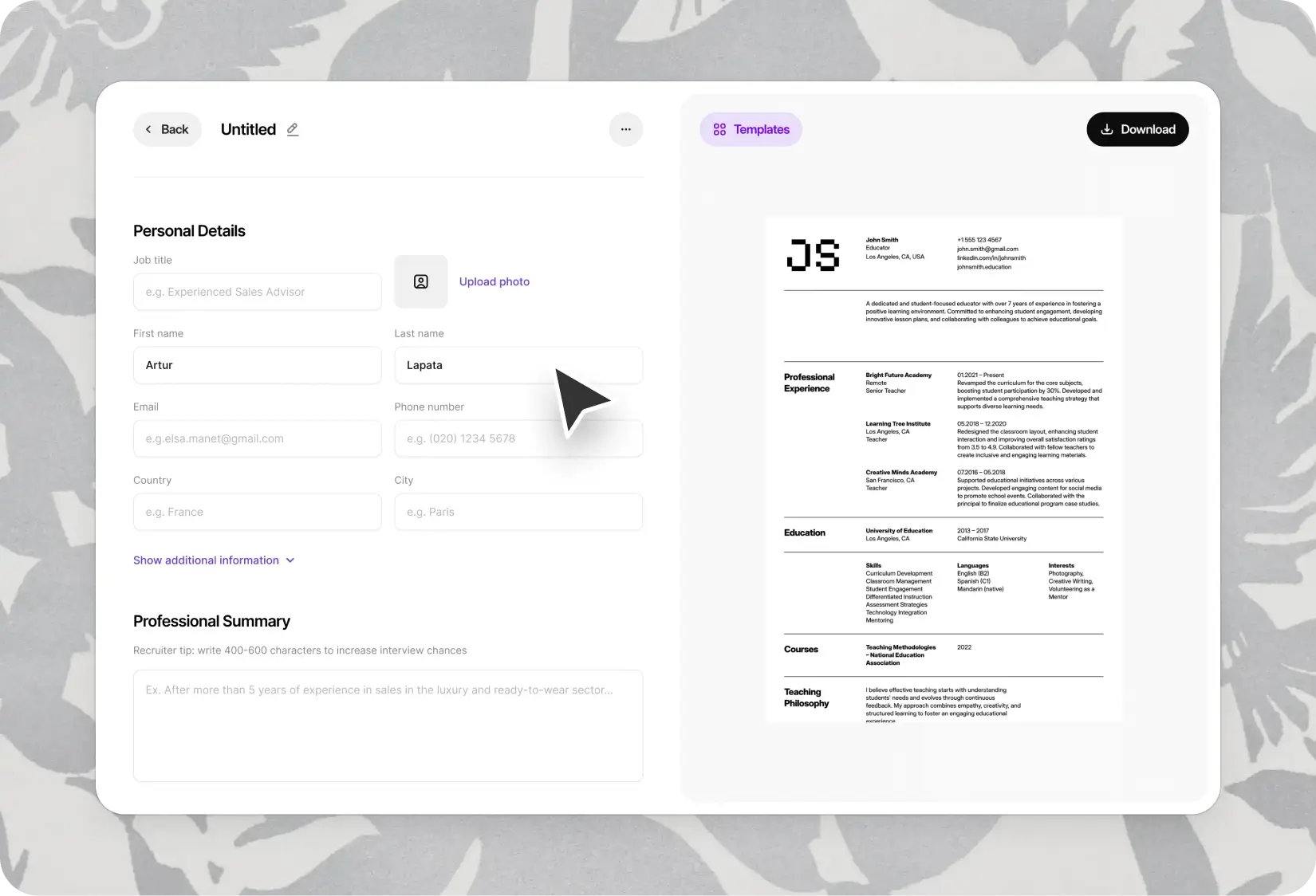
Resume builder interface showing personal details and professional summary fields, with a sample resume preview.

© 2026 Wensa. All right reserved.

Inspired by best practices from certified resume experts.

© 2026 Wensa. All right reserved.

Inspired by best practices from certified resume experts.