Operations Manager

Operations Manager Resume Examples: Less Job Description, More Results

8 operations manager resume examples across manufacturing, logistics, tech, retail, and healthcare. See how strong OM resumes prove impact — not just presence.

Updated Mar 26, 2026

Written by Artur Lopato
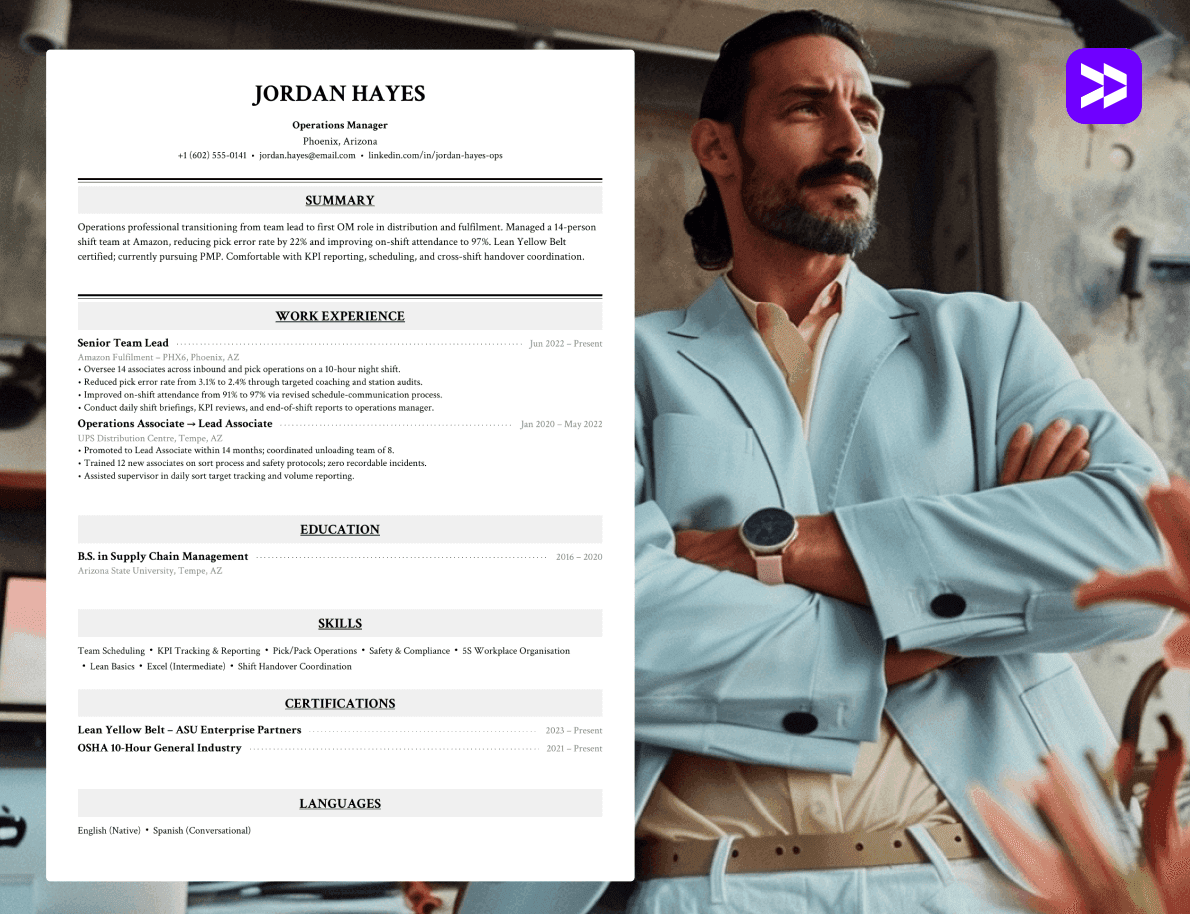
Operations manager resume example on a clean textured background

Operations manager is one of the broadest job titles in any organization — and that breadth is exactly what makes it hard to write a resume for. At a logistics company, the OM owns fleet routing, warehouse throughput, and carrier relationships. At a SaaS startup, the same title means vendor contracts, office infrastructure, and process documentation. At a hospital, it means patient flow, staff scheduling, and regulatory compliance across a 24-hour operation.

Most OM resumes respond to this breadth by listing everything. The result is a resume that proves you've been busy, not that you've been effective. Hiring managers don't need a job description. They need evidence that your presence made the operation measurably better.

The five pillars every operations manager resume gets scored against

Whatever the industry, hiring managers screening OM resumes are unconsciously checking for evidence across five dimensions. Most resumes only cover two or three. The ones that address all five consistently outperform:

  • People: How many did you manage, directly and indirectly? Did you hire, develop, or restructure the team? What were your retention or engagement outcomes? Headcount and team performance data belong in your summary and in every senior role.

  • Process: What did you improve, redesign, or build from scratch? Process improvement is the core of operations — name the methodology (Lean, Six Sigma, Kaizen, DMAIC) and the measurable result: cycle time reduced, error rate dropped, throughput increased.

  • Cost: Did you own a budget? What was its size, and what did you do with it? Cost reduction, budget adherence, and cost-per-unit improvements are the commercial language of operations. If you managed P&L or controlled significant OpEx, that belongs in your header or summary — not buried in a bullet.

  • Quality: What were your quality outcomes? Defect rates, customer satisfaction scores, compliance audit results, SLA adherence, Net Promoter Score — the specific metric depends on your industry, but the question is always the same: did quality improve on your watch?

  • Delivery: Did things arrive on time, within scope, and within budget — whether that's shipments, software releases, patient appointments, or project milestones? On-time delivery rates, SLA performance, and schedule adherence are the operational scorecards that tell the story most clearly.

The 8 examples in Wensa's operations manager collection are each built around all five pillars — weighted differently by industry, but present throughout. Browse them alongside a operations manager resume template already formatted for leadership-level roles, and read our resume writing guide before you tailor yours.

P&L ownership: the credential most OM resumes bury

Budget accountability is one of the most significant differentiators between OM candidates — and one of the most consistently undersold. An operations manager who has owned a $5M annual operating budget is a fundamentally different hire from one who executed within someone else's budget. If you've had P&L or budget accountability, state the size explicitly and early: "Managed $8.2M annual operating budget across 3 facilities" in your summary tells a hiring manager your commercial scope before they read a single bullet.

If your budget authority has been indirect — you influenced spend without formal P&L ownership — frame it in terms of cost impact: "Identified and implemented $1.4M in annual cost reductions across the supply chain" is a credible budget-adjacent signal that works even without formal ownership.

Operations Manager Resume Examples by Industry and Level
Entry-Level Operations Manager Resume

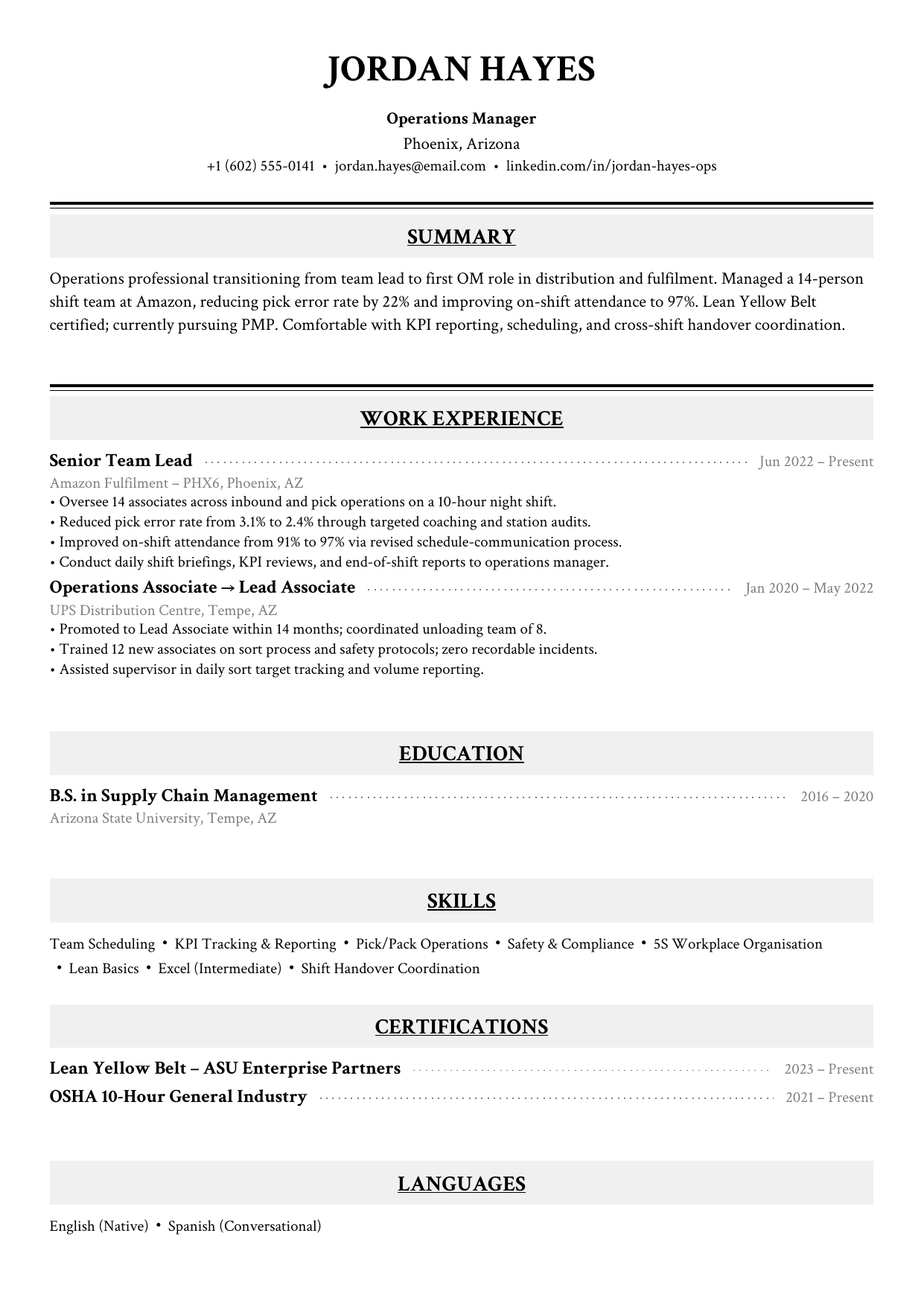
Built for candidates stepping into their first OM role from a team lead, supervisor, or coordinator background. Instead of hiding limited management scope, this resume maximizes what's there: team size managed, any process improvement with a result attached, cost or efficiency outcome from an initiative, and a summary that names the target industry and one transferable win. Lean Yellow Belt enrollment or PMP pursuit appears prominently if in progress.

Mid-Level Operations Manager Resume

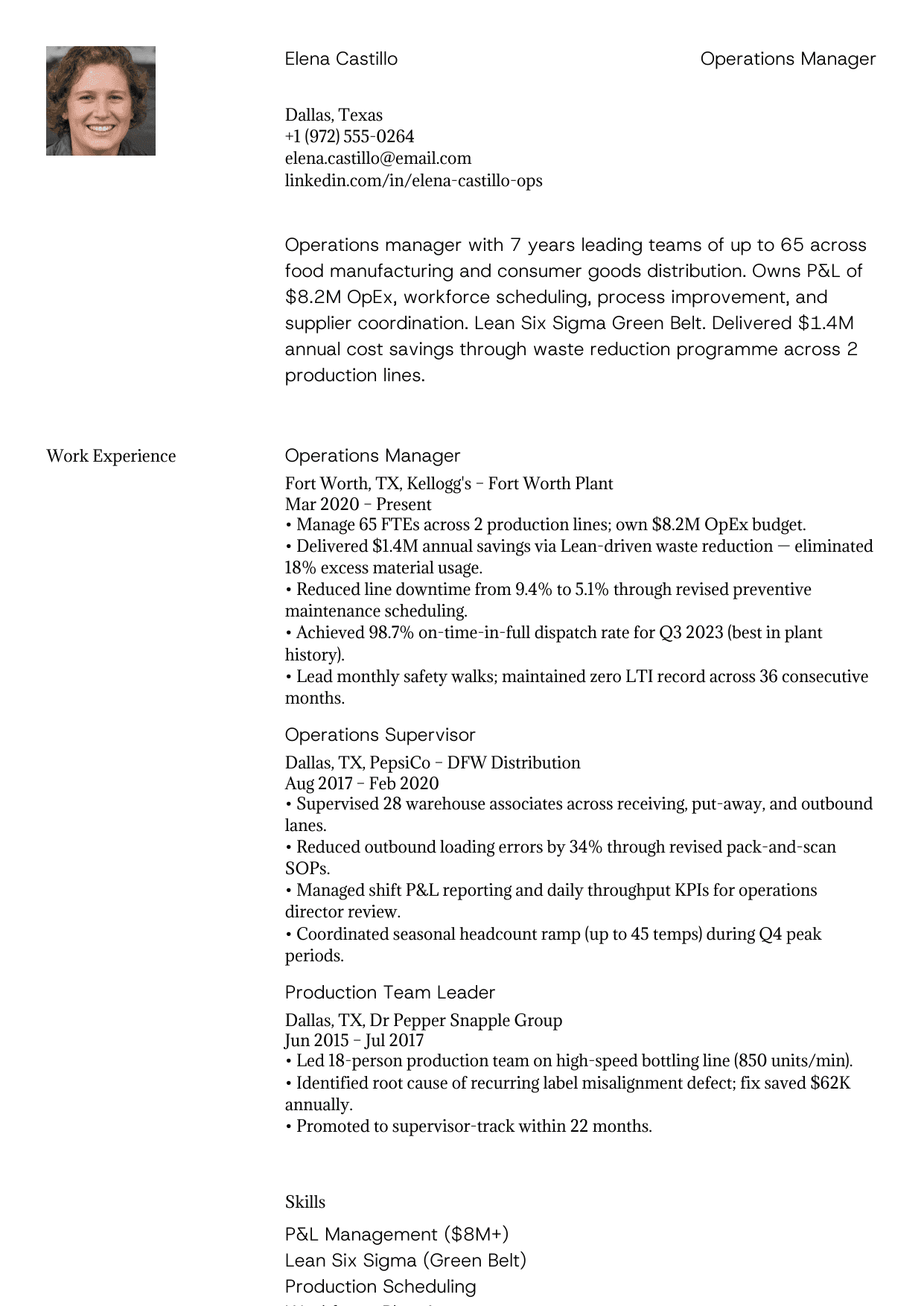
A strong mid-career example for OMs with 5-9 years managing teams, budgets, and process improvement programmes. The two-page resume opens with a summary that covers all five operational pillars in four lines: team size, budget scope, process methodology, and a headline efficiency or cost result. Experience bullets follow outcome-first structure — result, then method, then scope — making it fast to scan across multiple roles without losing the impact.

  • Shows P&L or OpEx budget ownership with explicit dollar figure

  • Names Lean, Six Sigma, or APICS credential alongside a project outcome it produced

  • Demonstrates cross-functional influence: procurement, HR, logistics, and IT partnerships that drove operational results

Senior Operations Manager Resume

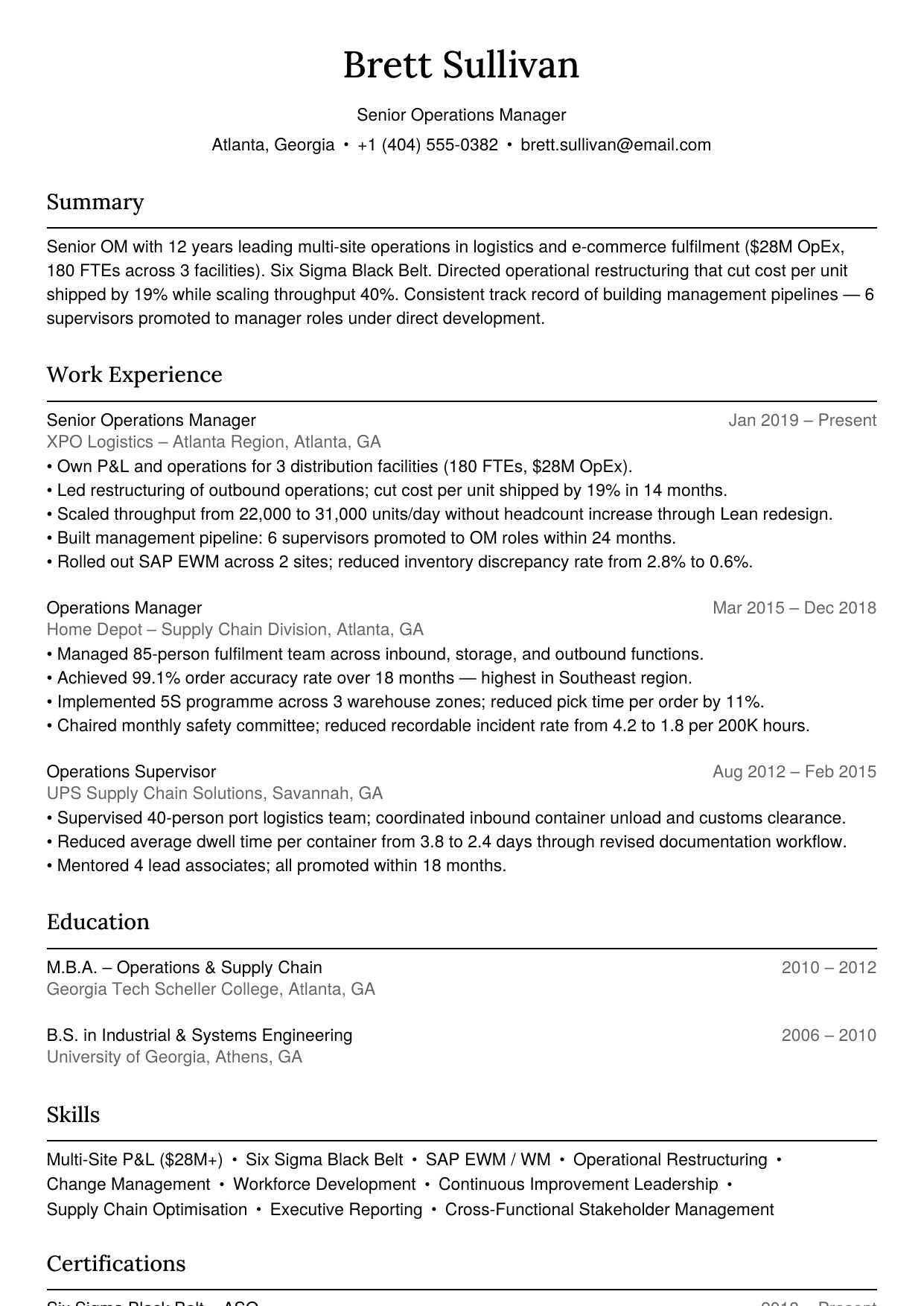
For OMs with 10+ years managing large teams, multi-site operations, and significant budget responsibility — and who are targeting director-track or regional leadership roles. The resume shifts its center of gravity from process execution to strategic operational leadership: restructuring a function, building a team from scratch, designing a new operational model, or leading a turnaround. People development outcomes — management pipeline created, succession plan executed, leadership team built — appear alongside process and cost results.

Six Sigma Black Belt or APICS CSCP appears in the header where held. The skills section at this level drops entry-level tool references and leads with leadership competencies: multi-site P&L management, change management, operational strategy, continuous improvement programme leadership, and executive stakeholder communication.

Director of Operations Resume

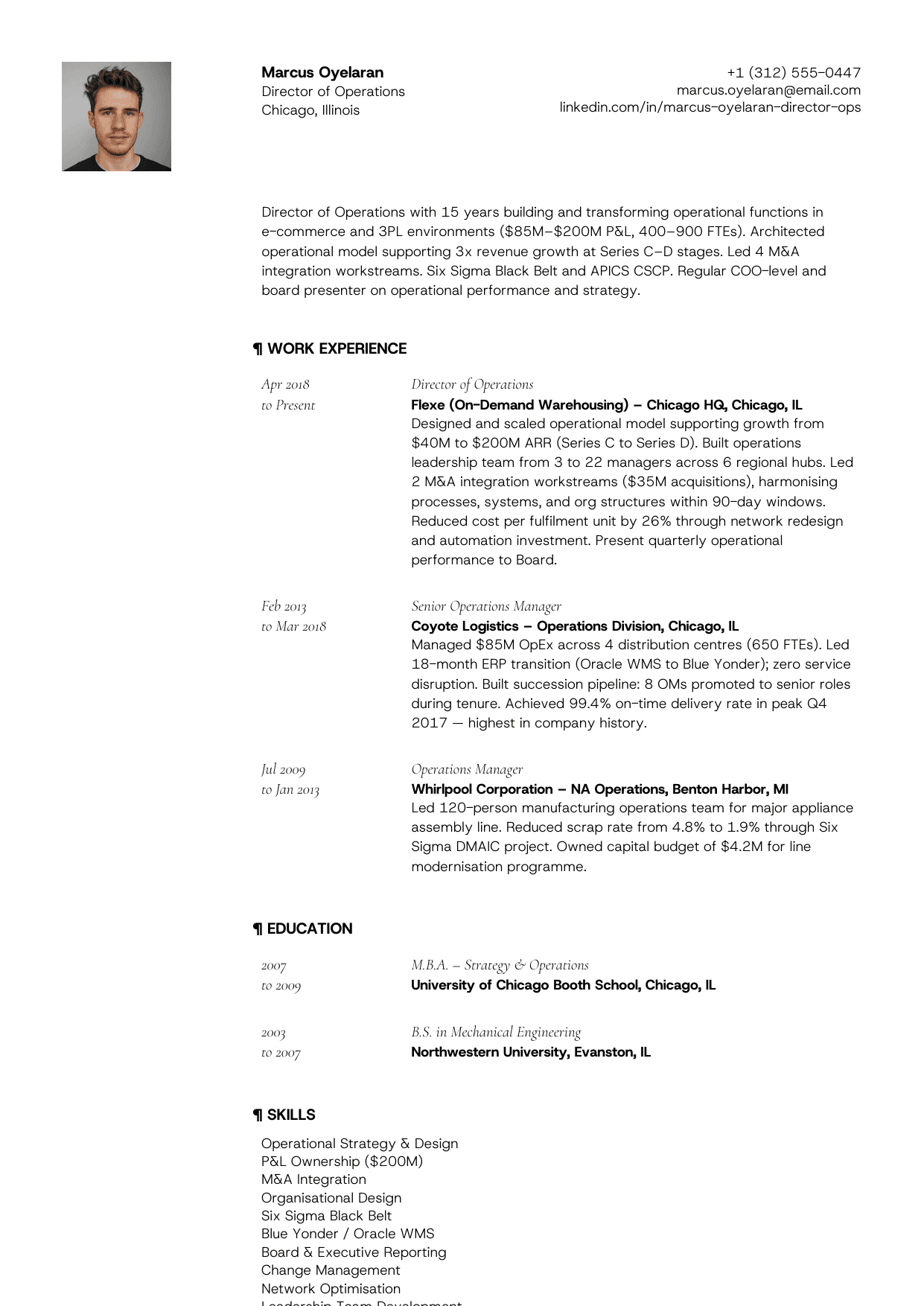
The transition from operations manager to director requires a resume that proves one thing above all else: you can build and lead an operational function, not just run one you were handed. This example leads with organizational scope — total P&L managed, management layers reporting in, strategic initiatives led — and positions every experience bullet around the decisions made and the organizational outcomes produced.

At director level, the resume answers one question before all others: did the operation perform better because you designed it, or just because you were diligent inside it?

The skills section at director level leads with strategic leadership competencies — operational strategy, organizational design, board reporting, M&A integration, transformation programme leadership — before operational methodology credentials. The separation between "things I executed" and "things I architected" should be visible throughout.

Manufacturing Operations Manager Resume

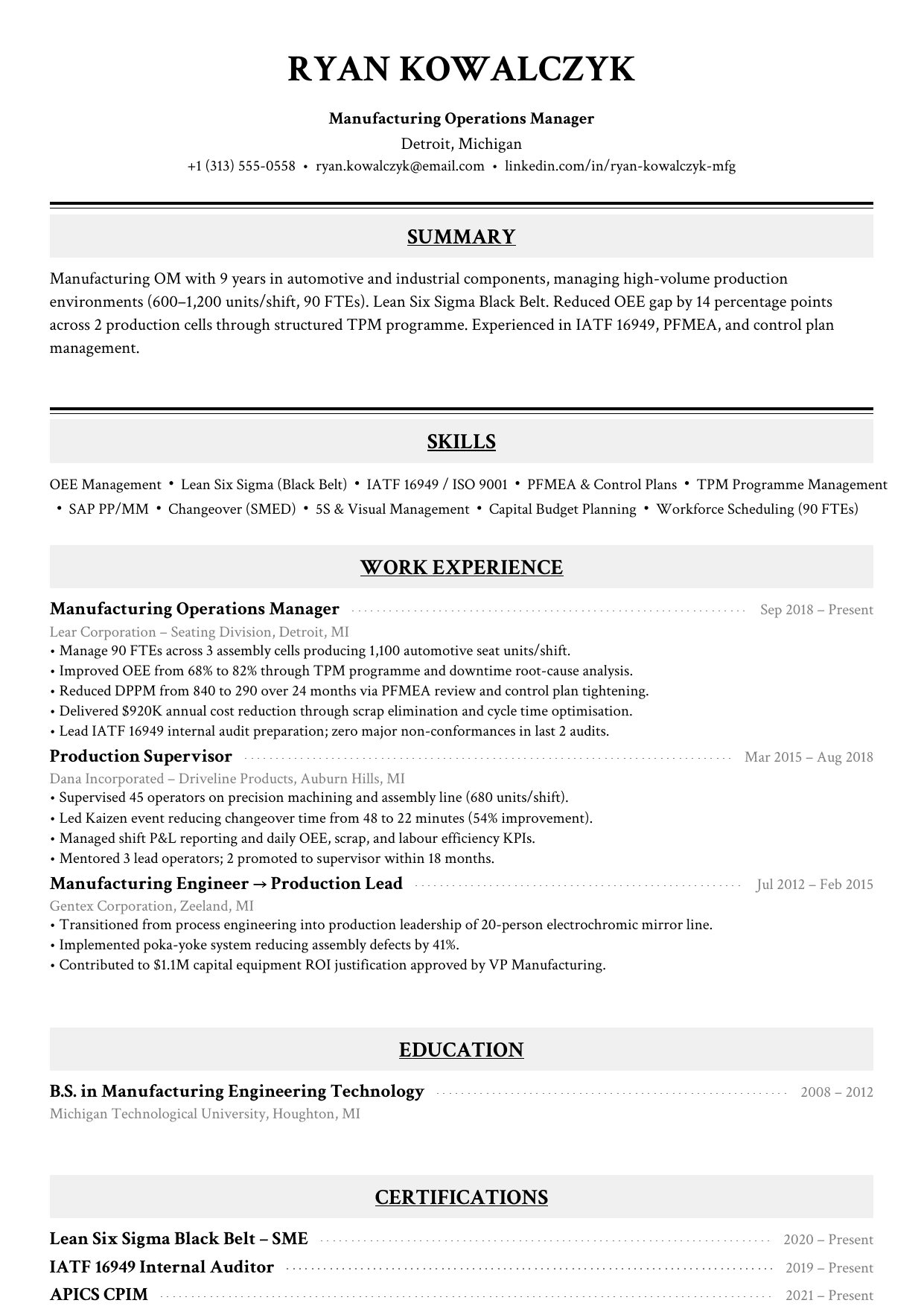
Manufacturing operations resumes are won and lost on plant-floor metrics. This example leads with OEE, throughput, and scrap rate improvements — the numbers that manufacturing hiring managers read first — before team size and budget scope. Lean manufacturing methodology and ISO certification status appear in the header. Every process improvement bullet names the baseline, the intervention, and the result, following the standard manufacturing improvement narrative that plant managers and VPs of Manufacturing recognize immediately.

  • Shows OEE improvement with pre/post percentages and annual production value impact

  • Names specific Lean tools used: 5S, SMED, Kanban, value stream mapping, PDCA — not just "Lean principles"

  • Includes safety outcomes: OSHA recordable rate, near-miss reduction, audit results — hard requirements in most manufacturing OM roles

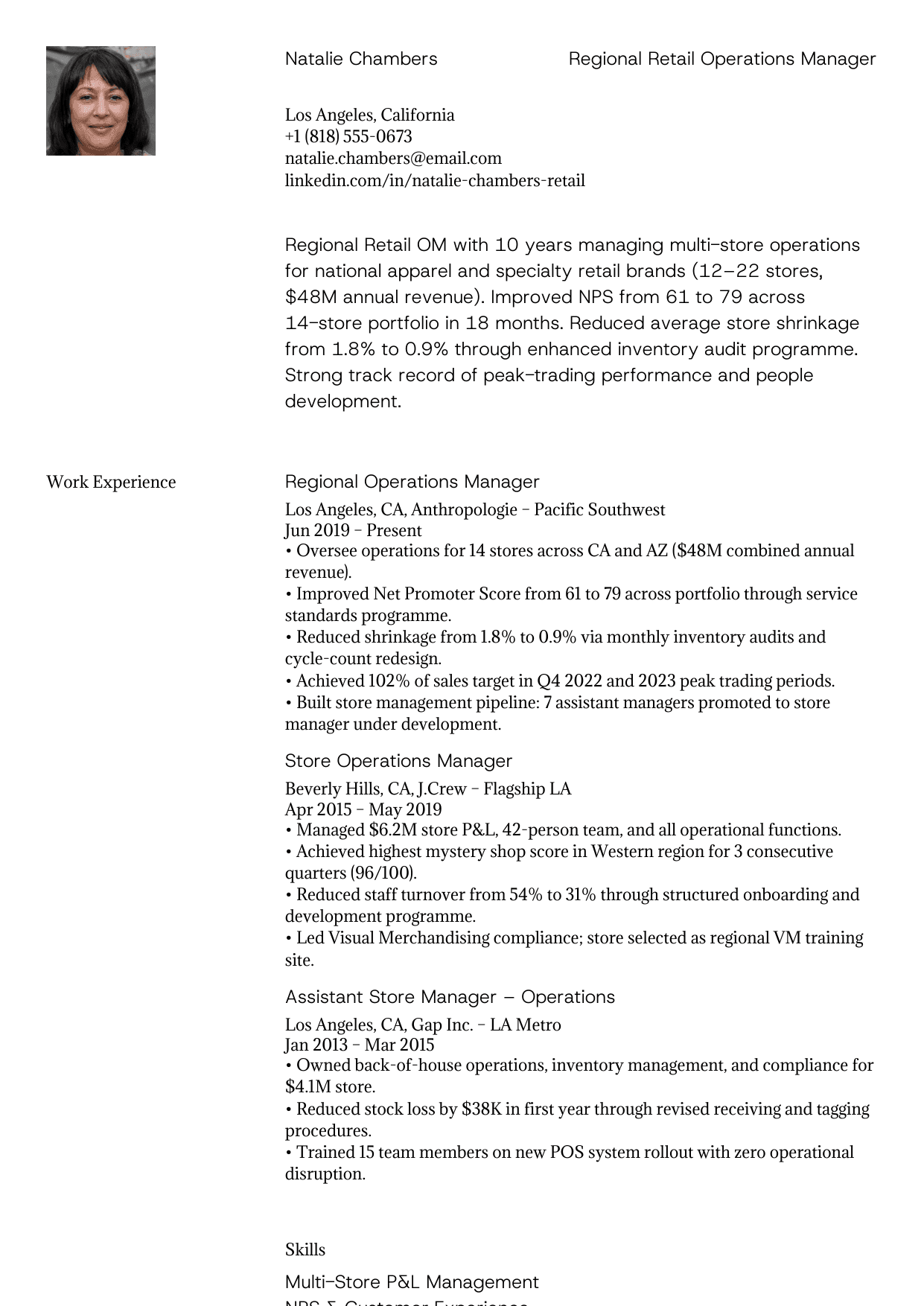
Retail Operations Manager Resume

Retail operations is a uniquely multi-dimensional OM specialization — combining people management at scale, store-level P&L, compliance audits, customer experience metrics, and supply chain coordination all within the same role. This resume addresses that breadth by organizing the experience section around the five pillars explicitly: people outcomes (turnover rate, NPS scores from staff surveys), process outcomes (audit scores, shrink reduction), cost outcomes (labor cost % of revenue, shrinkage), quality outcomes (mystery shop scores, compliance ratings), and delivery outcomes (in-stock rate, planogram compliance).

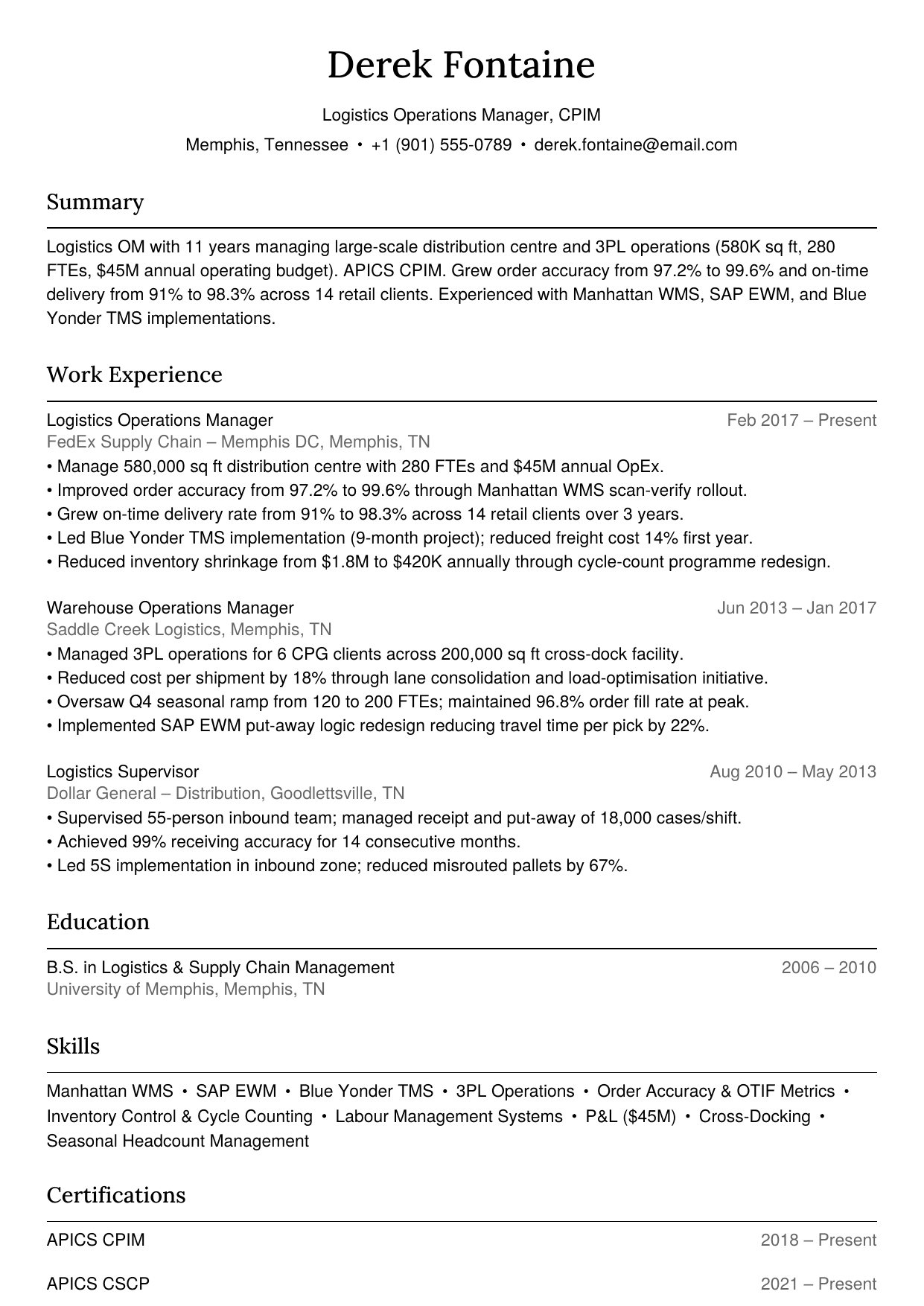
Logistics Operations Manager Resume

Logistics OM resumes are the most metric-dense in the operations category — and this example uses that to its advantage. Order accuracy, on-time delivery rate, cost per shipment, inventory turns, and warehouse throughput all appear as specific figures alongside the interventions that moved them. APICS CPIM or CSCP certification occupies a prominent position for supply chain-heavy roles. WMS platform experience (Manhattan, SAP EWM, Blue Yonder, HighJump) is named explicitly in both the skills section and within the relevant experience bullets.

The summary at logistics OM level leads with the scale of the operation: "Managed 600,000 sq ft distribution centre with 280 FTEs and $45M annual operating budget, serving 14 retail clients across the Midwest" — because warehouse and 3PL hiring managers evaluate scope before they evaluate achievement.

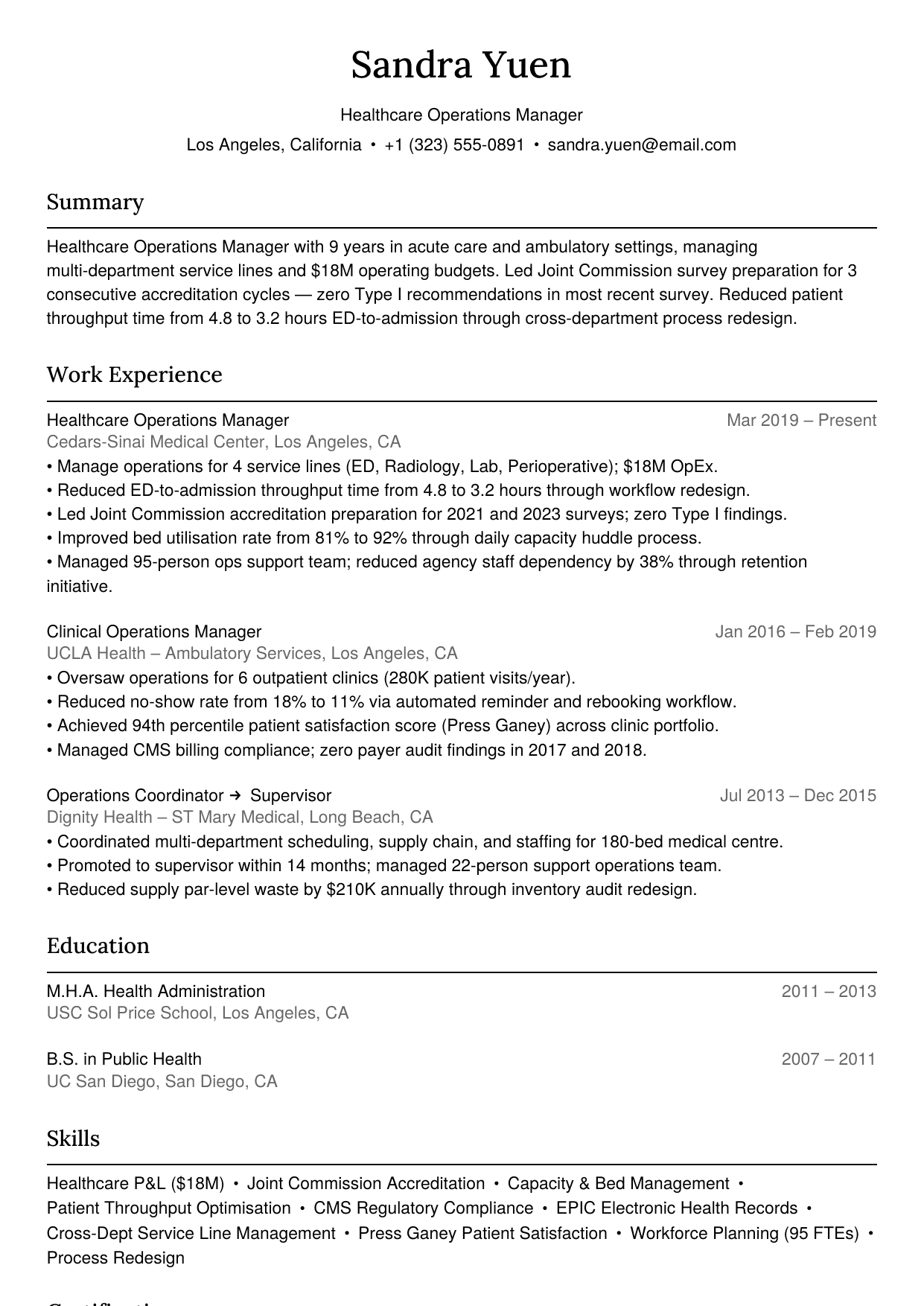
Healthcare Operations Manager Resume

Healthcare operations is the most compliance-intensive OM specialization — and the resume needs to reflect that compliance credibility before it demonstrates operational efficiency. This example leads with regulatory environment experience (CMS, Joint Commission, OSHA for healthcare), then moves to operational outcomes: patient throughput, bed utilization, cost per patient day, staff-to-patient ratios. The balance between clinical quality and operational efficiency is what healthcare hiring committees screen for — neither alone is sufficient.

Entry-Level Operations Manager Resume

Built for candidates stepping into their first OM role from a team lead, supervisor, or coordinator background. Instead of hiding limited management scope, this resume maximizes what's there: team size managed, any process improvement with a result attached, cost or efficiency outcome from an initiative, and a summary that names the target industry and one transferable win. Lean Yellow Belt enrollment or PMP pursuit appears prominently if in progress.

Mid-Level Operations Manager Resume

A strong mid-career example for OMs with 5-9 years managing teams, budgets, and process improvement programmes. The two-page resume opens with a summary that covers all five operational pillars in four lines: team size, budget scope, process methodology, and a headline efficiency or cost result. Experience bullets follow outcome-first structure — result, then method, then scope — making it fast to scan across multiple roles without losing the impact.

  • Shows P&L or OpEx budget ownership with explicit dollar figure

  • Names Lean, Six Sigma, or APICS credential alongside a project outcome it produced

  • Demonstrates cross-functional influence: procurement, HR, logistics, and IT partnerships that drove operational results

Senior Operations Manager Resume

For OMs with 10+ years managing large teams, multi-site operations, and significant budget responsibility — and who are targeting director-track or regional leadership roles. The resume shifts its center of gravity from process execution to strategic operational leadership: restructuring a function, building a team from scratch, designing a new operational model, or leading a turnaround. People development outcomes — management pipeline created, succession plan executed, leadership team built — appear alongside process and cost results.

Six Sigma Black Belt or APICS CSCP appears in the header where held. The skills section at this level drops entry-level tool references and leads with leadership competencies: multi-site P&L management, change management, operational strategy, continuous improvement programme leadership, and executive stakeholder communication.

Director of Operations Resume

The transition from operations manager to director requires a resume that proves one thing above all else: you can build and lead an operational function, not just run one you were handed. This example leads with organizational scope — total P&L managed, management layers reporting in, strategic initiatives led — and positions every experience bullet around the decisions made and the organizational outcomes produced.

At director level, the resume answers one question before all others: did the operation perform better because you designed it, or just because you were diligent inside it?

The skills section at director level leads with strategic leadership competencies — operational strategy, organizational design, board reporting, M&A integration, transformation programme leadership — before operational methodology credentials. The separation between "things I executed" and "things I architected" should be visible throughout.

Manufacturing Operations Manager Resume

Manufacturing operations resumes are won and lost on plant-floor metrics. This example leads with OEE, throughput, and scrap rate improvements — the numbers that manufacturing hiring managers read first — before team size and budget scope. Lean manufacturing methodology and ISO certification status appear in the header. Every process improvement bullet names the baseline, the intervention, and the result, following the standard manufacturing improvement narrative that plant managers and VPs of Manufacturing recognize immediately.

  • Shows OEE improvement with pre/post percentages and annual production value impact

  • Names specific Lean tools used: 5S, SMED, Kanban, value stream mapping, PDCA — not just "Lean principles"

  • Includes safety outcomes: OSHA recordable rate, near-miss reduction, audit results — hard requirements in most manufacturing OM roles

Retail Operations Manager Resume

Retail operations is a uniquely multi-dimensional OM specialization — combining people management at scale, store-level P&L, compliance audits, customer experience metrics, and supply chain coordination all within the same role. This resume addresses that breadth by organizing the experience section around the five pillars explicitly: people outcomes (turnover rate, NPS scores from staff surveys), process outcomes (audit scores, shrink reduction), cost outcomes (labor cost % of revenue, shrinkage), quality outcomes (mystery shop scores, compliance ratings), and delivery outcomes (in-stock rate, planogram compliance).

Logistics Operations Manager Resume

Logistics OM resumes are the most metric-dense in the operations category — and this example uses that to its advantage. Order accuracy, on-time delivery rate, cost per shipment, inventory turns, and warehouse throughput all appear as specific figures alongside the interventions that moved them. APICS CPIM or CSCP certification occupies a prominent position for supply chain-heavy roles. WMS platform experience (Manhattan, SAP EWM, Blue Yonder, HighJump) is named explicitly in both the skills section and within the relevant experience bullets.

The summary at logistics OM level leads with the scale of the operation: "Managed 600,000 sq ft distribution centre with 280 FTEs and $45M annual operating budget, serving 14 retail clients across the Midwest" — because warehouse and 3PL hiring managers evaluate scope before they evaluate achievement.

Healthcare Operations Manager Resume

Healthcare operations is the most compliance-intensive OM specialization — and the resume needs to reflect that compliance credibility before it demonstrates operational efficiency. This example leads with regulatory environment experience (CMS, Joint Commission, OSHA for healthcare), then moves to operational outcomes: patient throughput, bed utilization, cost per patient day, staff-to-patient ratios. The balance between clinical quality and operational efficiency is what healthcare hiring committees screen for — neither alone is sufficient.

What Operational Impact Actually Looks Like on a Resume

Operational metrics vary significantly by industry — which means the "use numbers" advice only helps once you know which numbers to use. Here's what strong quantification looks like across the industries where OM roles are most common:

Industry

Strong Metrics to Include

Manufacturing

OEE (Overall Equipment Effectiveness), scrap rate, throughput per shift, cycle time, defect rate (PPM), plant uptime, ISO/AS9100 audit outcomes

Logistics / Supply Chain

On-time delivery rate, order accuracy, cost per shipment, inventory turns, shrinkage rate, carrier SLA compliance

Tech / SaaS

Vendor contract savings, tool consolidation outcomes, process automation hours saved, headcount-to-output ratios, office/facilities cost per seat

Retail

Shrink percentage, store-level NPS, labor cost as % of revenue, compliance audit scores, multi-site consistency metrics, in-stock rate

Healthcare

Patient throughput, bed utilization, staff-to-patient ratios, regulatory compliance outcomes (CMS, Joint Commission), cost per patient day

General / Multi-industry

Budget adherence (% variance), headcount managed, cost reduction delivered ($), process improvement outcomes (% efficiency gain), team retention rate

One metric category that cross-cuts every industry and consistently impresses: speed of improvement after joining. "Reduced warehouse error rate from 4.2% to 0.8% within 6 months" is more compelling than the same improvement spread across three years — because it shows diagnostic speed and execution velocity, not just eventual success. If your best results came quickly, make the timeline part of the achievement.

Lean, Six Sigma, PMP: Which Operations Credentials Actually Move the Needle

Certifications in operations carry real weight — but not all of them, and not in all contexts. Here's how hiring managers actually read these credentials in 2026:

Credential

Best Context

What It Signals

Lean / Lean Manufacturing

Manufacturing, logistics, healthcare, any high-volume process environment

Waste reduction methodology, flow optimization, visual management, Kaizen culture — the most universally valued operations credential

Six Sigma Green Belt

Quality-critical roles: manufacturing, pharma, financial services

Statistical process control, DMAIC project experience — valued in regulated industries and process-heavy manufacturing

Six Sigma Black Belt

Senior OM, Director of Operations, continuous improvement leadership

End-to-end CI programme leadership, project financial impact typically $500K+, strong differentiator for senior roles

PMP (PMI)

Project-heavy OM roles: tech, construction, programme delivery

Structured project methodology, schedule and budget discipline — crosses well into general management tracks

APICS CPIM / CSCP

Supply chain, inventory management, manufacturing planning

Supply chain and operations planning depth — highly valued at logistics companies, 3PLs, and manufacturing firms

ISO 9001 Lead Auditor

Quality management, regulated industries, multi-site operations

Quality system ownership, audit readiness — niche but highly weighted where ISO certification is a customer requirement

A Lean certification without a project outcome attached to it on your resume is just a line item. A Lean certification followed by "reduced changeover time 42%, saving $380K annually" is a business case.

Certifications belong in a dedicated section near the top — not the bottom — and each one should ideally have a corresponding achievement in your experience section that demonstrates it in action. Browse the full operations manager resume examples to see how credentials are presented alongside outcomes across different industries.

How to Write an Operations Manager Resume Summary That Doesn't Sound Generic

Operations manager summaries are the most formula-prone section on any management resume. "Results-driven operations professional with 10+ years of experience in process optimization and team leadership" describes approximately 40% of all OM candidates. It gets skipped.

A summary that works does three specific things in four lines or fewer:

  • Names your industry and scope. "Manufacturing operations" means something different from "SaaS business operations" — and your summary should make it clear immediately. Include the industry, the size of the operation you've managed (revenue, headcount, or facility count), and your career level.

  • Leads with your single best result. One strong number in the first sentence — cost saved, efficiency improved, team scaled, or quality outcome — does more work than four sentences of adjectives. Make it the first thing after your title, not the last thing after the preamble.

  • Signals your methodology or credential. Lean practitioner, Six Sigma Black Belt, PMP-certified, APICS-credentialed — one credential relevant to the target role positions you in a specific tier of candidate before the hiring manager reaches your experience section.

What not to do: don't write your summary as a wish list for your next role. The summary isn't about what you want — it's about what you offer. Use our professional operations manager templates which already include a pre-structured summary block to make this easier.

Operations Manager Resume FAQs

How long should an operations manager resume be?

Two pages for most experienced operations managers. The role carries enough substantive content — budget scope, headcount, process improvements, multi-site experience, certifications — that one page forces you to compress the wrong things or cut outcomes that would differentiate you. The exception is early-career candidates stepping into their first OM role, where one tight page is often more effective. At director level, two pages is standard; three pages is only justified for candidates with extensive multi-site or international programme histories.

Should I tailor my operations manager resume for every industry I apply to?

Yes, and more than most candidates expect. Operations management is one of the most industry-specific roles in any organization — the metrics that matter in a hospital are completely different from those in a warehouse, which differ from those in a SaaS company. Keep a master version and maintain two or three industry-specific variants that weight different achievements and use industry-appropriate vocabulary throughout. A resume using manufacturing terminology (OEE, downtime, throughput) when applying to a tech company signals misalignment before the hiring manager reads a single bullet.

What's the difference between an operations manager resume and a director of operations resume?

At manager level, the resume emphasizes execution excellence — how well you ran the operation you were given. At director level, it shifts to strategic ownership — how you designed, restructured, or scaled the operation itself. Director-level resumes lead with organizational scope (total P&L managed, number of managers who report to you, strategic initiatives led) rather than hands-on process improvements. If you're making this transition, your resume needs to reframe your management experience as strategic leadership — not just show more of the same work at a larger scale.

How do I show leadership on an operations resume without just listing team sizes?

Team size is a scope signal, not a leadership signal. Pair every headcount number with a performance or development outcome: "Led team of 34 across 2 shifts; reduced turnover from 42% to 18% in 12 months through structured onboarding and weekly 1:1 coaching" proves leadership. "Managed team of 34" proves you had a team. Other strong signals: promotion rates among direct reports, training programs built, and any organizational restructuring you designed and implemented.
Recruiter Approved

Build a Resume That Works. Literally.

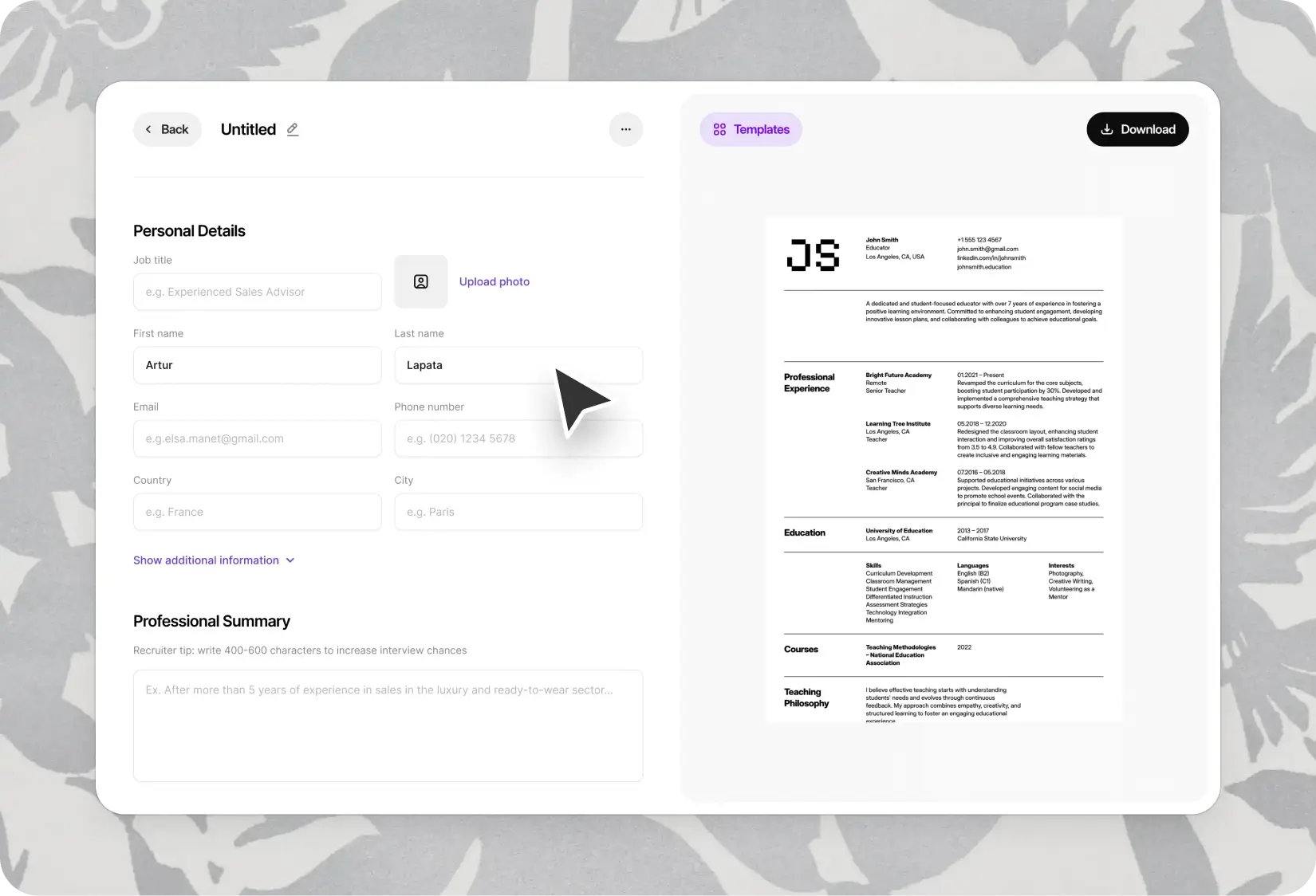
Resume builder interface showing personal details and professional summary fields, with a sample resume preview.

© 2026 Wensa. All right reserved.

Inspired by best practices from certified resume experts.

© 2026 Wensa. All right reserved.

Inspired by best practices from certified resume experts.