Teacher Resume Examples That Get You Hired in 2026

Real teacher resume examples for elementary, high school, special education, ESL, and STEM roles — at every career level. See how educators turn classroom impact into resumes that land interviews.

Updated Mar 16, 2026

Written by Artur Lopato

Teacher resume example on a clean textured background

Teaching resumes sit in a category of their own. Unlike sales or marketing roles, you don't have quarterly revenue numbers to lead with. But that doesn't mean your impact is unquantifiable — it just means you have to know where to look for the numbers that principals and hiring committees actually care about.

Standardized test growth, class sizes managed, IEP caseloads, student reading level gains, attendance rates improved, students advanced to honors tracks — these are the metrics that translate teaching excellence into resume language. The educators who get called for interviews are the ones who've learned to write their experience this way. Those who default to task lists — "prepared lesson plans," "taught reading" — blend into the background regardless of how strong their actual practice is.

The hiring window most teachers underestimate

Teaching has a seasonal job market unlike almost any other profession. The bulk of K-12 hiring in the US happens between March and July, with a secondary wave in August when last-minute vacancies open before the school year. Submitting a resume in September for a position that's been posted since April puts you at a structural disadvantage — not because you're less qualified, but because the pipeline has already moved forward.

This means your resume needs to be ready — and genuinely strong — well before summer. The best time to update your teaching resume is January through March: early enough to catch the main hiring wave, late enough that you have the full current school year's results to include. A reading specialist who waits until June to refresh their resume misses the window where most districts are actively scheduling interviews.

What principals look for first

Principals and department heads screening teacher resumes are looking for a handful of signals: appropriate state certification, relevant grade band and subject experience, and evidence of student outcomes. These three things account for most of the initial screening decision. Everything else — activities, memberships, professional development — fills in the picture afterward.

Your certifications belong near the top of the resume, not buried in an education section at the bottom. If you're certified in multiple states or hold dual endorsements, make that immediately visible. And if your credential is still in progress or pending, say so explicitly — omitting it creates uncertainty that schools resolve by moving on to the next candidate. Start with one of our teacher resume templates built to highlight certification and classroom credentials at a glance, and read our full resume writing guide if you're building from scratch.

Teacher Resume Examples by Role and Grade Level
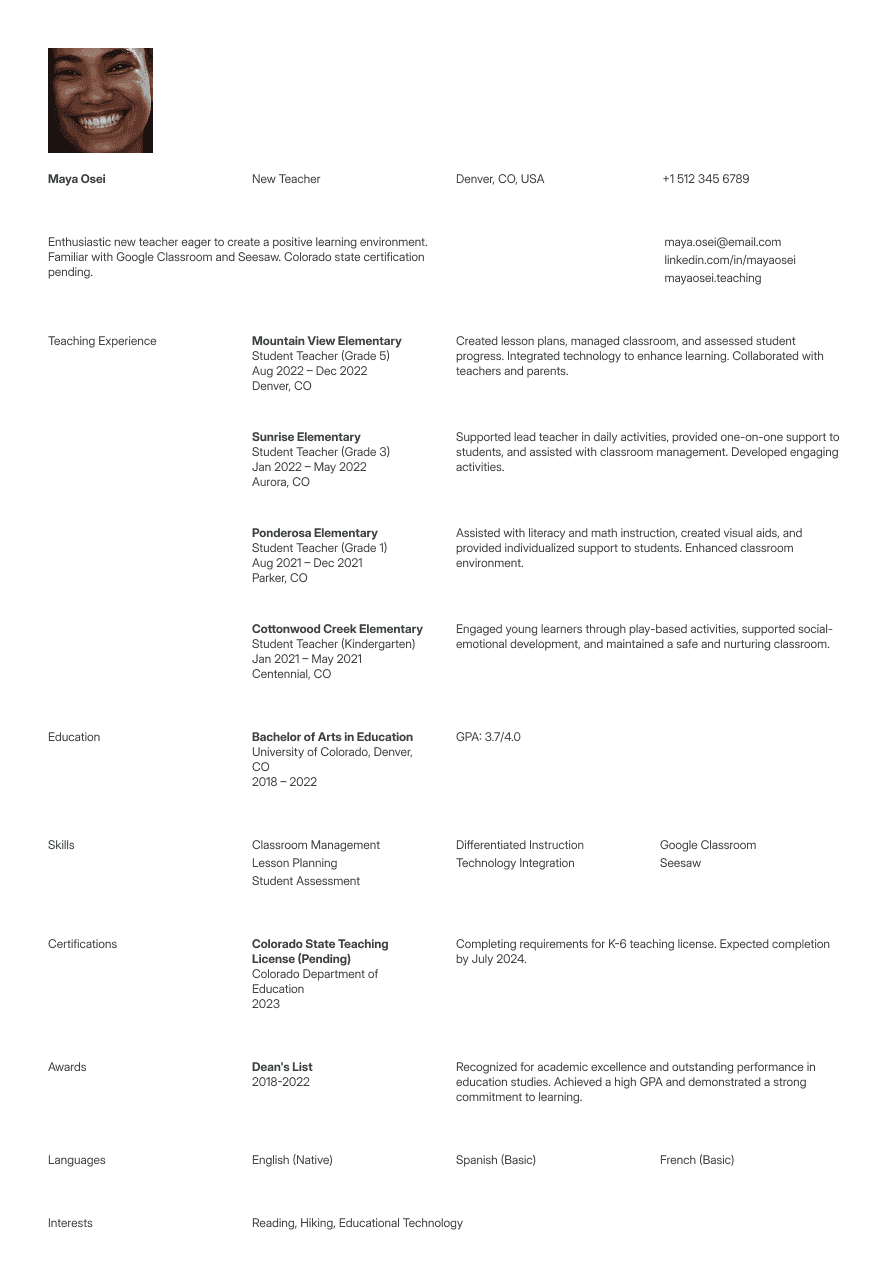
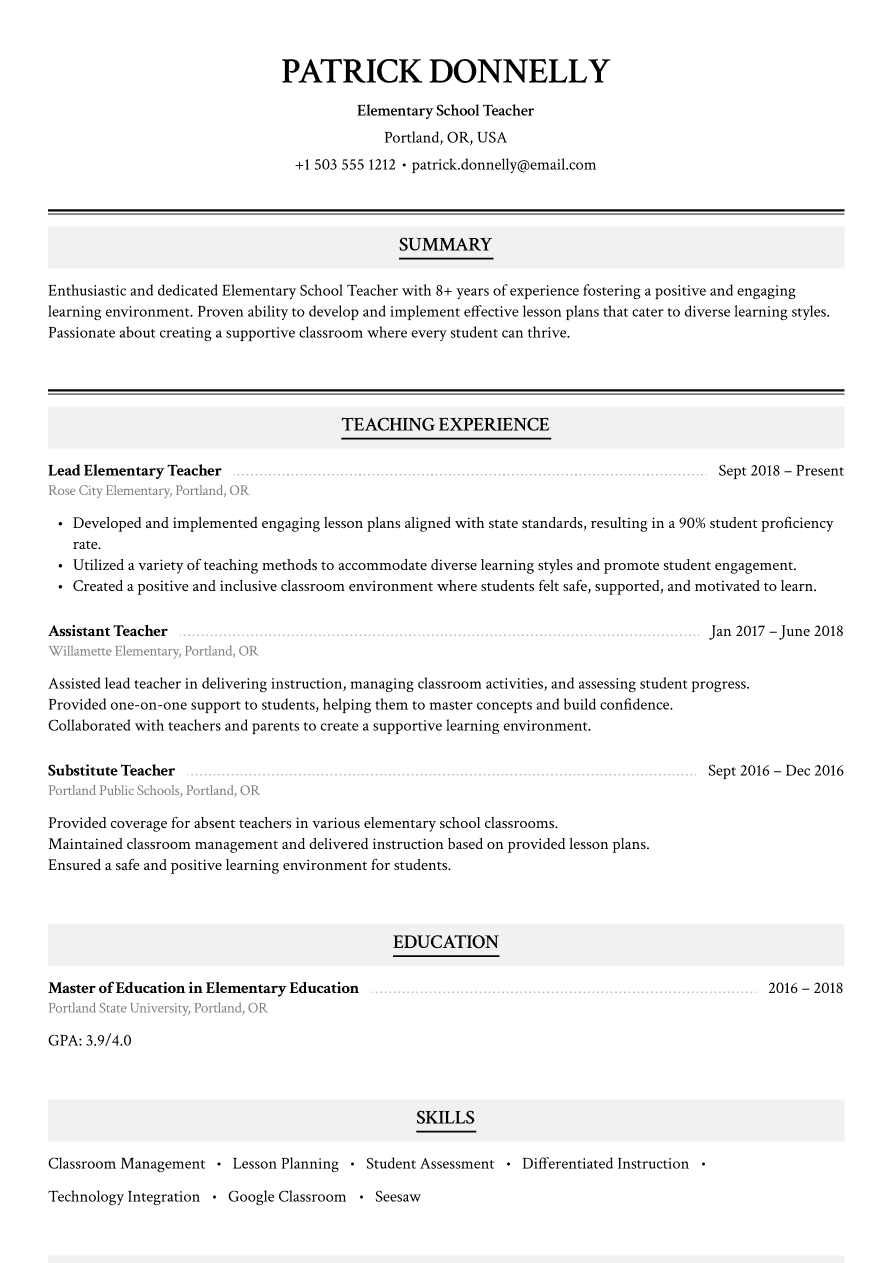
New Teacher Resume

Designed for candidates in their first year or emerging from student teaching. This resume front-loads state certification and degree at the top — the first two things principals check — then builds an experience section from student teaching placements, practicum hours, and tutoring roles. Specific class sizes, grade levels, and curriculum programs replace generic task descriptions throughout.

The skills section uses named instructional tools (Google Classroom, Seesaw, SMART Board) and approaches (differentiated instruction, UDL) to pass ATS filters at districts that route new applicants through automated screening.

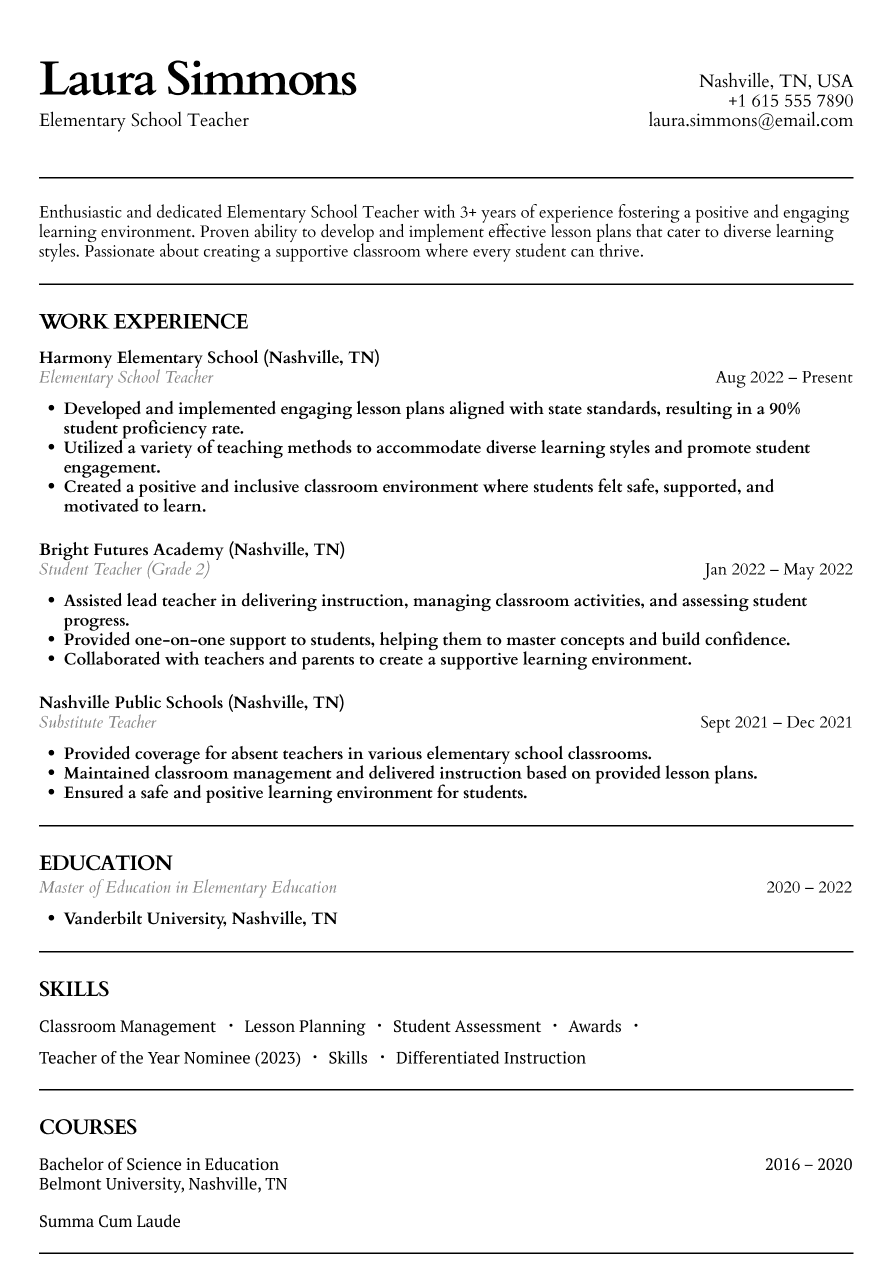
Elementary School Teacher Resume

A focused example for K-5 educators that leads with student outcome data: reading level gains, math proficiency improvements, and standardized assessment growth tied to specific instructional programs. The experience section names the curriculum used (Fountas & Pinnell, Saxon Math, Wonders) alongside the results — giving hiring committees both the method and the evidence it worked.

  • Highlights differentiated instruction for diverse learners including ELL and IEP students

  • Shows parent communication practices and conference participation rates

  • Names technology platforms: Seesaw, IXL, Renaissance Learning, Google Classroom

Mid-Career Teacher Resume

For educators with 6-12 years in the classroom who are ready to move into a stronger school or take on a lead role. This two-page resume shows progression across multiple grade levels and schools, with a summary that anchors on their strongest result from the current or most recent role. Curriculum leadership, mentor teacher responsibilities, and professional development facilitation all appear as evidence of readiness for the next level.

The skills section goes beyond classroom basics to include instructional coaching, curriculum mapping, data team participation, and assessment design — the competencies that separate experienced classroom teachers from those ready for department-level influence.

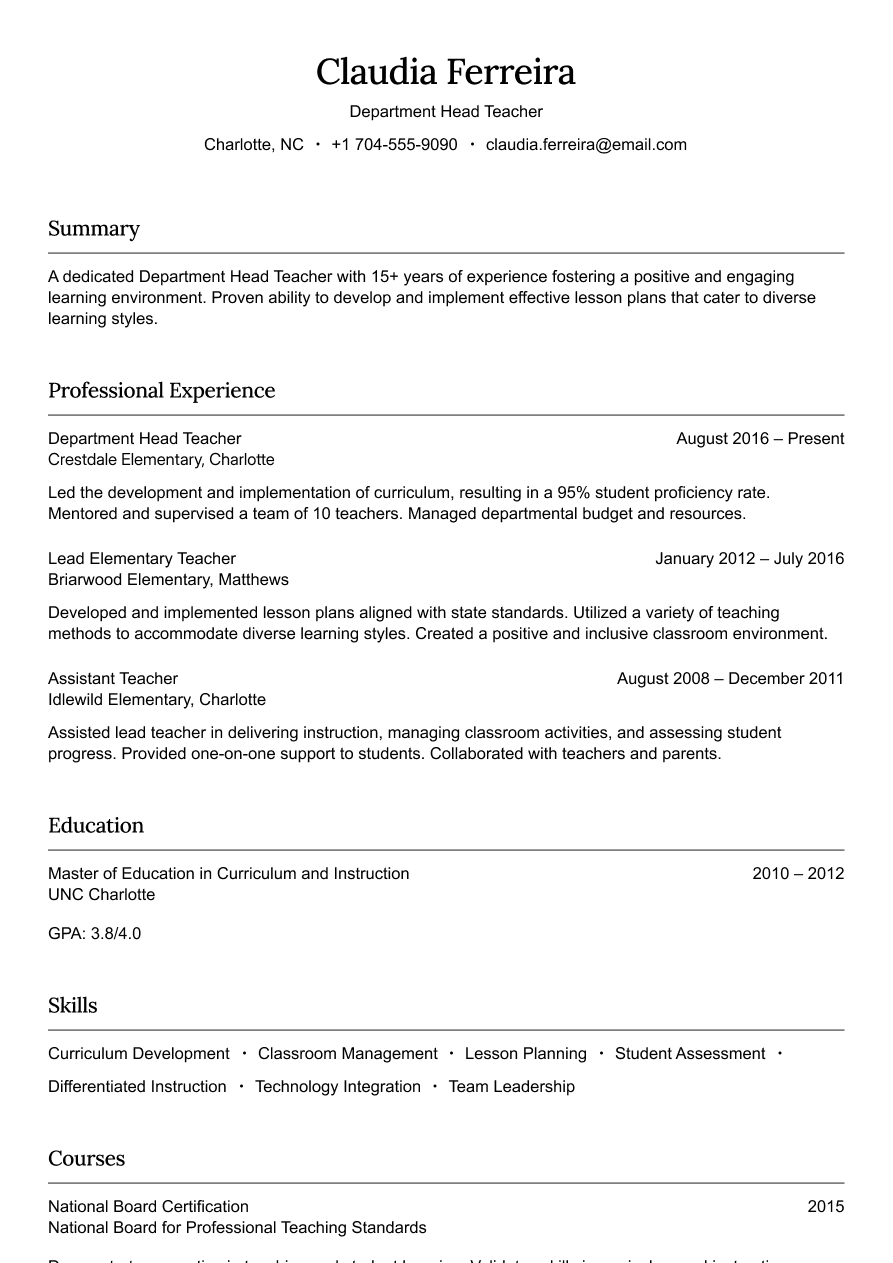
Department Head Teacher Resume

A leadership-transition example for senior classroom teachers stepping into or seeking their first formal department leadership role. The resume bridges individual teaching excellence with early leadership contributions: mentoring colleagues, leading curriculum reviews, chairing department meetings, and managing department budgets. Both the classroom results and the leadership scope appear in the summary, positioning the candidate at the intersection of practice and management.

"The strongest department head candidates show me they can still teach brilliantly and lead a team. Their resumes prove both — with specifics, not adjectives."

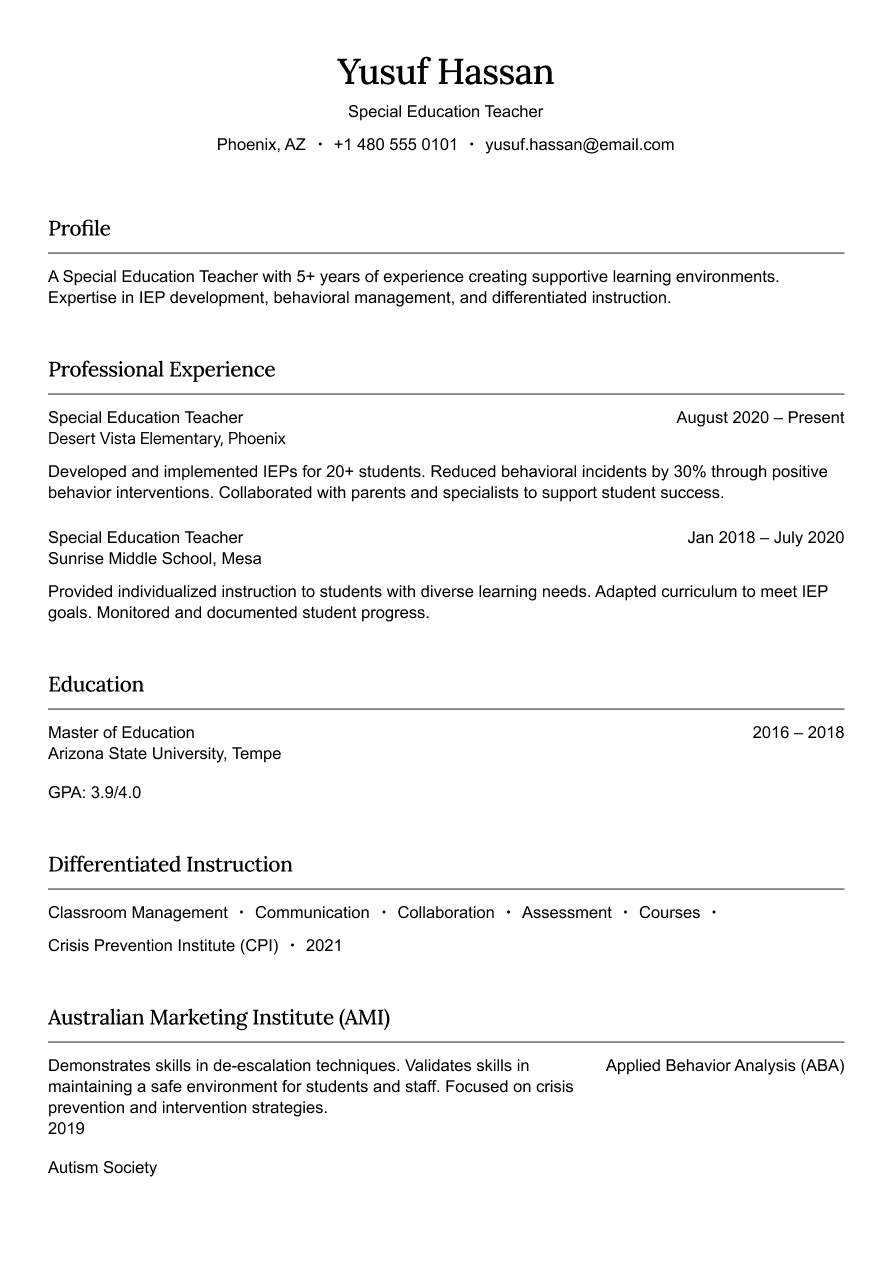
Special Education Teacher Resume

Specialized for educators working with students with disabilities, learning differences, and complex needs. This resume leads with the candidate's endorsements and specialized certifications (Special Education, Autism Spectrum Disorder, Applied Behavior Analysis) and builds an experience section around IEP management, multi-disciplinary collaboration, and measurable student progress on individualized goals.

  • Shows IEP caseload size and student disability categories served

  • Demonstrates collaboration with OT, SLP, school psychologist, and family teams

  • Includes behavioral support experience: PBIS, FBA, BIP implementation

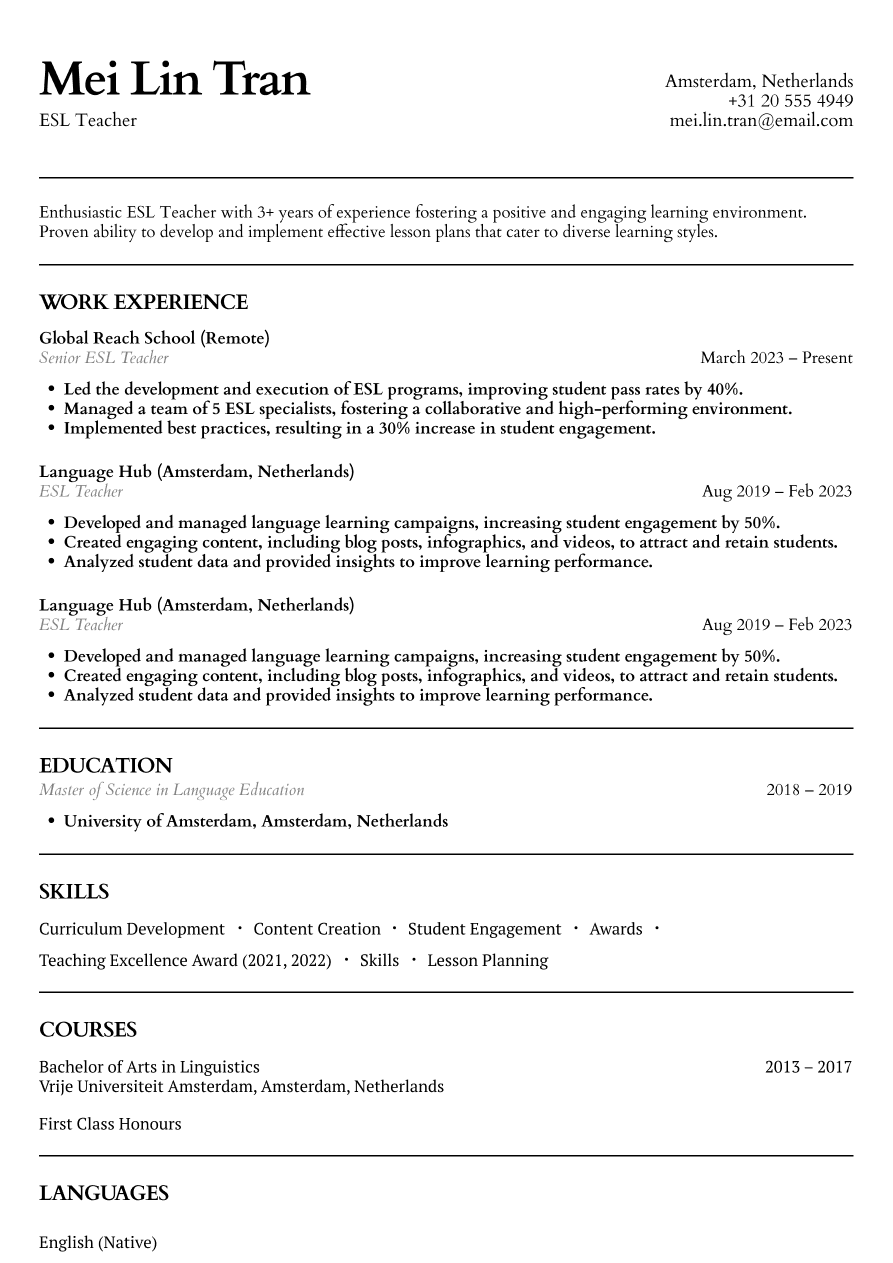
ESL Teacher Resume

Purpose-built for English language educators teaching in US schools or language programs. Leads with ESOL/ESL endorsement status and the language backgrounds of student populations served — a critical signal for districts with high ELL enrollment. Pulls Level 1-5 proficiency progression data, WIDA ACCESS scores, and reclassification rates as outcome metrics that ELL hiring committees recognize immediately.

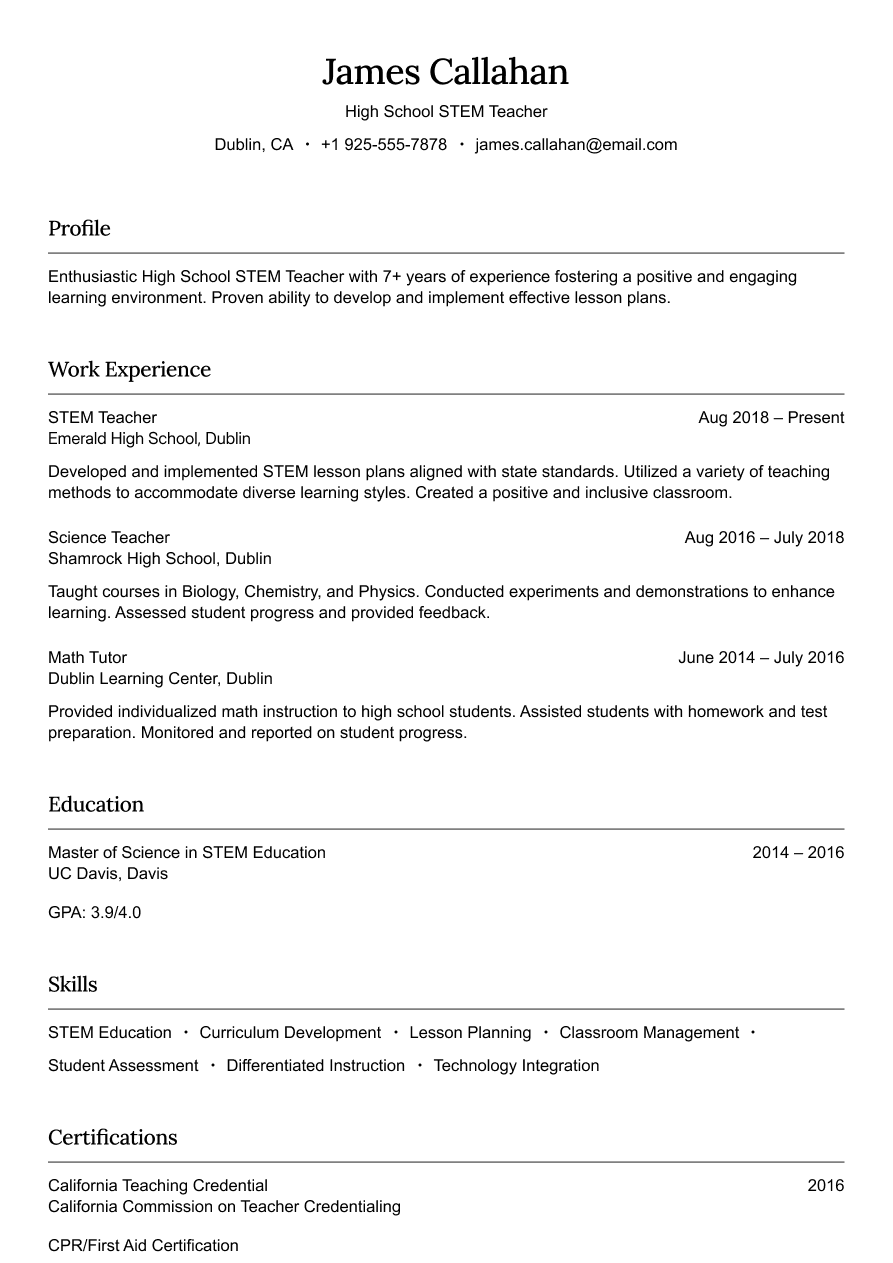
High School STEM Teacher Resume

Designed for secondary educators in mathematics, science, engineering, or technology disciplines where subject expertise and exam outcome data carry the most weight. This resume leads with state certification and subject endorsements, then builds an experience section anchored on AP and honors course outcomes — pass rates, score distributions, year-over-year improvement — alongside classroom size and course variety managed.

The skills section includes both pedagogy (inquiry-based learning, project-based learning, STEM integration) and subject-specific tools (Desmos, Geogebra, lab management platforms, coding environments). For STEM teachers, this dual profile matters — schools want content mastery and instructional range, not one or the other.

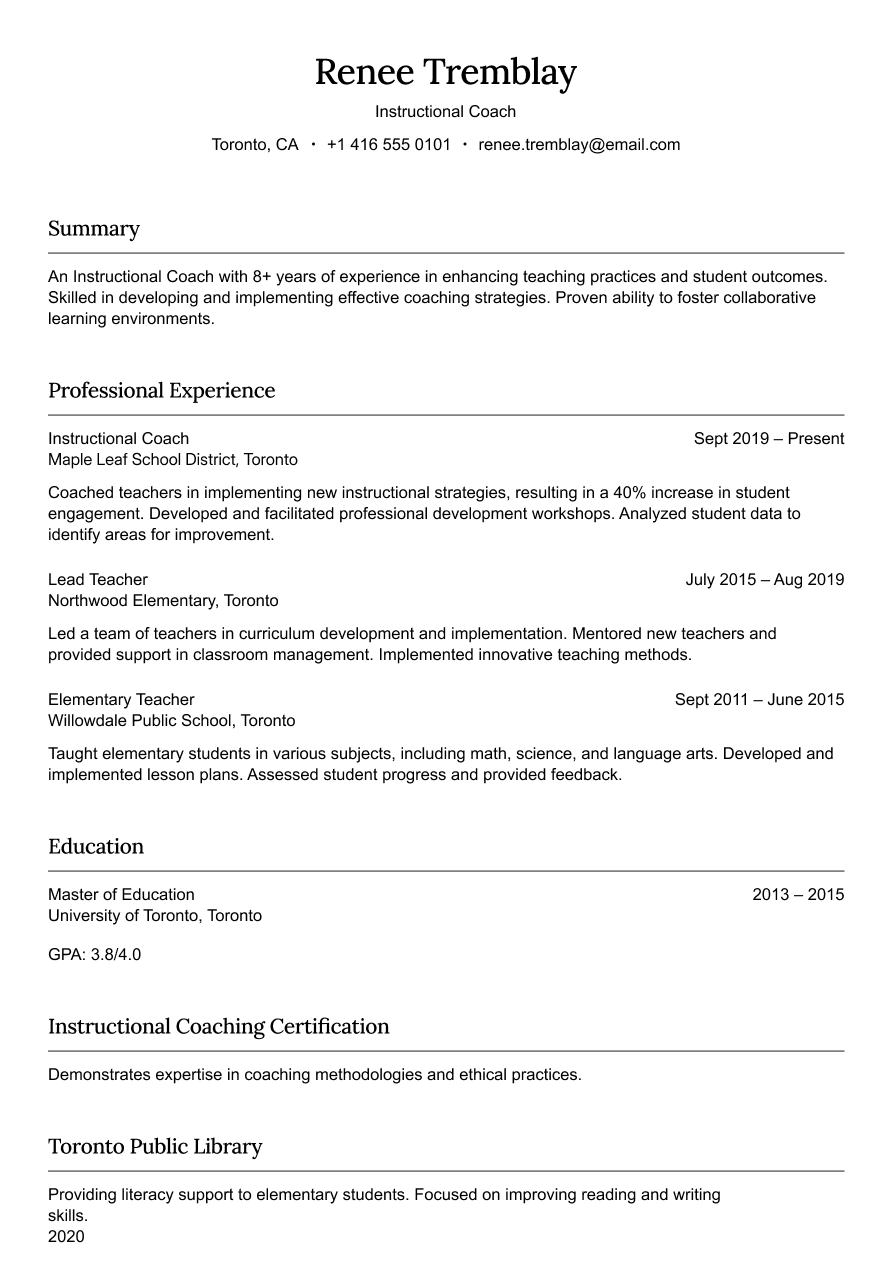
Instructional Coach Resume

A step beyond the classroom — this example is for experienced teachers moving into school-wide or district-level instructional leadership. The resume pivots the framing from "my students" to "the teachers I coached" and "the school data we moved." Metrics include number of teachers coached, professional development sessions facilitated, and school-wide assessment improvements tied to coaching cycles. Shows the transition clearly without abandoning classroom credibility.

New Teacher Resume

Designed for candidates in their first year or emerging from student teaching. This resume front-loads state certification and degree at the top — the first two things principals check — then builds an experience section from student teaching placements, practicum hours, and tutoring roles. Specific class sizes, grade levels, and curriculum programs replace generic task descriptions throughout.

The skills section uses named instructional tools (Google Classroom, Seesaw, SMART Board) and approaches (differentiated instruction, UDL) to pass ATS filters at districts that route new applicants through automated screening.

Elementary School Teacher Resume

A focused example for K-5 educators that leads with student outcome data: reading level gains, math proficiency improvements, and standardized assessment growth tied to specific instructional programs. The experience section names the curriculum used (Fountas & Pinnell, Saxon Math, Wonders) alongside the results — giving hiring committees both the method and the evidence it worked.

  • Highlights differentiated instruction for diverse learners including ELL and IEP students

  • Shows parent communication practices and conference participation rates

  • Names technology platforms: Seesaw, IXL, Renaissance Learning, Google Classroom

Mid-Career Teacher Resume

For educators with 6-12 years in the classroom who are ready to move into a stronger school or take on a lead role. This two-page resume shows progression across multiple grade levels and schools, with a summary that anchors on their strongest result from the current or most recent role. Curriculum leadership, mentor teacher responsibilities, and professional development facilitation all appear as evidence of readiness for the next level.

The skills section goes beyond classroom basics to include instructional coaching, curriculum mapping, data team participation, and assessment design — the competencies that separate experienced classroom teachers from those ready for department-level influence.

Department Head Teacher Resume

A leadership-transition example for senior classroom teachers stepping into or seeking their first formal department leadership role. The resume bridges individual teaching excellence with early leadership contributions: mentoring colleagues, leading curriculum reviews, chairing department meetings, and managing department budgets. Both the classroom results and the leadership scope appear in the summary, positioning the candidate at the intersection of practice and management.

"The strongest department head candidates show me they can still teach brilliantly and lead a team. Their resumes prove both — with specifics, not adjectives."

Special Education Teacher Resume

Specialized for educators working with students with disabilities, learning differences, and complex needs. This resume leads with the candidate's endorsements and specialized certifications (Special Education, Autism Spectrum Disorder, Applied Behavior Analysis) and builds an experience section around IEP management, multi-disciplinary collaboration, and measurable student progress on individualized goals.

  • Shows IEP caseload size and student disability categories served

  • Demonstrates collaboration with OT, SLP, school psychologist, and family teams

  • Includes behavioral support experience: PBIS, FBA, BIP implementation

ESL Teacher Resume

Purpose-built for English language educators teaching in US schools or language programs. Leads with ESOL/ESL endorsement status and the language backgrounds of student populations served — a critical signal for districts with high ELL enrollment. Pulls Level 1-5 proficiency progression data, WIDA ACCESS scores, and reclassification rates as outcome metrics that ELL hiring committees recognize immediately.

High School STEM Teacher Resume

Designed for secondary educators in mathematics, science, engineering, or technology disciplines where subject expertise and exam outcome data carry the most weight. This resume leads with state certification and subject endorsements, then builds an experience section anchored on AP and honors course outcomes — pass rates, score distributions, year-over-year improvement — alongside classroom size and course variety managed.

The skills section includes both pedagogy (inquiry-based learning, project-based learning, STEM integration) and subject-specific tools (Desmos, Geogebra, lab management platforms, coding environments). For STEM teachers, this dual profile matters — schools want content mastery and instructional range, not one or the other.

Instructional Coach Resume

A step beyond the classroom — this example is for experienced teachers moving into school-wide or district-level instructional leadership. The resume pivots the framing from "my students" to "the teachers I coached" and "the school data we moved." Metrics include number of teachers coached, professional development sessions facilitated, and school-wide assessment improvements tied to coaching cycles. Shows the transition clearly without abandoning classroom credibility.

How to Quantify Teaching Impact on a Resume

The biggest challenge for teachers writing their own resumes is finding the numbers. Here's where to look — and how to frame the results you already have, even if they don't feel like traditional metrics:

What You Did

How to Say It With Data

Taught reading to 3rd graders

"Moved 78% of students to grade-level reading within 9 months through guided reading groups and targeted phonics instruction"

Ran after-school tutoring

"Facilitated after-school tutoring for 14 at-risk students; 11 achieved passing grades by semester end"

Managed a special education caseload

"Maintained IEP caseload of 18 students across 3 grade levels, coordinating with 6 service providers"

Improved classroom behavior

"Reduced disciplinary referrals 60% in first semester through Positive Behavioral Interventions and Supports (PBIS) implementation"

Prepared students for AP exams

"Achieved 87% AP exam pass rate (score 3+) across two sections of AP US History; district average was 71%"

If you don't have formal data — your district doesn't share test scores, or you're a first-year teacher without a track record — focus on scope and specificity instead. Class sizes, grade levels taught simultaneously, curriculum programs implemented, and programs or clubs you've launched all add concrete texture to your experience. A first-year teacher who "launched a lunchtime debate club that grew to 28 students" has something far more memorable than one who "participated in extracurricular activities."

Teacher Resume ATS: Keywords That Actually Matter

School districts and charter networks increasingly route applications through applicant tracking systems before they reach a hiring committee. The keyword profile for teacher resumes differs from corporate roles, but the stakes are identical — miss the right terms and your resume may not surface at all.

Most of the keywords that carry ATS weight for teacher resumes come from three categories:

  • Certification and credential terms — Your state-specific license (e.g., "New York State Teaching Certificate," "Texas SBEC certification"), endorsements (ESL, Special Education, Gifted), and credential level (Initial, Professional, Clear).

  • Instructional approach keywords — Differentiated instruction, project-based learning (PBL), culturally responsive teaching, Universal Design for Learning (UDL), Socratic seminars, inquiry-based learning, blended learning, data-driven instruction.

  • Technology and platform terms — Google Classroom, Canvas, Schoology, Seesaw, IXL, Kahoot, SMART Board, Nearpod, Renaissance Learning. Name every platform you've used. ATS systems at larger districts scan for these specifically.

Where most teacher resumes fall short: listing methods without naming the programs. "Used technology to enhance instruction" scores poorly. "Integrated Seesaw and Nearpod into daily instruction for a 1:1 iPad classroom of 28 students" scores well — it's specific, it names the platforms, and it gives context. Browse our full teacher resume examples to see how educators in different specializations structure these keyword-dense sections without losing readability.

Non-Traditional Experience That Actually Belongs on a Teacher Resume

Career changers and new teachers both wrestle with the same problem: limited formal classroom experience. The instinct is to either pad the resume with tangentially related work or leave it sparse. Both approaches underperform. The better strategy is to translate your non-teaching experience into the language of teaching competencies — and principals are good at reading between the lines when you do this well.

  • Coaching and youth leadership — If you've coached a youth sports team, led a scout troop, or run a summer camp program, you have direct experience with group instruction, differentiation (adapting to different skill levels), classroom management, and parent communication. Name it all explicitly.

  • Corporate training and facilitation — Professionals who've developed training programs, delivered workshops, or onboarded employees have transferable curriculum design and adult learning experience. A corporate trainer moving into teaching can credibly describe instructional design, learning objectives, and assessment — because they've done them, just for a different audience.

  • Tutoring and private instruction — Even informal one-on-one tutoring demonstrates subject mastery, individualized instruction, and student relationship building. Mention number of students, subjects, grade levels, and any measurable outcomes (grade improvements, exam results).

  • Community and volunteer roles — Literacy volunteers, after-school program staff, religious education instructors, and ESL conversation partners all carry legitimate instructional experience. Include them with the same structure as paid roles: scope, approach, and outcomes.

"I've hired teachers who came from nursing, military service, and retail management. The ones who get interviews are the ones whose resumes show they understand what teaching requires — not just that they've done other things."

For career changers, our professional resume templates include combination layouts that front-load skills before work history — which works particularly well when your most relevant experience isn't your most recent job title.

Teacher Resume FAQs

How long should a teacher resume be?

One page for new and early-career teachers (0-5 years). Two pages for experienced educators, department leads, or those with multiple grade levels, endorsements, or curriculum development experience worth documenting. Unlike corporate roles where two pages can feel padded, a well-structured two-page teacher resume is both common and expected for mid-career and senior educators. The three-page resume is generally only appropriate for those with publication histories or extensive professional development records.

Should certifications go at the top or bottom of a teacher resume?

Near the top — either in your header, directly below your summary, or in a clearly labeled "Certifications" section before your experience. Principals and HR staff check credentials before they read experience bullets. Burying your teaching license in an education section at the bottom of page one costs you scan-time with the most important screening signal on your resume. If your certification is state-specific or pending, note the status explicitly.

Do I need a different resume for every school I apply to?

Not from scratch — but meaningful tailoring matters more in education hiring than most candidates expect. Each school or district has a specific profile: Title I vs. private, STEM focus vs. arts integration, high-need population vs. suburban district. A teaching resume that reflects the priorities of the specific school — using language from the job posting, emphasizing relevant experience with their student population — consistently outperforms the generic version. It doesn't require rewriting; it requires adjusting 20-30% of the content.

Should I include student teaching experience if I've been teaching for several years?

Generally, no. Once you have 3+ years of full-time classroom experience, student teaching no longer needs its own resume entry. It can remain in your education section as context ("Including student teaching at Lincoln Elementary, Grade 3") but shouldn't compete for space with your actual classroom record. The exception: if your student teaching experience included a particularly notable placement — Teach For America, a nationally recognized school, or a distinctive population — it may be worth keeping briefly.
Recruiter Approved

Build a Resume That Works. Literally.

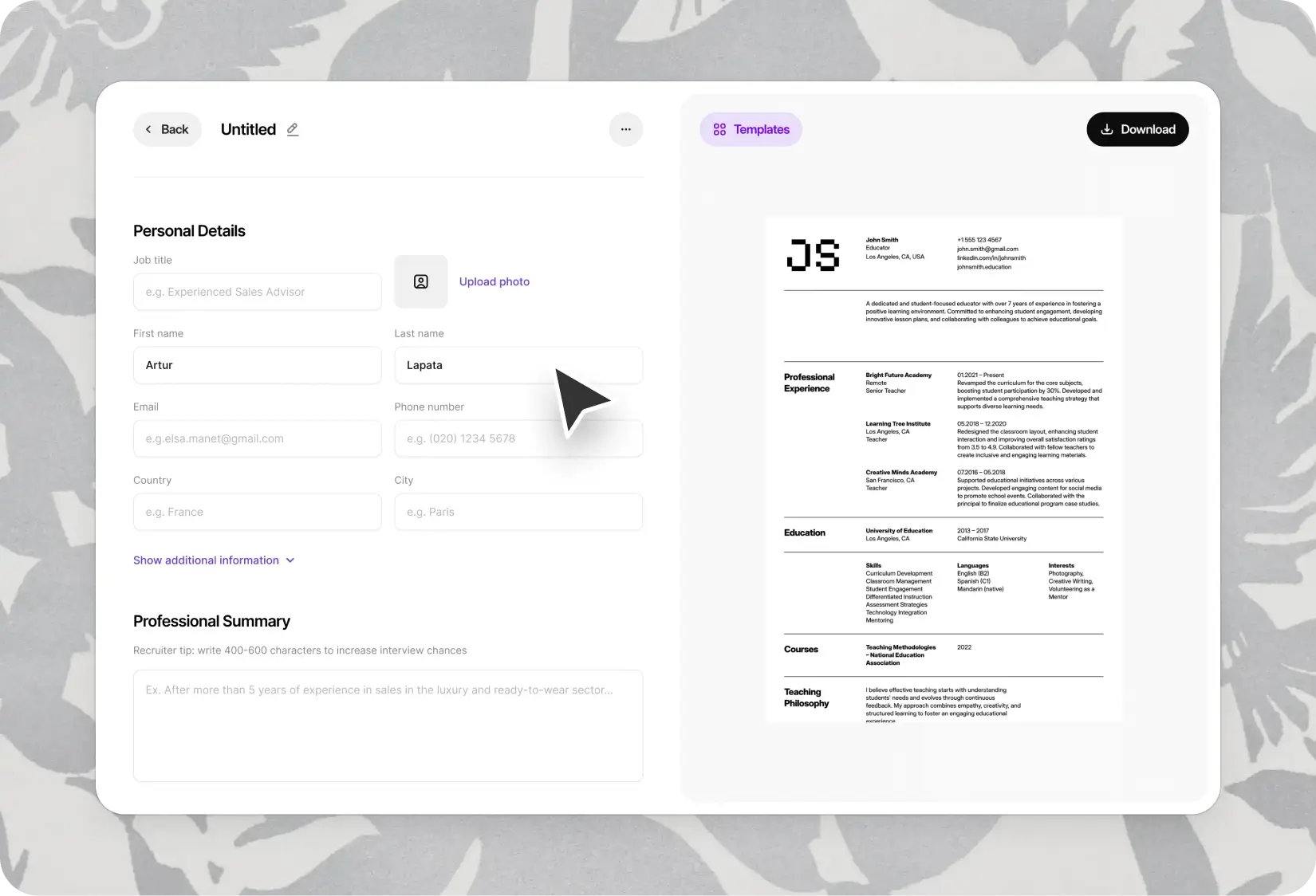
Resume builder interface showing personal details and professional summary fields, with a sample resume preview.

© 2026 Wensa. All right reserved.

Inspired by best practices from certified resume experts.

© 2026 Wensa. All right reserved.

Inspired by best practices from certified resume experts.