Registered Nurse Resume Examples That Land Interviews (2026)
Registered nurse resume examples for new grads, experienced RNs, and specialty roles. See how nurses present clinical skills, patient outcomes, and certifications — and use these examples to build a resume that works in 2026.
Updated Mar 4, 2026
Written by Artur Lopato
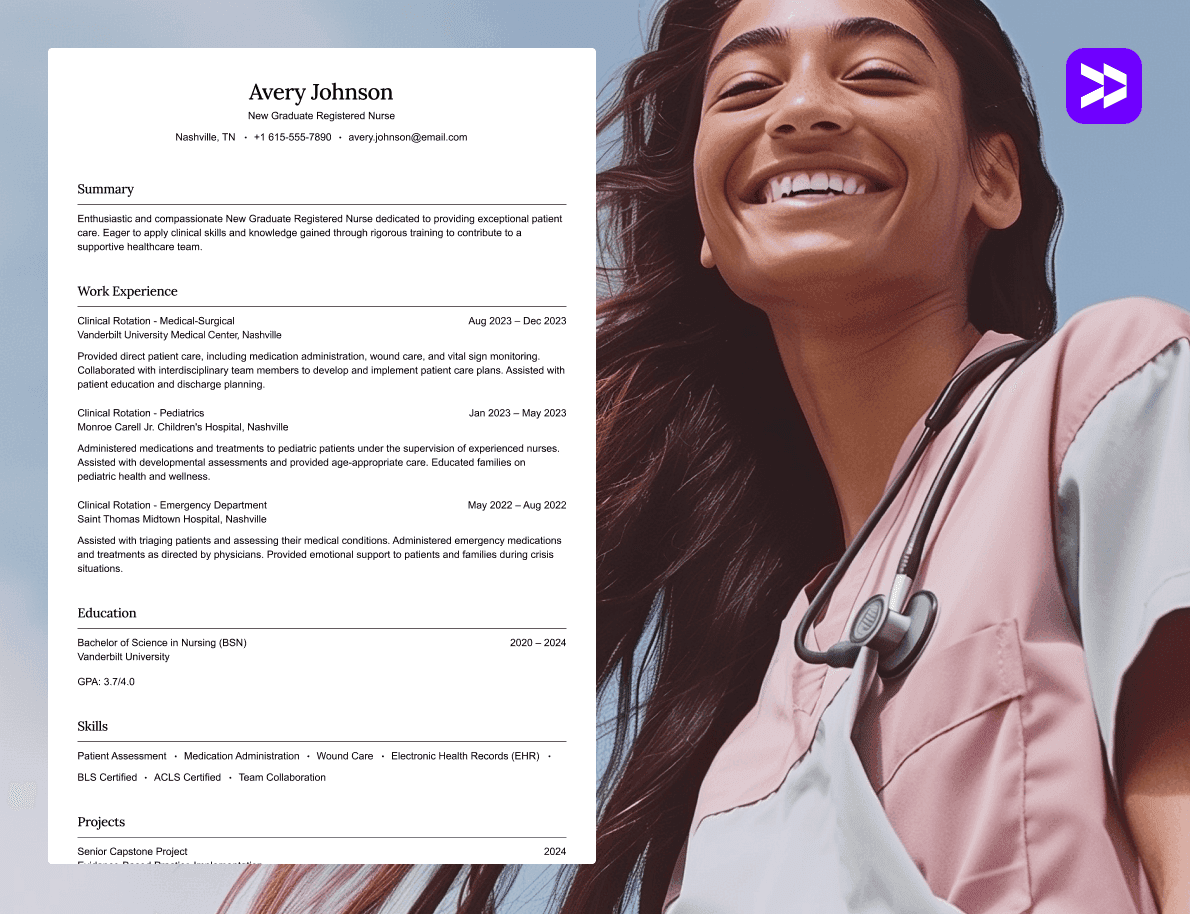
Nursing hiring has never moved faster. Hospitals review hundreds of RN resumes for each opening, and most are filtered out before a recruiter ever sees them — not because candidates lack qualifications, but because resumes fail to show what actually matters.
A strong registered nurse resume doesn't just list duties. It demonstrates patient impact, clinical expertise, and the ability to work under pressure in fast-paced healthcare environments.
Before reviewing the examples below, understand what makes nursing resumes different:
Employers need proof of licensure, measurable patient outcomes, and evidence you can handle high-stakes situations.
What Healthcare Recruiters Scan For First
Nursing recruiters typically spend under 10 seconds on initial resume screening. They look for three signals immediately: active RN license, relevant certifications (BLS, ACLS, specialty certs), and quantified clinical experience.
The best nursing resumes make these elements impossible to miss. They show patient-to-nurse ratios, improved satisfaction scores, reduced readmission rates, and successful implementation of safety protocols.
"A nursing resume should prove you can deliver quality care under pressure — not just that you showed up for shifts."
If you're still determining how to structure your nursing resume or which format works best for healthcare applications, starting from a proven ATS-friendly resume template designed for medical professionals can help you avoid common formatting mistakes that cause automatic rejection.
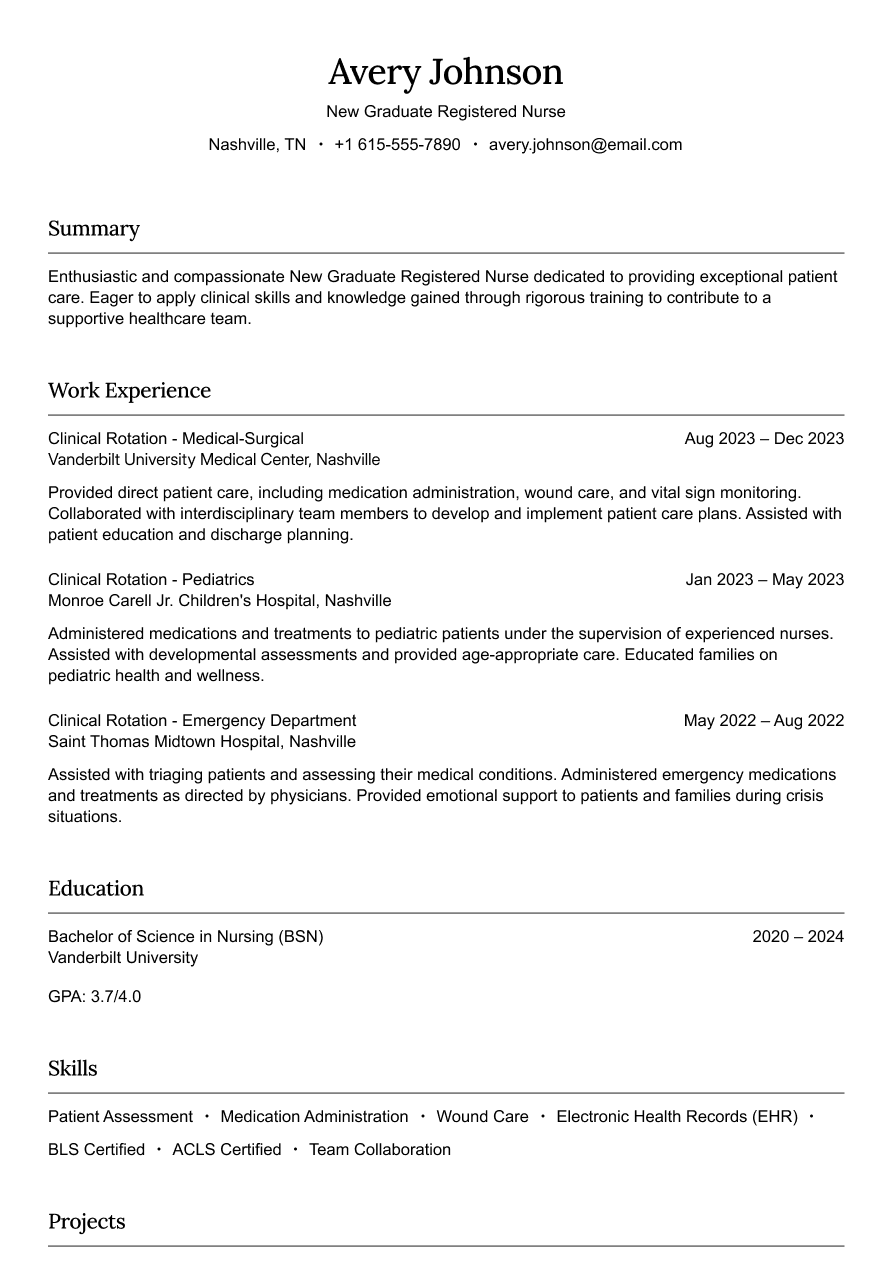
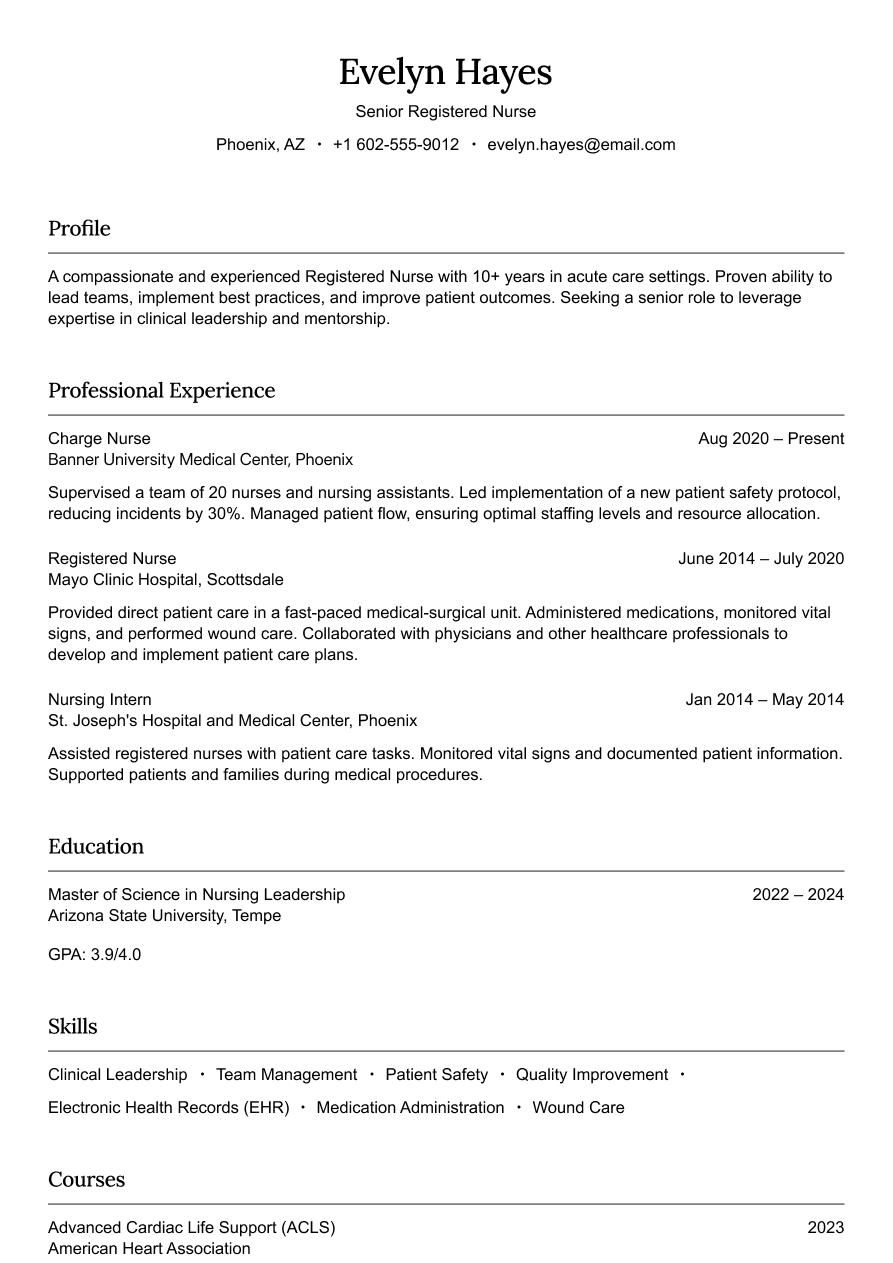
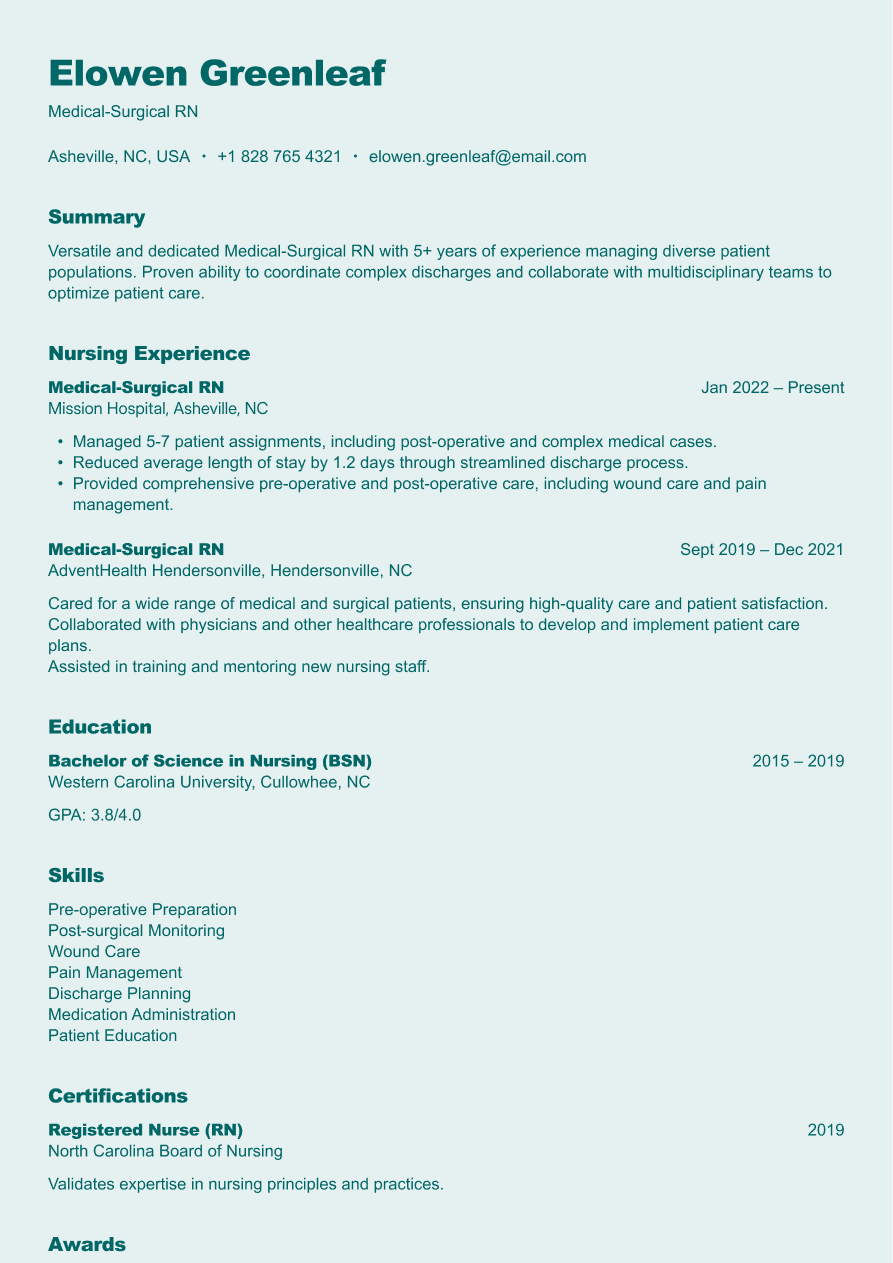
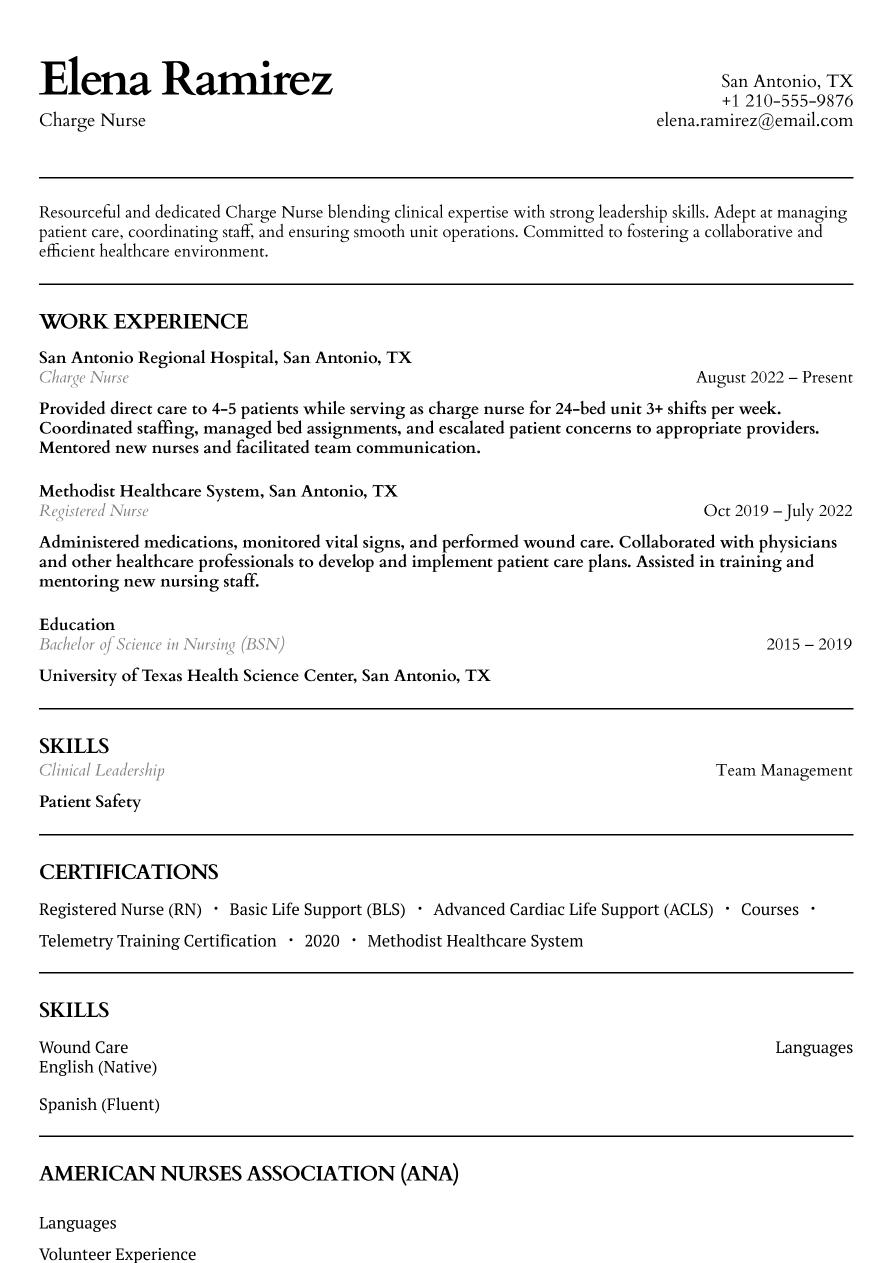
Registered Nurse Resume Examples by Experience and Specialty
Certifications and Licenses: What Actually Matters
For registered nurses, credentials aren't optional extras — they're the foundation of your entire resume. Missing or unclear licensing information will get you filtered out immediately, regardless of experience.
Critical credentials to include:
RN License: State, license number, expiration date (always list current status)
BLS/ACLS: Basic and Advanced Cardiac Life Support from recognized organizations
Specialty Certifications: PALS, CEN, CCRN, or other role-specific credentials
Education: BSN preferred over ADN for most hospital systems
Format matters. Don't just list "RN" — write "Registered Nurse, California License #123456, Active." ATS systems search for specific terminology and many won't recognize shortened versions.
For guidance on structuring your entire resume including education and certification sections, see our complete guide on how to write a resume that balances credentials with clinical experience.
How to Quantify Patient Care Impact
The biggest mistake nurses make is describing responsibilities instead of outcomes. "Provided patient care" tells recruiters nothing. "Managed 6-patient assignment in 30-bed ICU, reducing pressure ulcer incidents by 40%" shows real impact.
Effective ways to quantify nursing work:
Category | What to Measure |
|---|---|
Patient outcomes | Readmission rates, satisfaction scores, complication reduction |
Clinical scope | Patient load, acuity level, unit size (beds) |
Safety & quality | Infection rates, fall prevention, medication error reduction |
Efficiency | Discharge times, throughput improvements, resource utilization |
Even new grads can quantify: "Completed 240 clinical hours across ICU, ER, and med-surg rotations" or "Assisted with 50+ deliveries during OB rotation" demonstrates hands-on experience with measurable scope.
New Grad vs Experienced RN: Resume Strategy Differences
New graduate nurses and experienced RNs need fundamentally different resume approaches. What works for entry-level applications can actually hurt experienced candidates — and vice versa.
For new grad nurses (0-2 years):
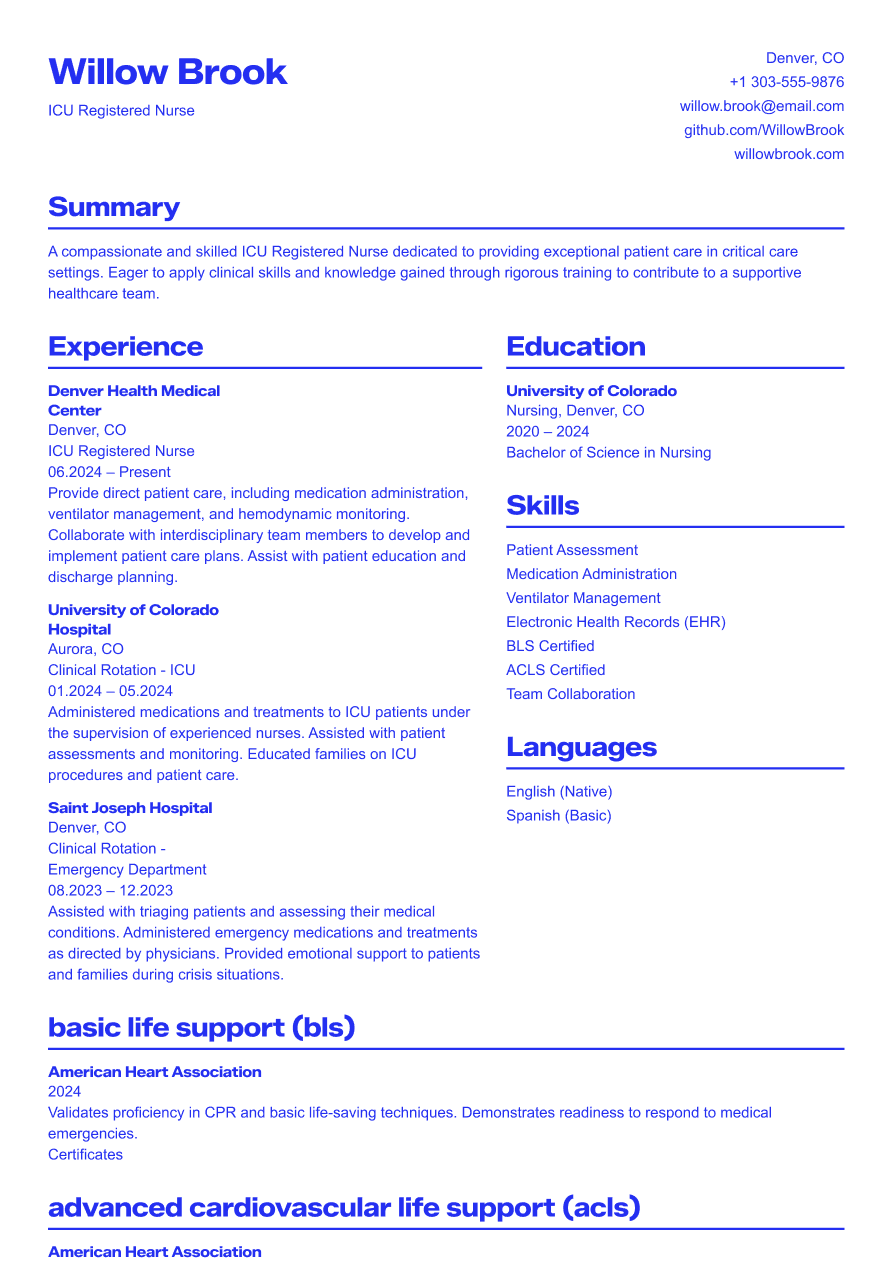
Lead with education and clinical rotations
Emphasize specific skills learned in each rotation
Include relevant healthcare experience (CNA, medical assistant, etc.)
Highlight NCLEX passage and any specialty training
For experienced RNs (3+ years):
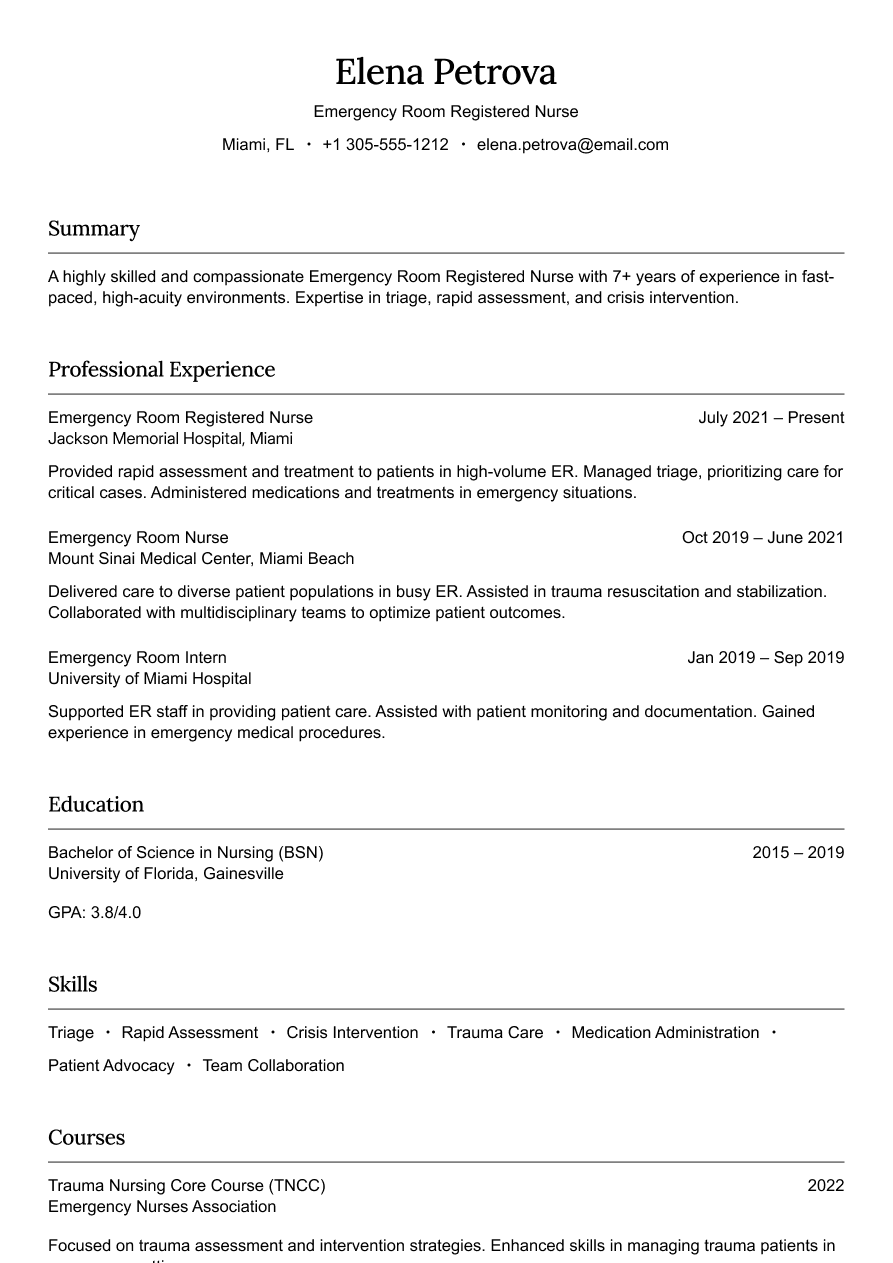
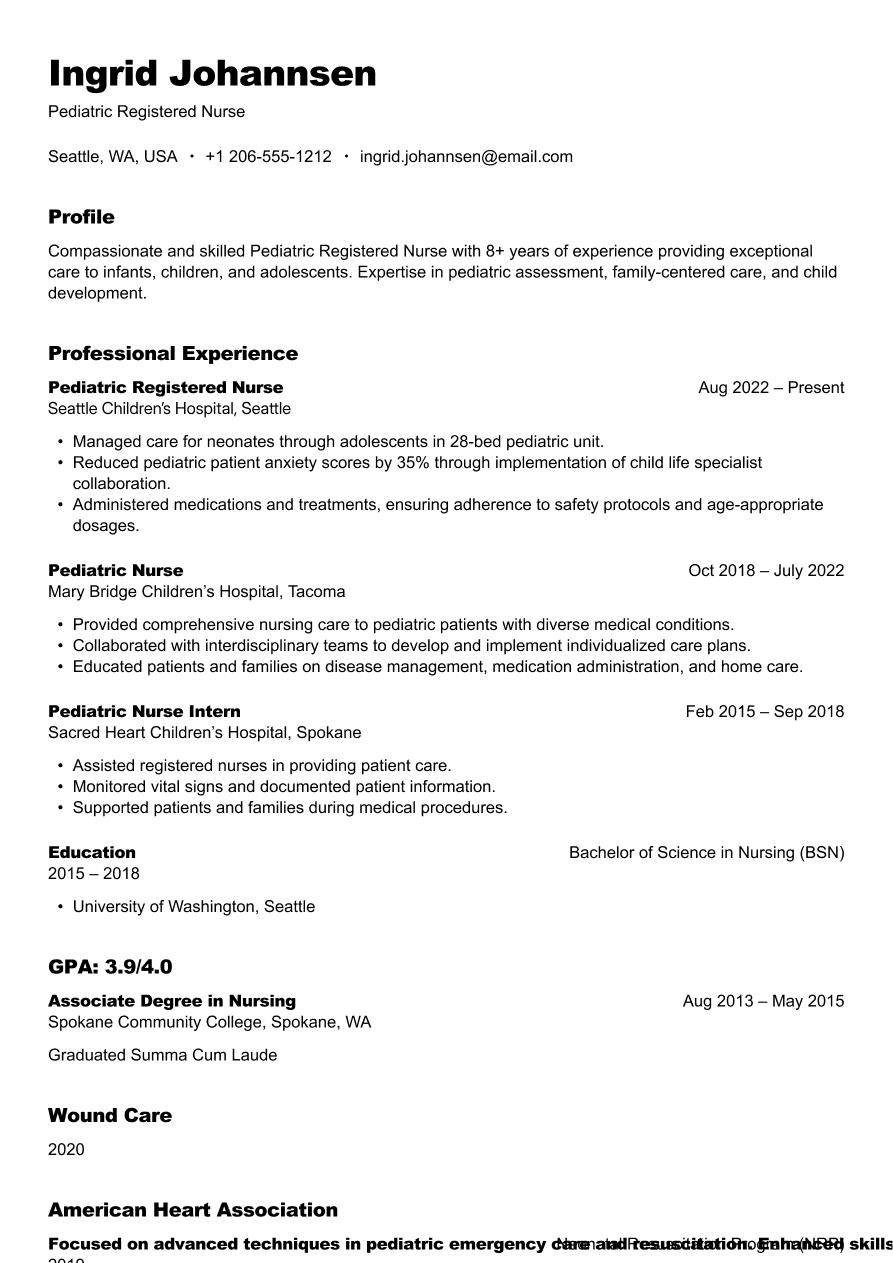
Lead with most recent clinical experience and achievements
Focus on patient outcomes and process improvements
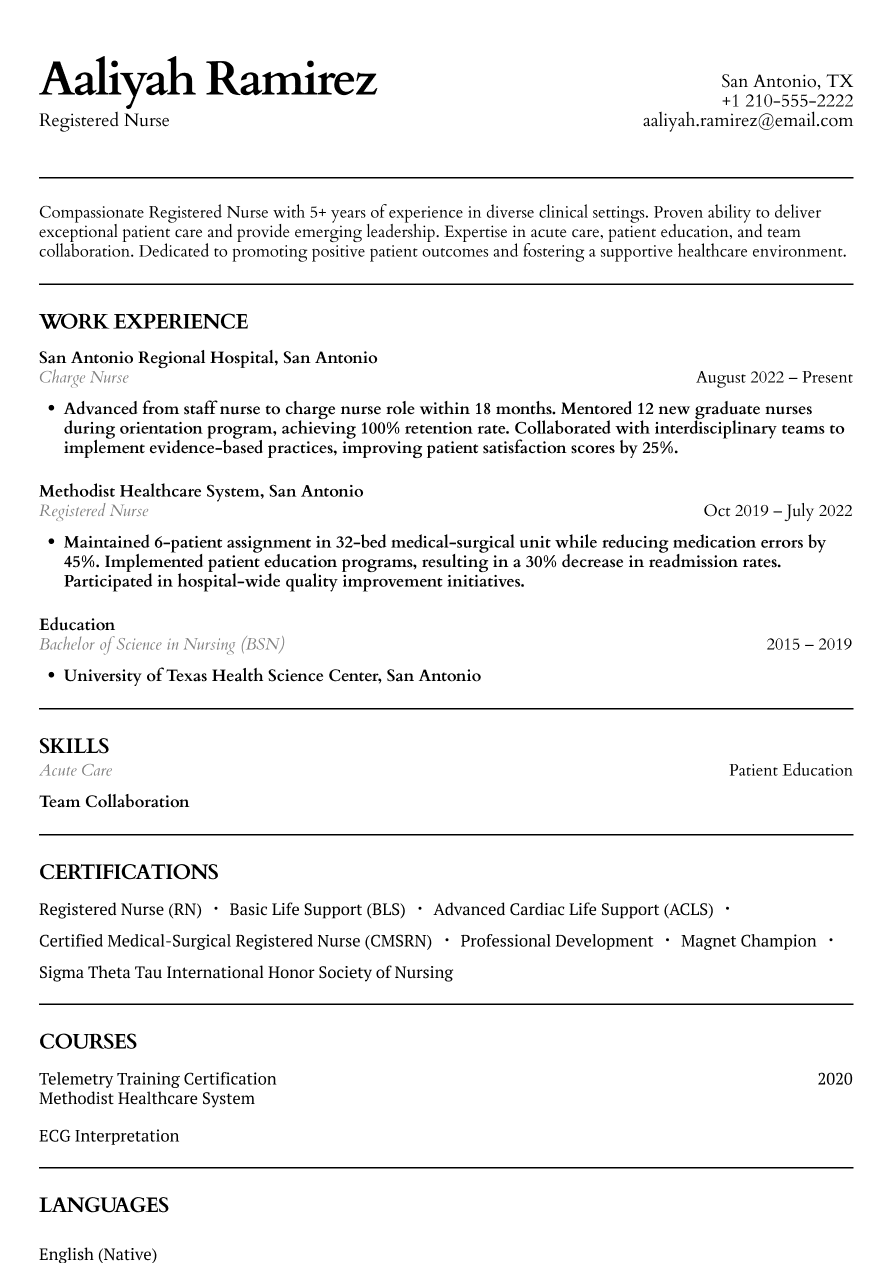
Demonstrate progression (staff nurse → charge nurse → specialty role)
Minimize or remove clinical rotation details
The key difference: new grads prove potential through training, experienced nurses prove value through results.
Choosing the Right Resume Template for Nursing Roles
Healthcare employers need to scan nursing resumes quickly and extract critical information fast. Complex layouts, graphics, or unconventional formats create barriers — even if they look impressive.
Effective nursing resumes use:
Clear section headers (Experience, Education, Certifications, Skills)
Standard fonts that render correctly in ATS systems
Prominent placement of RN license and certifications
Bullet points that start with strong action verbs
Using a professional resume template designed for healthcare roles helps ensure your credentials, clinical experience, and patient care achievements remain the focus — especially critical when applying across multiple specialties or hospital systems.
Avoid: photos, graphics, color blocks, or creative layouts. These often break ATS parsing and make it harder for recruiters to find what they need quickly.
Registered Nurse Resume FAQ
Q: Should I include my RN license number on my resume?
Yes. Include your state, license number, and expiration or renewal date. This demonstrates active licensure and prevents delays in the hiring process. Format: "Registered Nurse, California License #123456, expires 12/2027."
Q: How do I describe clinical rotations if I'm a new grad with no RN experience?
Create a "Clinical Experience" section separate from your work history. For each rotation, include the unit type, hospital name, number of hours completed, and 2-3 specific skills or procedures you performed. Example: "ICU Rotation - 120 hours: Assisted with ventilator management, central line care, and hemodynamic monitoring for critically ill patients."
Q: Should nursing resumes be one page or two pages?
One page for new grads and nurses with less than 5 years of experience. Two pages are acceptable for experienced RNs with multiple specialties, certifications, or leadership roles. If using two pages, ensure page one contains your strongest achievements — many recruiters never scroll.
Q: Do I need to list every certification or just current ones?
List only active certifications. Include the certification name (spelled out, not just acronym), certifying body, and expiration date. Example: "Advanced Cardiovascular Life Support (ACLS), American Heart Association, expires 6/2026." Don't list expired certifications — this raises questions about current competency.
Q: How do I show leadership experience as a bedside nurse?
Highlight charge nurse shifts, preceptor responsibilities, committee participation, or protocol development. Quantify when possible: "Served as charge nurse 2-3 shifts per week, coordinating care for 24-bed unit" or "Mentored 8 new graduate nurses during 12-month orientation period, with 100% retention rate."