Two-column

Two-Column CV Templates — More Information, Cleaner Layout

Browse 11 two-column CV templates. Fit more skills, experience, and qualifications onto one page — without making it feel crowded. Pick a design and start building in minutes.
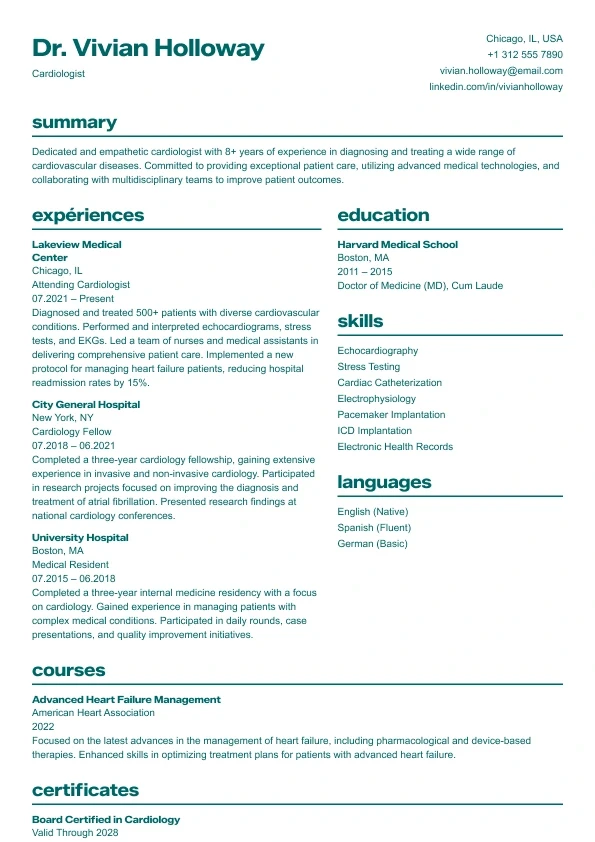
Aurora resume template — clean two-column professional layout.

Aurora

Clean and structured layout with bold headings and a clear two-column design.
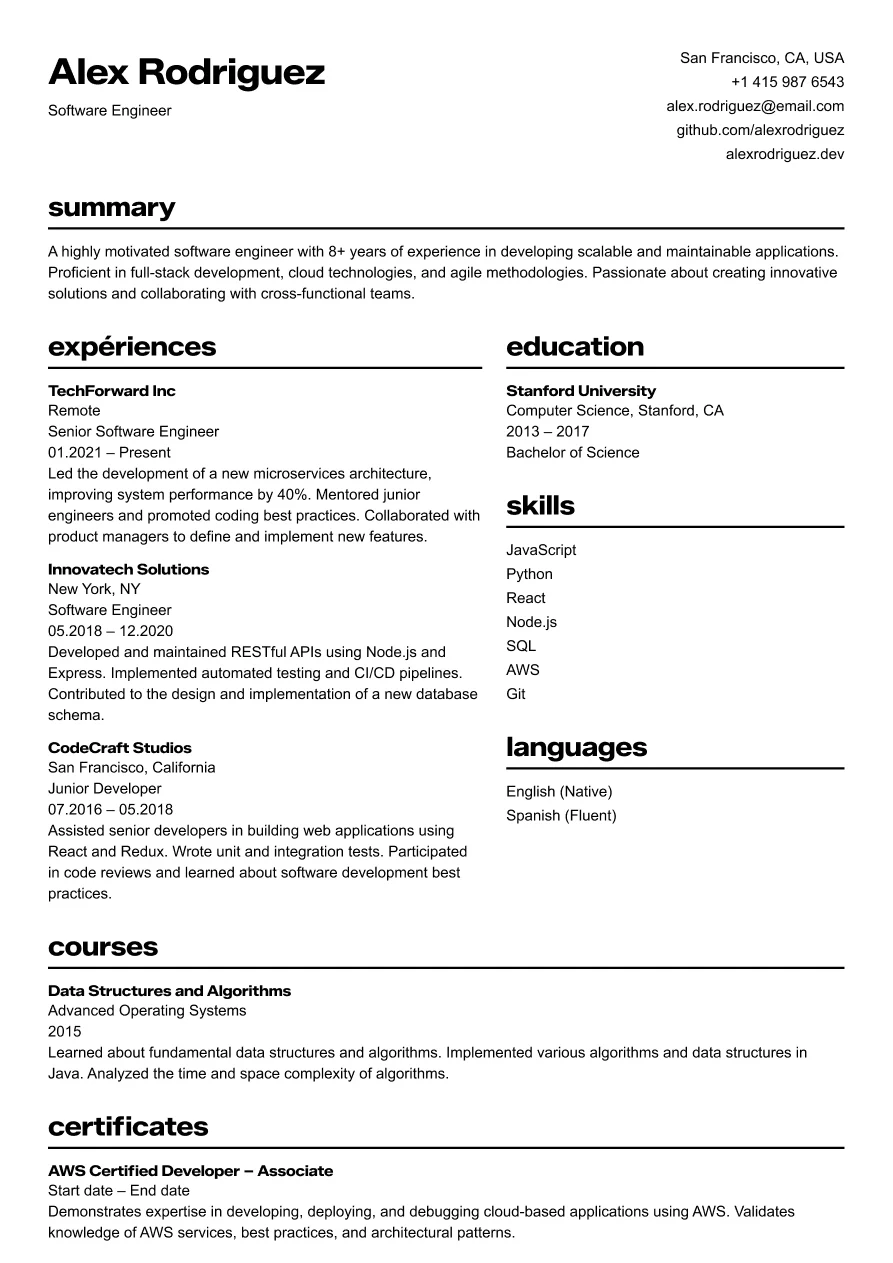
Two-column modern resume for software engineer with strong typography and clear section layout.

Osaka

Clear and structured layout for tech professionals.
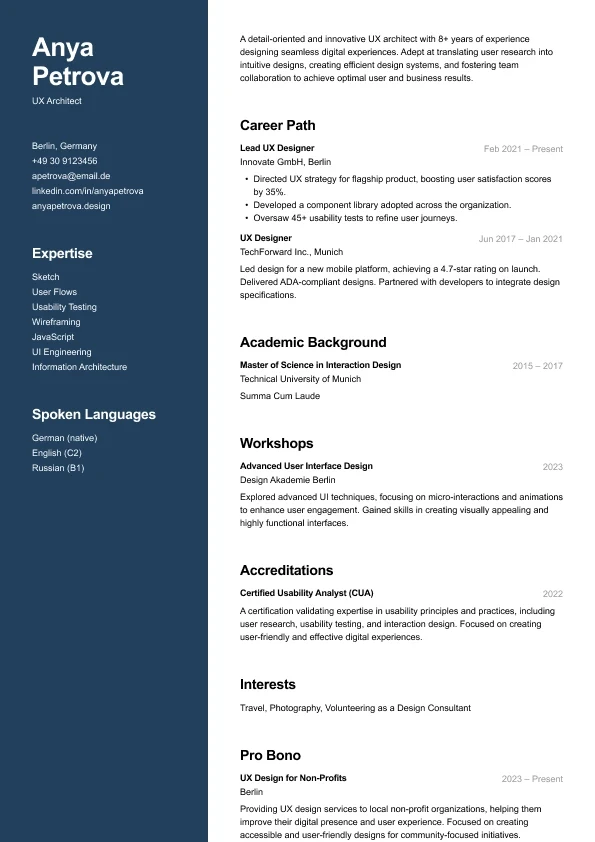
Carbon resume template — modern two-column layout for designers

Carbon

A modern two-column resume who want strong visual hierarchy and clean structure.
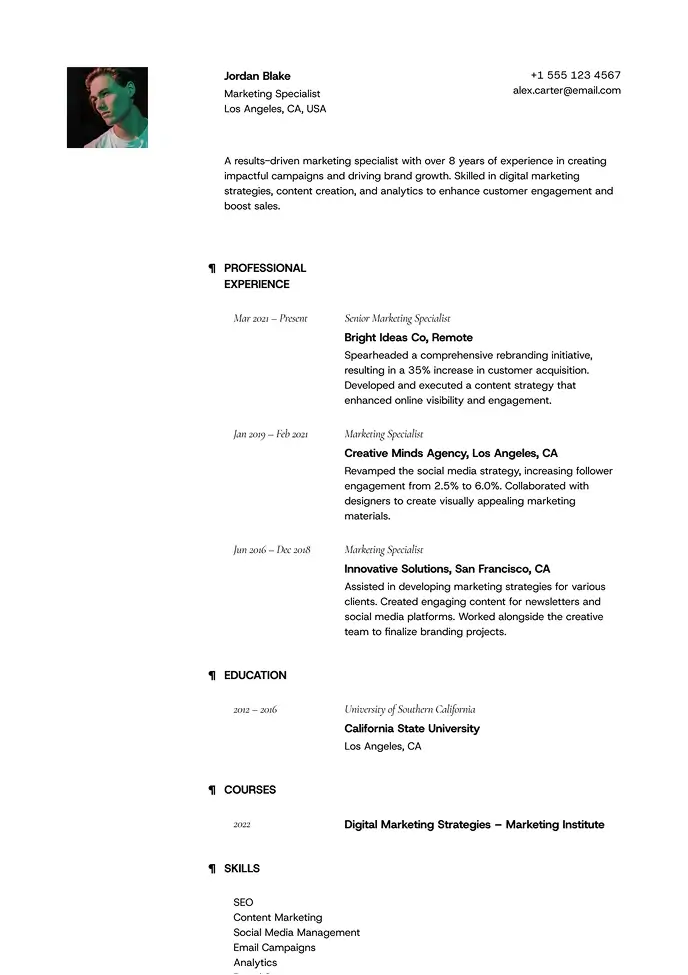
Light resume template with clean sections

Lima

Minimal and airy, perfect for professionals who value clarity.
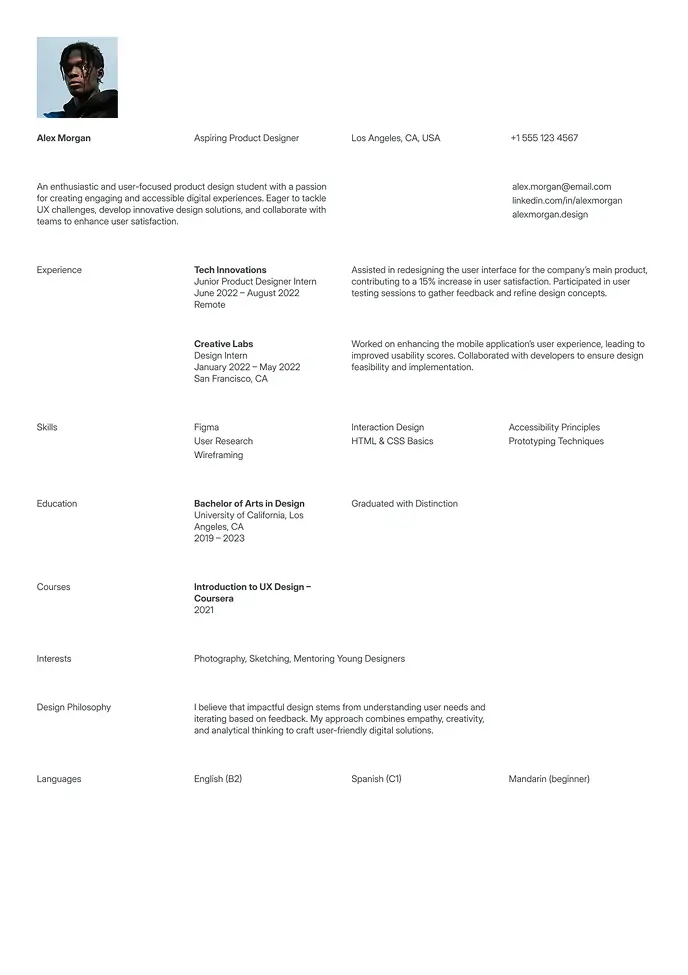
White neutral resume template for entry-level jobs

Berlin

Clean and simple resume, great for students or interns.
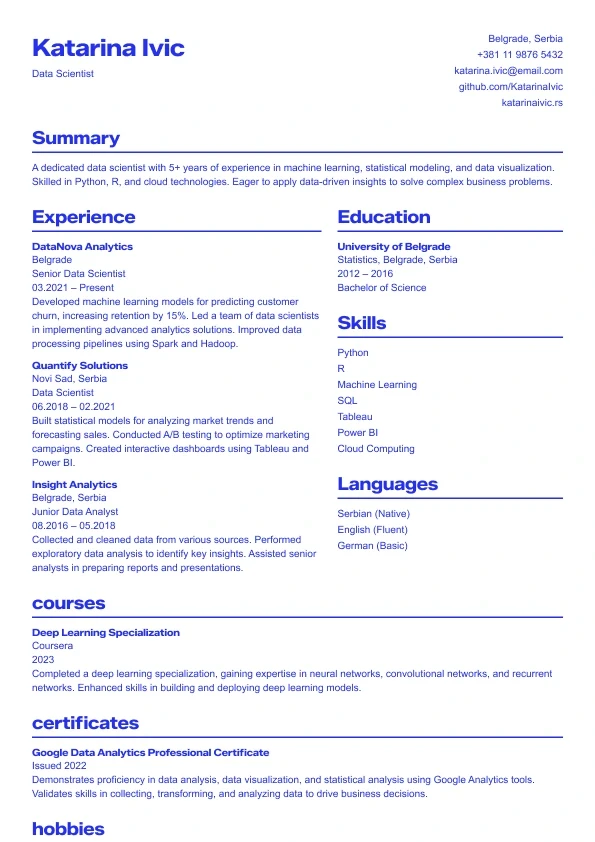
Sapphire resume template — bold blue professional layout.

Sapphire

A bold, modern resume template with strong blue accents.
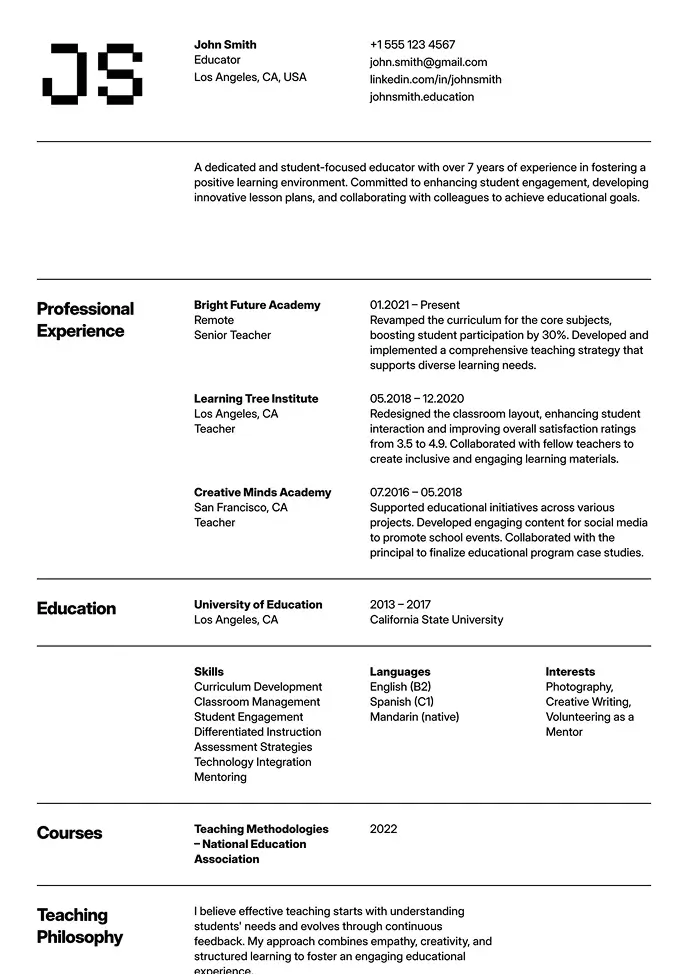
Black-and-white resume with academic feel

Oslo

Classic structure with modern typography and grid-based layout.
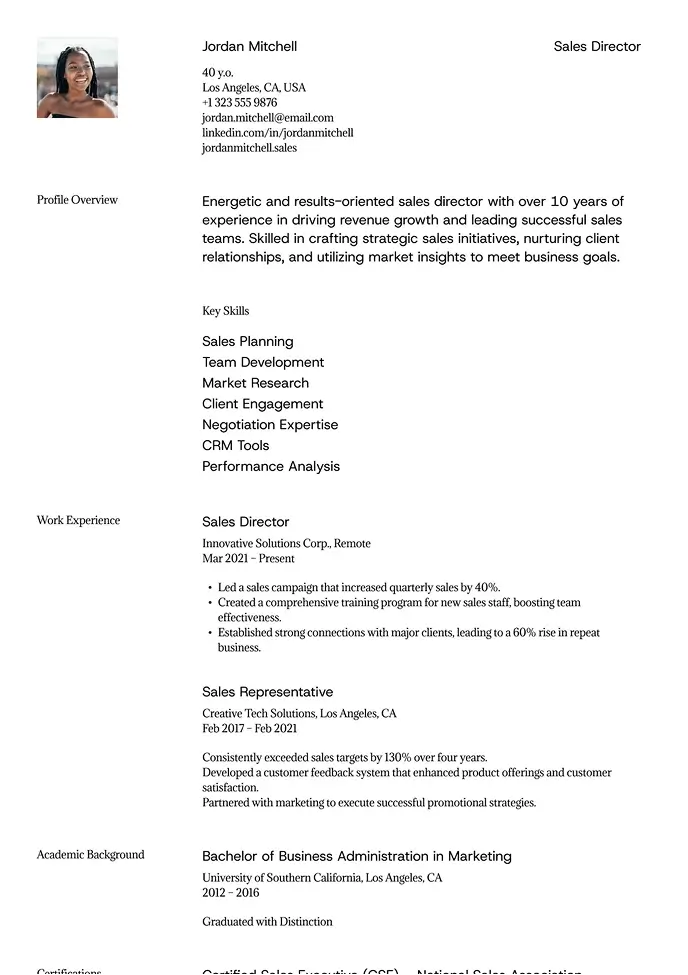
Business-style resume template with strong hierarchy

Sienna

Professional layout with a clear focus on leadership.
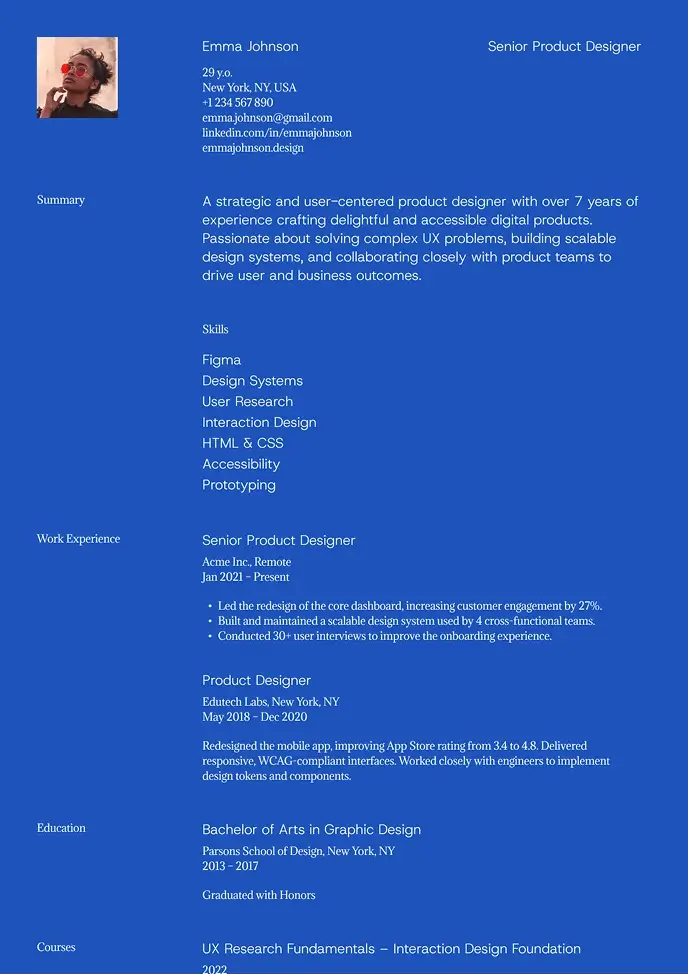
Blue modern resume template with bold layout

Kyoto

Bold and modern resume with strong contrast and easy structure.
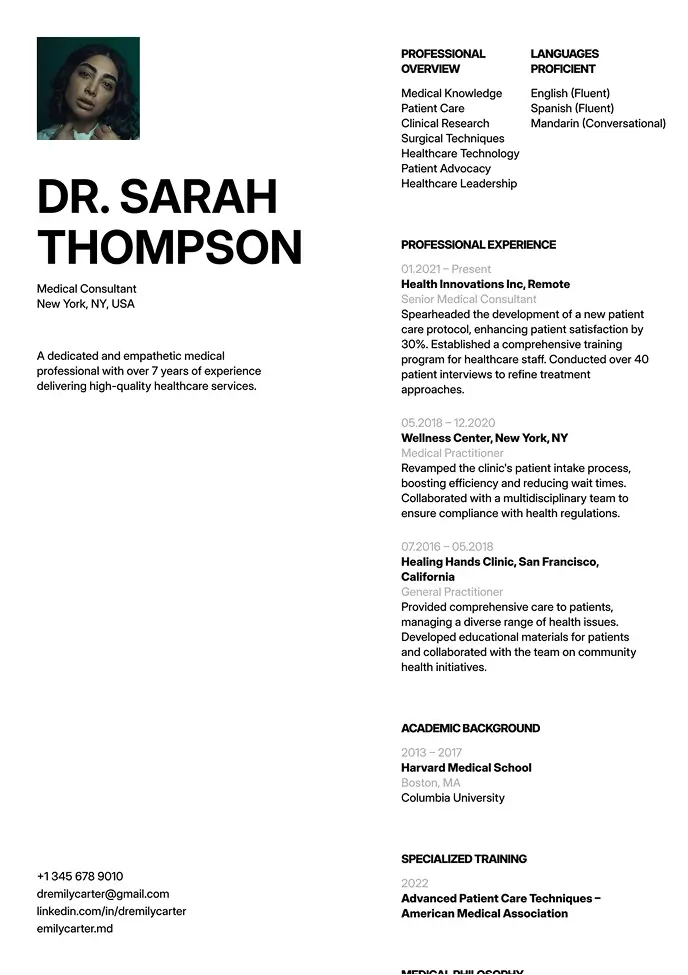
White minimal resume template with strong structure

Oxford

Clean layout for clear info flow, great for formal industries.
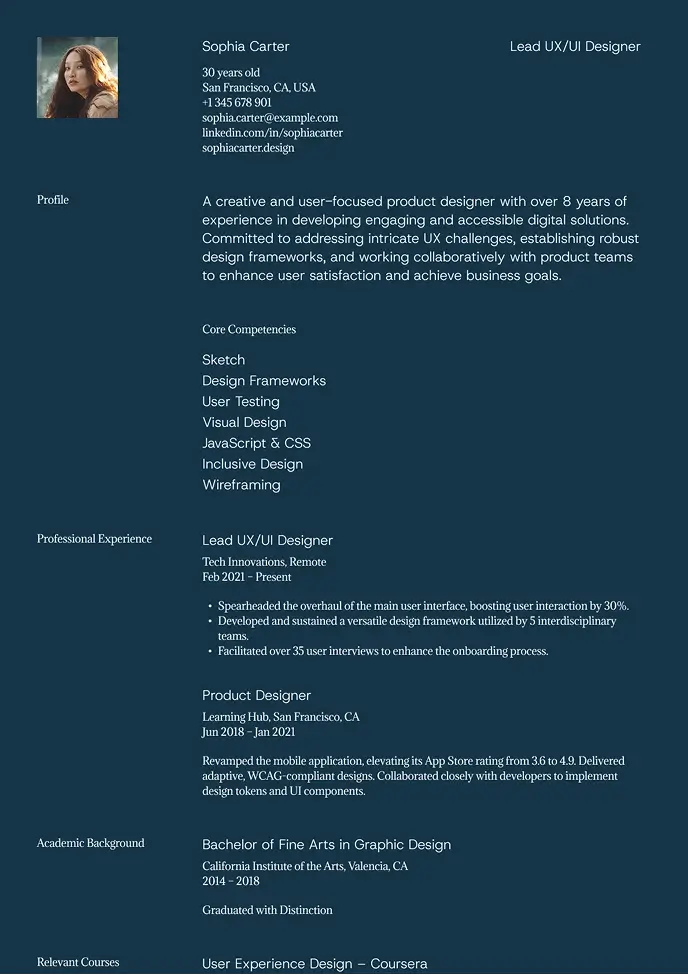
Dark resume layout with bold accents

Denali

Dark, stylish design that highlights key details with contrast.

Why Job Seekers Choose Two-Column CV Layouts

A two-column layout solves one of the most common CV problems: too much relevant information, not enough space. Skills, certifications, languages, tools, and qualifications all compete for room on a single-column page — and something always gets cut or compressed to the point of being easy to miss.

By splitting the page into a narrower sidebar and a wider main column, a two-column CV creates dedicated space for contextual information without shrinking the work experience section that recruiters spend most of their time reading.

A two-column layout solves this by creating a dedicated structure for contextual information — languages, skills, tools, qualifications — in a narrower sidebar, while career history occupies the fuller main column.

The result is a denser but highly organized document that reads quickly and positions you as both accomplished and methodical.

This approach is particularly effective for candidates applying to management consulting firms, European multinationals, and global tech companies where a rich, diverse profile needs to be communicated in a limited number of pages.

What Goes in Each Column: A Practical Guide

Narrower Left Column

Wider Right Column

Contact details

Personal profile / summary

Key skills / core competencies

Work experience (reverse chronological)

Languages with proficiency levels

Most recent 2–3 roles with achievements

Certifications and qualifications

Education section

Software and tools

Projects or publications if relevant

This placement ensures ATS systems parse your experience correctly while human reviewers can quickly scan your full profile. For ATS compatibility notes on two-column formats, see our ATS CV templates.

Who Should Use a Two-Column CV?

Two-column layouts work best when you have enough content to fill both columns meaningfully. Here's a practical guide to whether it's the right choice for you.

Good fit:

  • Mid to senior-level professionals with 5+ years of experience, multiple roles, and a developed skill set — the two-column structure gives you room to show depth without going to a second page

  • Tech and engineering candidates who need to list languages, frameworks, tools, and certifications alongside a full work history — the sidebar handles the technical stack cleanly

  • Multilingual or internationally experienced candidates with qualifications, education, or experience across different countries or systems

  • Marketing, design, and creative professionals applying to modern companies where a structured, design-aware layout signals visual competence

  • Project managers and consultants with certifications (PMP, PRINCE2, Agile), multiple industries, and a diverse client or project history

Less suitable for:

  • Entry-level candidates with limited content — a two-column layout with thin content in the sidebar looks sparse and draws attention to what's missing

  • Government, legal, and traditional academic roles — these sectors typically expect single-column formats, and a two-column submission may read as unfamiliar or informal

  • Roles that explicitly require ATS submission through older systems — if you're applying via a company's legacy careers portal, a single-column ATS template is the safer choice (see ATS CV templates)

If you're unsure, a practical rule: if your sidebar would have at least 5–6 distinct items across skills, languages, tools, and certifications — the two-column format will work for you.

Who Should Use a Two-Column CV?

Two-column layouts work best when you have enough content to fill both columns meaningfully. Here's a practical guide to whether it's the right choice for you.

Good fit:

  • Mid to senior-level professionals with 5+ years of experience, multiple roles, and a developed skill set — the two-column structure gives you room to show depth without going to a second page

  • Tech and engineering candidates who need to list languages, frameworks, tools, and certifications alongside a full work history — the sidebar handles the technical stack cleanly

  • Multilingual or internationally experienced candidates with qualifications, education, or experience across different countries or systems

  • Marketing, design, and creative professionals applying to modern companies where a structured, design-aware layout signals visual competence

  • Project managers and consultants with certifications (PMP, PRINCE2, Agile), multiple industries, and a diverse client or project history

Less suitable for:

  • Entry-level candidates with limited content — a two-column layout with thin content in the sidebar looks sparse and draws attention to what's missing

  • Government, legal, and traditional academic roles — these sectors typically expect single-column formats, and a two-column submission may read as unfamiliar or informal

  • Roles that explicitly require ATS submission through older systems — if you're applying via a company's legacy careers portal, a single-column ATS template is the safer choice (see ATS CV templates)

If you're unsure, a practical rule: if your sidebar would have at least 5–6 distinct items across skills, languages, tools, and certifications — the two-column format will work for you.

Two-Column CVs and ATS in 2026

The most common concern about two-column CVs is ATS compatibility — and it's a fair one. Here's the current picture.

The short answer: a well-built two-column CV passes modern ATS systems. A poorly built one doesn't.

The distinction comes down to how the layout is constructed. Two-column CVs that use real text in a CSS or table-based layout — the kind that Wensa's templates use — are parsed correctly by current ATS platforms including Greenhouse, Lever, Workday, and iCIMS. The system reads the text, extracts job titles, dates, and skills, and scores the resume normally.

Two-column CVs that use text boxes, floating elements, or graphics — the kind common in Canva or Photoshop-built templates — fail ATS parsing. The system either reads both columns simultaneously in the wrong order, or skips the sidebar entirely. This is the problem, not the two-column format itself.

What this means in practice:

  • If you're applying directly through a company's careers page or ATS portal, use one of the text-based two-column templates from this page — they're built to parse correctly

  • If a job posting explicitly asks for a plain text or Word document, switch to a single-column format for that application

  • Always test: paste your CV text into Notepad. If it reads in a logical order — contact, summary, experience, education, skills — your layout is ATS-safe

Modern ATS platforms have improved significantly at reading structured two-column layouts. The format is no longer a liability — as long as the template is built correctly.

For roles where ATS is a known priority — large employers, high-volume applications, corporate or tech companies — see our ATS CV templates for single-column alternatives designed specifically for those environments.

Two-Column CV Acceptance Across International Markets

Two-column layouts are more widely accepted internationally than many candidates expect:

  • UK, Ireland, and Netherlands: Modern two-column CVs are well-accepted in technology, design, marketing, and consulting. They read as professional and contemporary.

  • Scandinavia: Design sensibility is valued. A well-structured two-column CV works well across Sweden, Denmark, Norway, and Finland.

  • Germany and DACH: Traditional sectors prefer single-column Lebenslauf format. International companies and multinationals in the region are generally comfortable with two-column.

  • Australia: Two-column CVs are increasingly common in tech, marketing, and project management. Major employers including Telstra, Commonwealth Bank, and international firms accept the format. For an example of how a two-column layout looks for a professional role, see our Project Manager CV Example.

  • Conservative sectors globally: Government, traditional finance, and academic institutions in any country tend to prefer single-column regardless of region.

For a modern, design-forward two-column option, see our modern CV templates. For bold creative roles, explore our creative CV templates. For single-column alternatives, browse our professional CV templates.

FAQ — Two-Column CV Templates

Is a two-column CV ATS-friendly?

It depends on how it's built. Two-column CVs that use real, selectable text in a structured layout pass modern ATS systems including Greenhouse, Lever, and Workday. Templates built with text boxes, graphics, or floating elements fail parsing regardless of how they look visually. All templates on this page use text-based layouts and are built to parse correctly.

Should I use a two-column CV or a single-column CV?

Use a two-column CV if you have enough content to fill both columns — typically mid to senior-level candidates with skills, certifications, languages, or tools that would otherwise compress or disappear in a single-column format. Use a single-column CV for entry-level applications, government or legal roles, or any submission that explicitly requires plain text formatting.

What goes in the left column of a two-column CV?

The narrower column (usually left or sidebar) works best for contextual information: contact details, key skills, languages with proficiency levels, certifications, tools and software, and education. The wider main column should hold your work experience, professional summary, and achievements — the content recruiters spend the most time reading.

Are two-column CVs acceptable in Europe?

Yes, in most industries and countries. The UK, Ireland, Netherlands, and Scandinavia are broadly comfortable with two-column formats in technology, marketing, consulting, and design. Germany and the DACH region varies — traditional sectors prefer single-column Lebenslauf, while international companies are generally fine with two-column. Conservative sectors (government, academic, traditional finance) prefer single-column regardless of country.

Can a two-column CV fit on one page?

Yes — that's one of the main reasons candidates choose the format. By moving skills, languages, and certifications into a sidebar, you free up the main column for a fuller work history. Most mid-level candidates with 5–8 years of experience can fit their complete CV on one page using a two-column layout where a single-column version would run to two pages.

What's the difference between a two-column CV and a two-column resume?

Structurally, nothing — the layout works the same way. The terminology differs by region: «CV» is standard in the UK, Europe, Australia, and most of the world; «resume» is used in the US and Canada. For the US market, see our two-column resume templates.

Which industries work best with two-column CV templates?

Technology, software engineering, data science, digital marketing, project management, consulting, and design roles are the strongest fits. For role-specific examples of how a two-column layout looks in practice, see our Software Engineer CV Example and Digital Marketing CV Example.

FAQ — Two-Column CV Templates

Is a two-column CV ATS-friendly?

It depends on how it's built. Two-column CVs that use real, selectable text in a structured layout pass modern ATS systems including Greenhouse, Lever, and Workday. Templates built with text boxes, graphics, or floating elements fail parsing regardless of how they look visually. All templates on this page use text-based layouts and are built to parse correctly.

Should I use a two-column CV or a single-column CV?

Use a two-column CV if you have enough content to fill both columns — typically mid to senior-level candidates with skills, certifications, languages, or tools that would otherwise compress or disappear in a single-column format. Use a single-column CV for entry-level applications, government or legal roles, or any submission that explicitly requires plain text formatting.

What goes in the left column of a two-column CV?

The narrower column (usually left or sidebar) works best for contextual information: contact details, key skills, languages with proficiency levels, certifications, tools and software, and education. The wider main column should hold your work experience, professional summary, and achievements — the content recruiters spend the most time reading.

Are two-column CVs acceptable in Europe?

Yes, in most industries and countries. The UK, Ireland, Netherlands, and Scandinavia are broadly comfortable with two-column formats in technology, marketing, consulting, and design. Germany and the DACH region varies — traditional sectors prefer single-column Lebenslauf, while international companies are generally fine with two-column. Conservative sectors (government, academic, traditional finance) prefer single-column regardless of country.

Can a two-column CV fit on one page?

Yes — that's one of the main reasons candidates choose the format. By moving skills, languages, and certifications into a sidebar, you free up the main column for a fuller work history. Most mid-level candidates with 5–8 years of experience can fit their complete CV on one page using a two-column layout where a single-column version would run to two pages.

What's the difference between a two-column CV and a two-column resume?

Structurally, nothing — the layout works the same way. The terminology differs by region: «CV» is standard in the UK, Europe, Australia, and most of the world; «resume» is used in the US and Canada. For the US market, see our two-column resume templates.

Which industries work best with two-column CV templates?

Technology, software engineering, data science, digital marketing, project management, consulting, and design roles are the strongest fits. For role-specific examples of how a two-column layout looks in practice, see our Software Engineer CV Example and Digital Marketing CV Example.

Recruiter Approved

Build a Resume That Works. Literally.

Our templates are designed to get you noticed, shortlisted, and hired — fast.
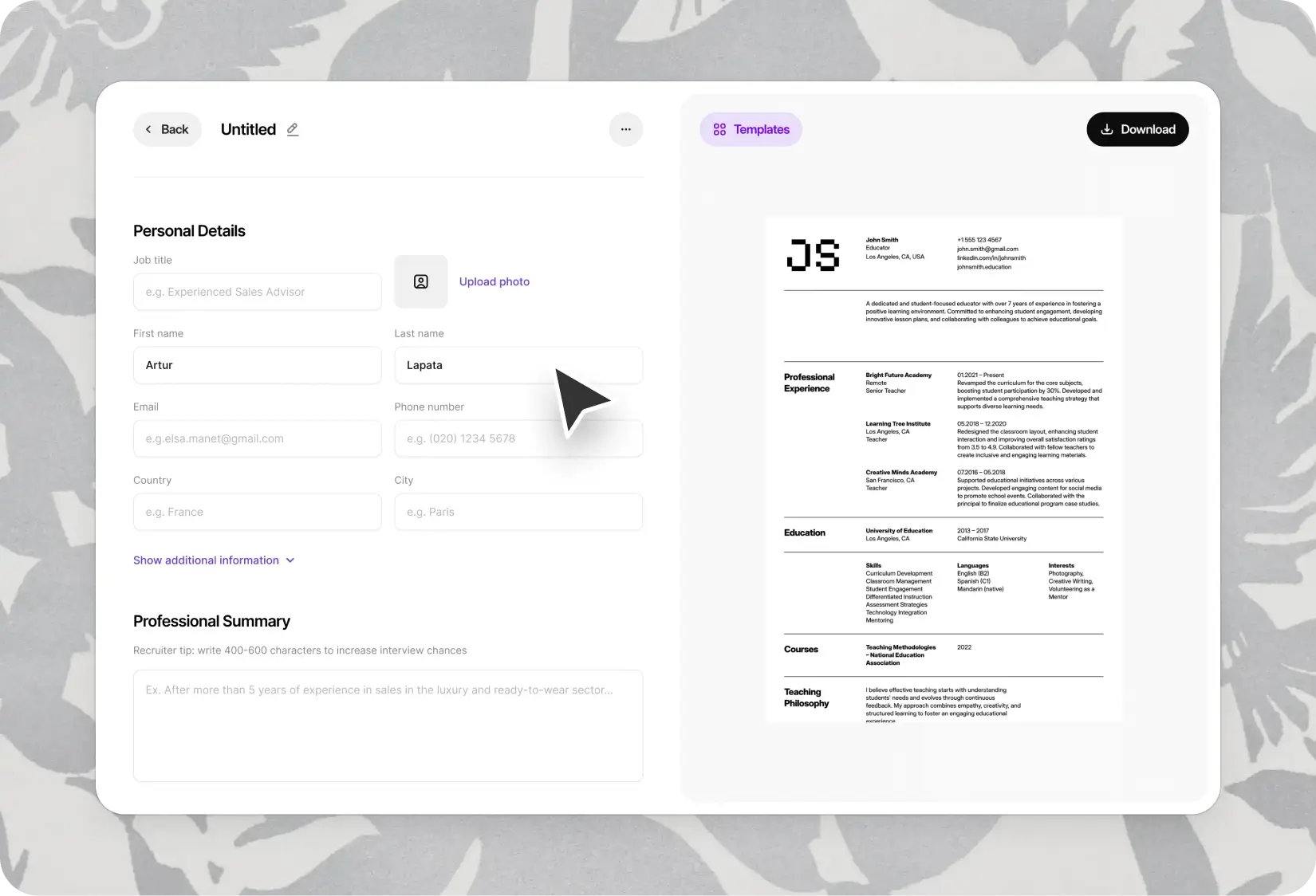
Resume builder interface showing personal details and professional summary fields, with a sample resume preview.

© 2026 Wensa. All right reserved.

Inspired by best practices from certified resume experts.

© 2026 Wensa. All right reserved.

Inspired by best practices from certified resume experts.