Business Development Manager

BDM Resume Examples — Prove Strategy, Not Just Sales Numbers

8 BDM resume examples across SaaS, enterprise, fintech, and consulting. See how top candidates show pipeline strategy — not just closed deals.

Updated Apr 2, 2026

Written by Artur Lopato

Business development manager resume example on a clean textured background

Most business development manager resumes read like a sales highlight reel: deals closed, revenue generated, quota exceeded. The problem? So does every sales rep resume on the pile next to yours.

What separates a BDM from a sales rep isn't the deals they closed. It's the deals they chose to pursue — and the ones they walked away from. Strategic pipeline curation is the core BDM skill, and it's almost invisible on most resumes.

A BDM who can show "declined 18 low-fit opportunities using a custom scoring model, resulting in 2.4x average contract value" tells a hiring manager something no quota number alone can: that this person protects pipeline quality, not just pipeline volume.

The BDM identity problem: sales, strategy, or both?

Business development sits at the intersection of sales, strategy, and partnerships — and different companies mean very different things by the title. Before writing a word, identify which version of BDM the role requires:

  • Revenue-focused BDM — owns a new business quota, manages outbound pipeline, and closes contracts. Resume should lead with ARR generated, win rates, and deal sizes.

  • Partnerships-focused BDM — builds strategic alliances, channel relationships, and ecosystem deals. Resume should lead with partner revenue contributed, ecosystem breadth, and co-selling outcomes.

  • Market-expansion BDM — opens new verticals, geographies, or customer segments. Resume should lead with new markets entered, first logos acquired, and revenue established from zero.

A resume that blurs these three profiles convinces no one. Match your framing to what the job description actually describes — even if your background spans all three.

Why pipeline metrics outperform revenue metrics on a BDM resume

Revenue figures tell a hiring manager what happened. Pipeline metrics tell them how — and how repeatable it is.

"Generated $3.2M in new ARR" is strong. "Built outbound pipeline from $0 to $4.8M in 14 months, converting 22% of qualified opportunities against an industry average of 12%" is the difference between a result and a system. Hiring managers at growth-stage companies are buying the system, not just the number.

Browse Wensa's 8 BDM examples to see how different profiles — from enterprise BDMs to SaaS partnerships leads — structure this distinction. Start with an ATS-compatible BDM resume template already formatted for the experience-and-impact layout recruiters read fastest. Our resume writing guide covers the foundational structure before you begin tailoring.

Business Development Manager Resume Examples by Role and Industry
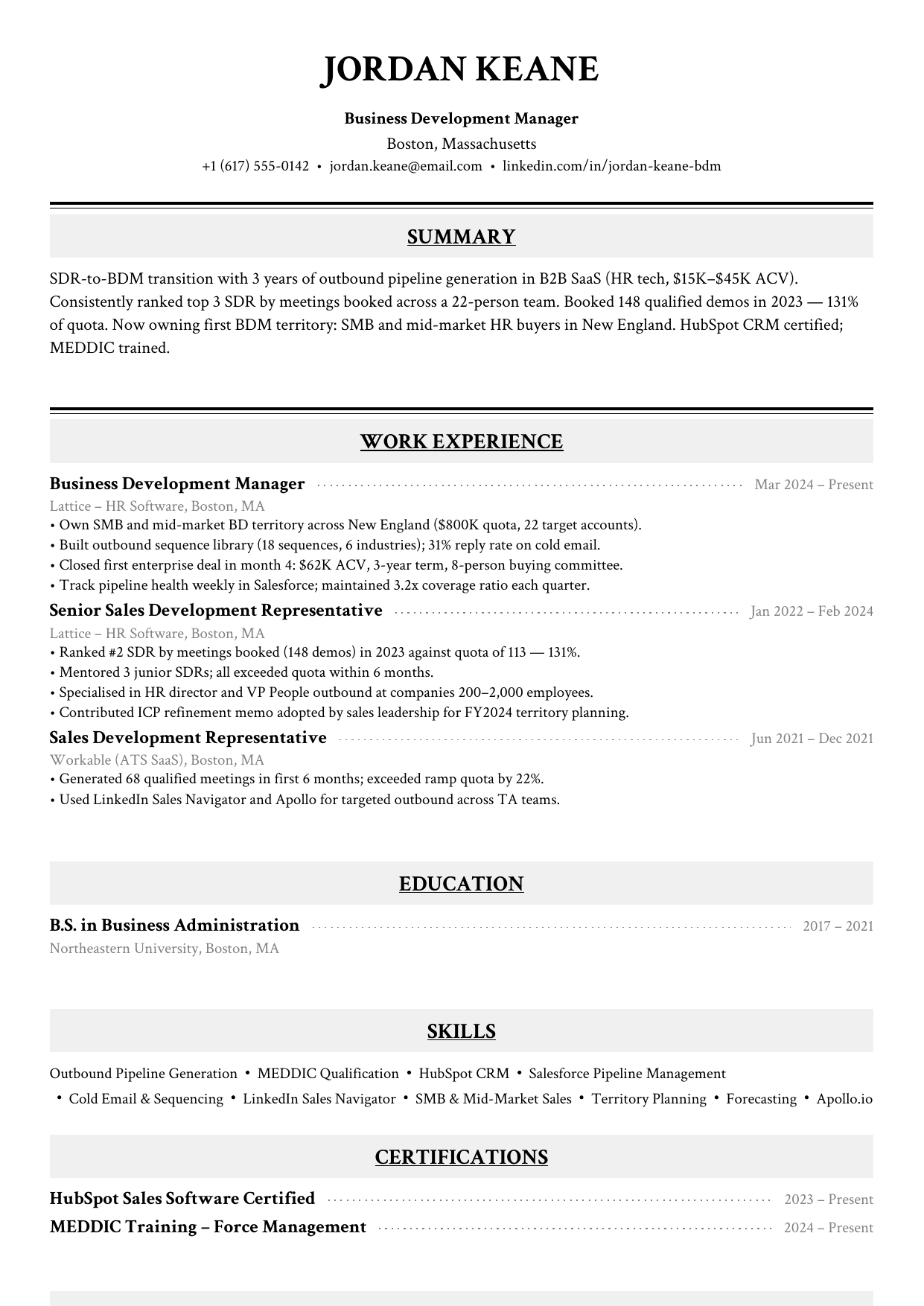
Entry-Level Business Development Manager Resume

Built for SDRs and BDRs stepping into their first BDM role. Front-loads outbound activity metrics (calls, sequences, meetings booked) alongside early pipeline ownership data. A focused summary names the target sector and a standout result from the previous role — framed as strategic decision-making, not just activity volume. CRM proficiency (Salesforce, HubSpot) appears prominently in a dedicated tools section.

Mid-Level Business Development Manager Resume

A well-rounded example for BDMs with 4-7 years owning new business quotas, building outbound systems, and closing mid-market to enterprise deals. The summary leads with sector, deal complexity, and a top-line commercial outcome. Experience bullets follow the decision-first structure throughout: what market insight or strategic choice drove the result, not just what the result was.

  • Shows ICP definition and pipeline qualification methodology alongside closed revenue

  • Demonstrates CRM ownership: Salesforce pipeline hygiene, forecasting accuracy, and deal stage discipline

  • Includes any vertical expansion or new market entry work — the most differentiating BDM signal at this level

Senior Business Development Manager Resume

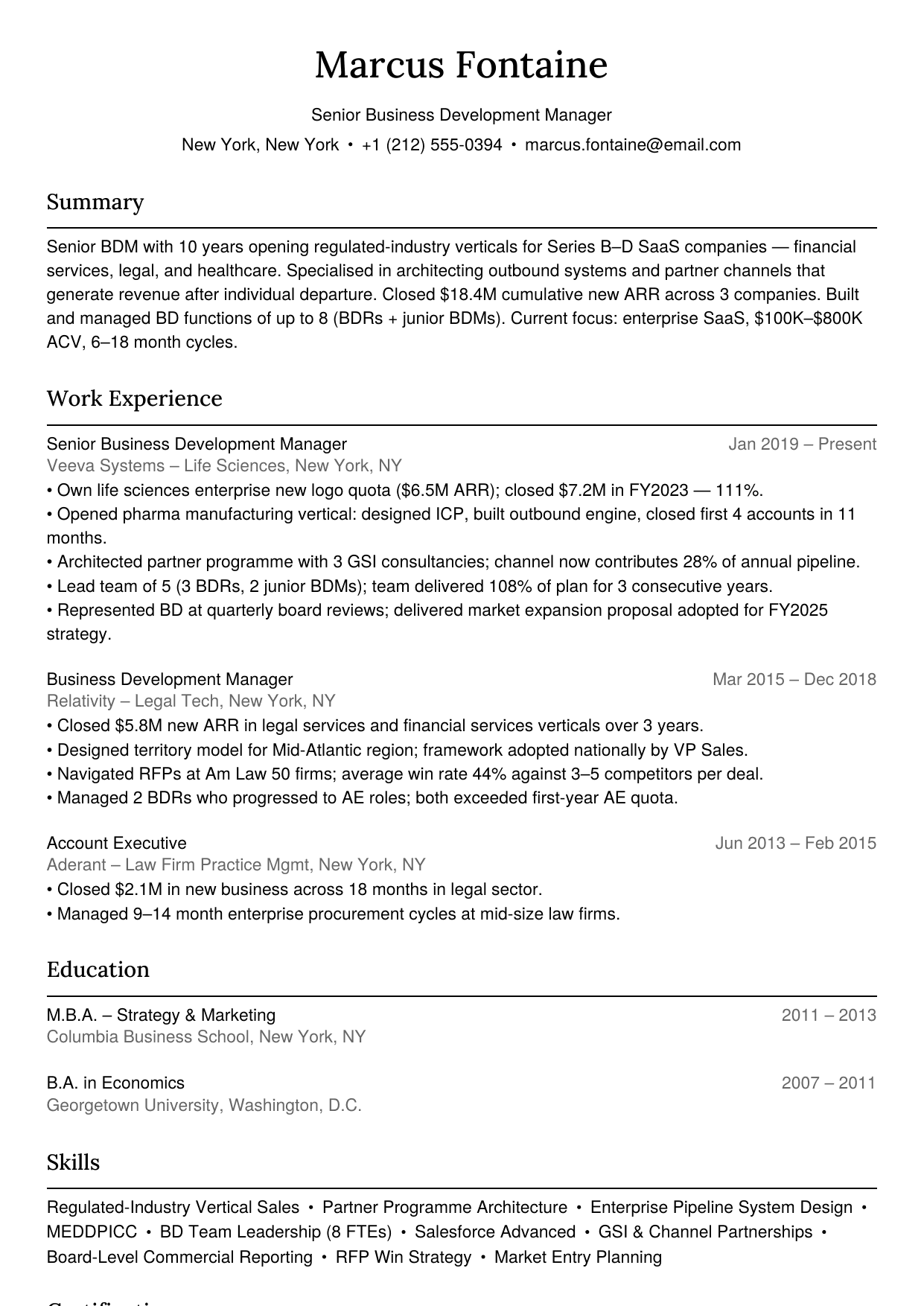
For BDMs with 8-12 years who have owned significant revenue targets, opened new markets, and begun influencing commercial strategy. The resume shifts from "I closed" to "I architected" — partner programmes built, verticals opened, outbound systems designed that outlasted the individual's tenure. Any team leadership — BDRs or junior BDMs managed — is documented with performance outcomes, not just headcount.

The summary at this level names a specialization that sets the candidate apart: "Specialize in opening regulated-industry verticals for Series B-to-D SaaS companies" is a positioning statement that immediately narrows the field against candidates with broader but shallower track records.

Director of Business Development Resume

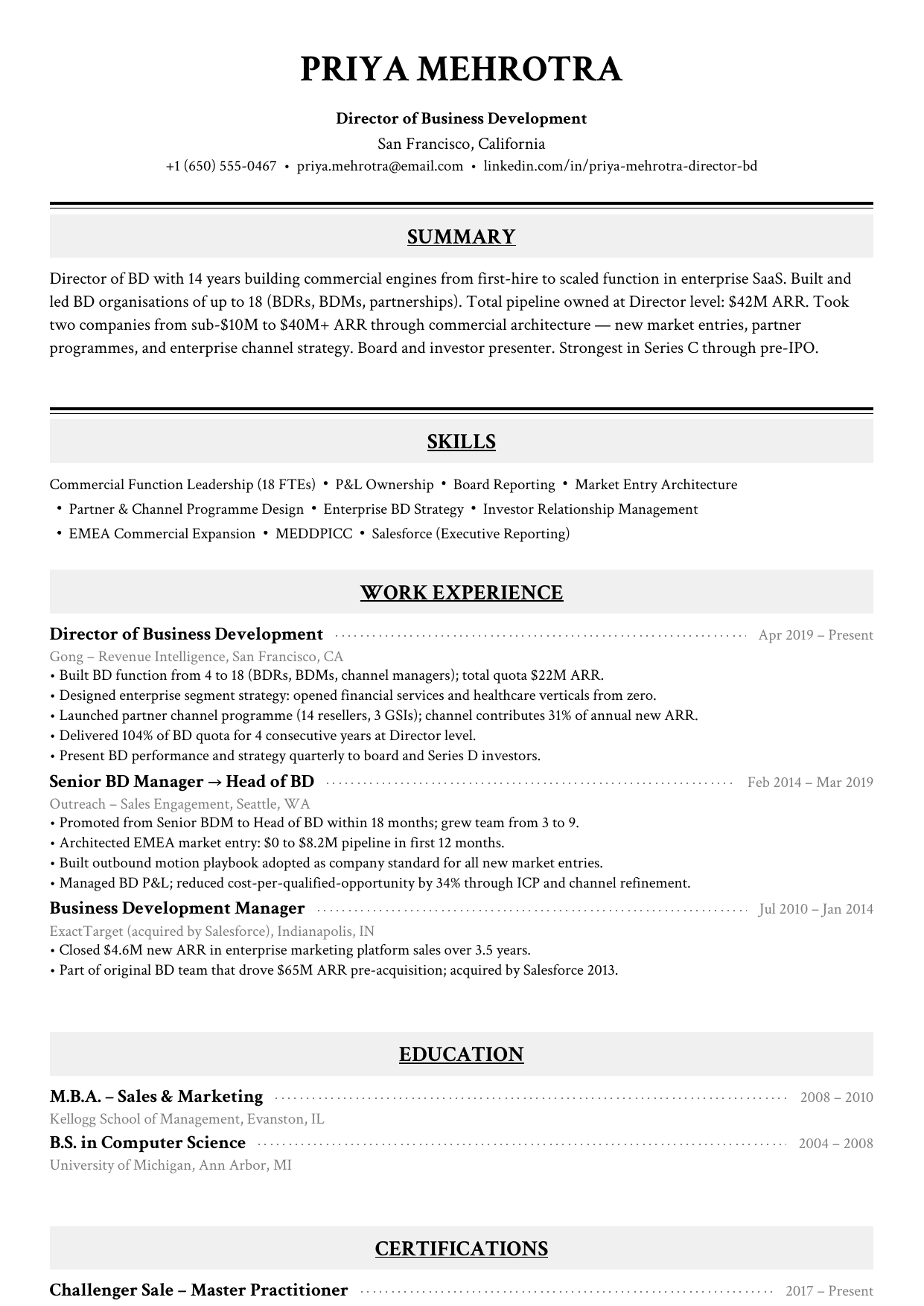
The director-level BDM resume pivots from individual revenue contribution to commercial function leadership. This example leads with organizational scope: BD team built, total pipeline owned, revenue targets set vs achieved, and strategic initiatives designed. Every bullet proves a decision at organizational scale — not an account won, but a market entered, a partner model launched, or a BD function restructured.

At director level, the resume answers: how big was the commercial engine you built, what did it produce, and what kind of company needs that engine next?

SaaS Business Development Manager Resume

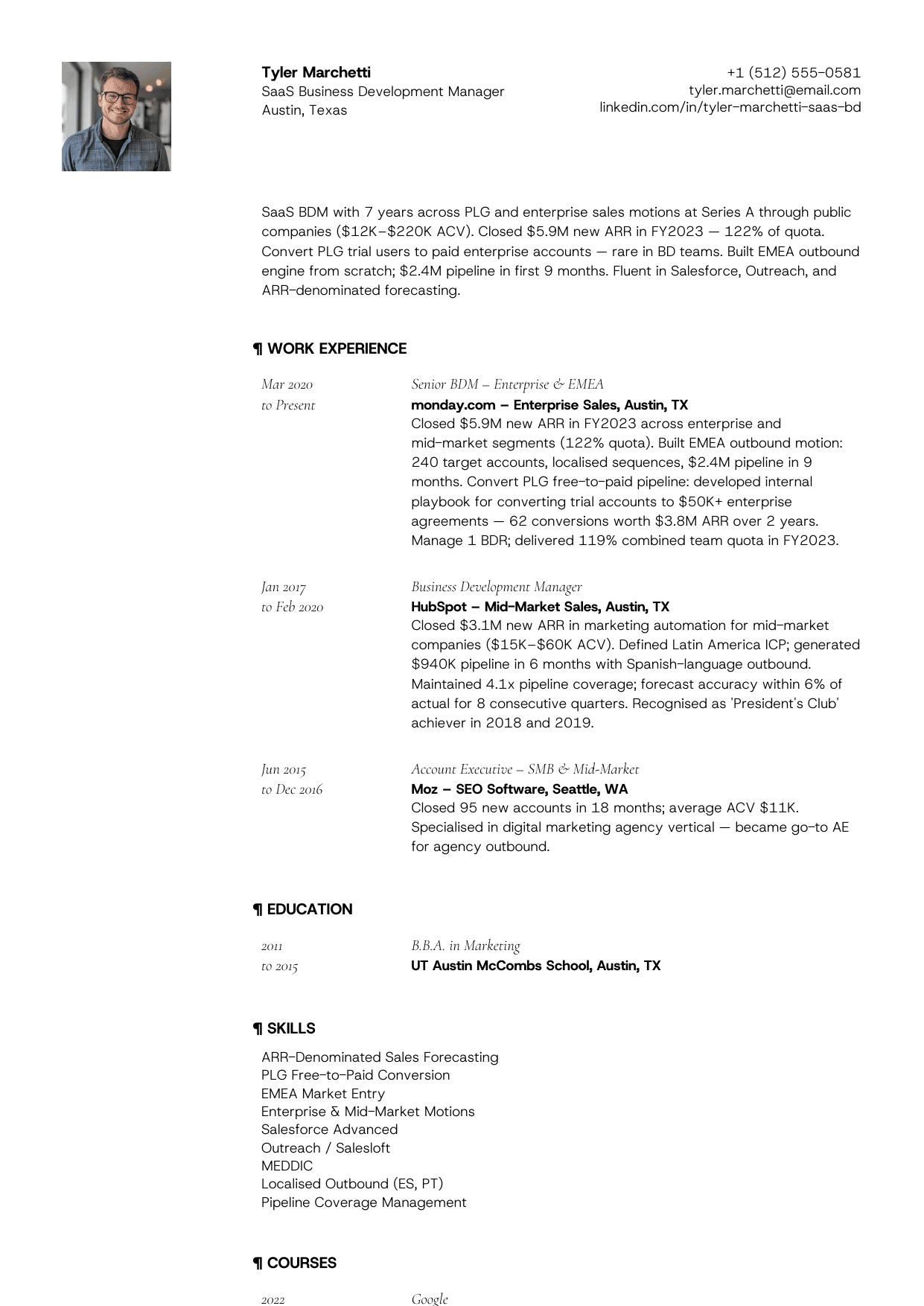
SaaS BDM resumes operate on ARR-denominated metrics — and this example uses them correctly. Every revenue bullet names the ARR tier (not just dollar figure), the sales motion (PLG, sales-led, enterprise), and the deal economics (ACV, expansion revenue, NRR contribution). Product-led growth familiarity and the ability to convert free/trial users to paid accounts appears as a distinct competency where held — it's a rare BDM skill that SaaS-native companies specifically filter for.

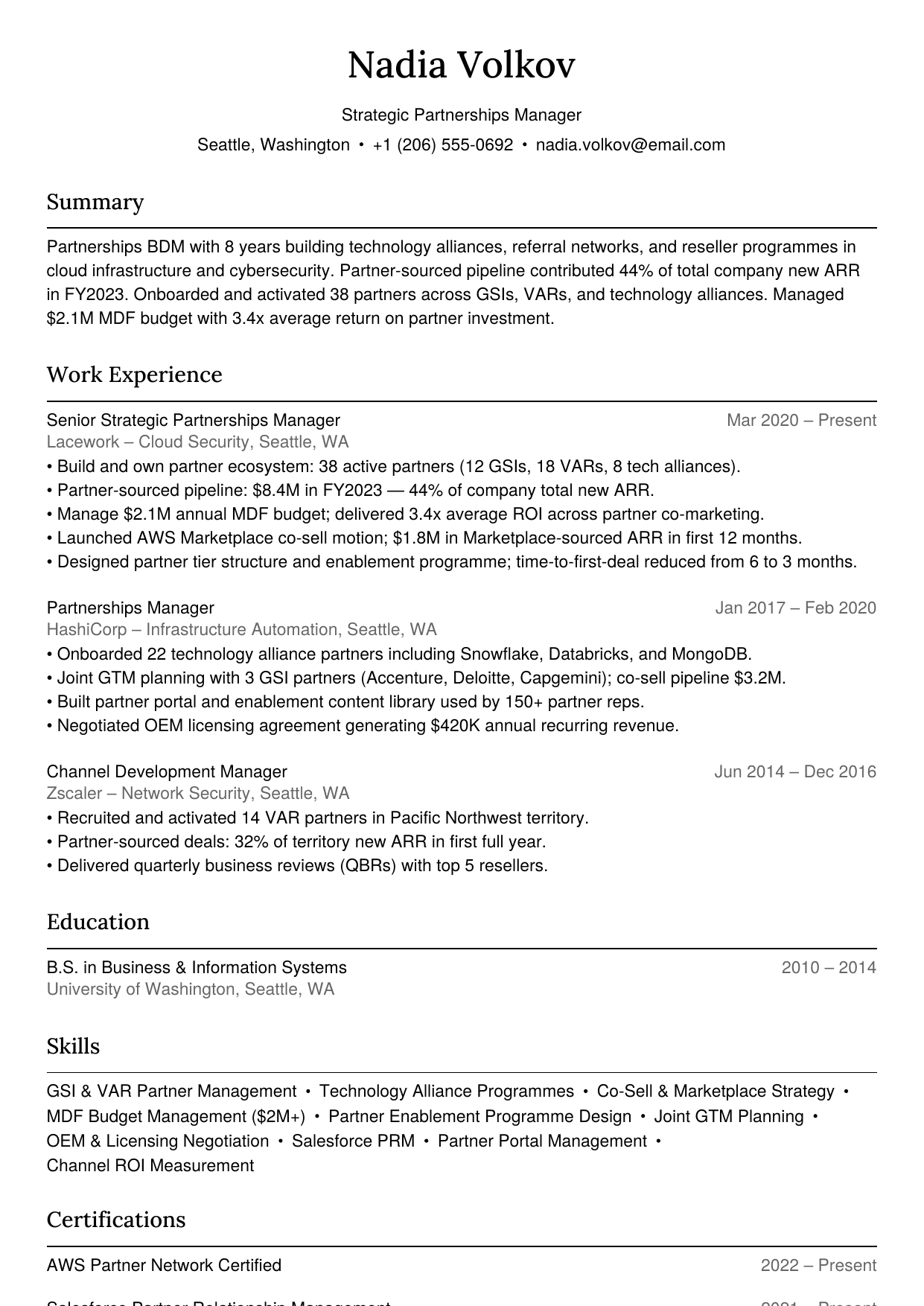
Partnerships Business Development Manager Resume

Partnership-focused BDM resumes need to prove ecosystem thinking, not just deal-making. This example separates partner-sourced pipeline from direct new business, names partner types (GSIs, VARs, technology alliances, referral networks), and shows both the activation metrics (partners onboarded, enablement completed) and the commercial outcomes (co-sell revenue, pipeline influenced, customer introductions converted). MDF management and joint GTM planning experience appear as distinct competencies.

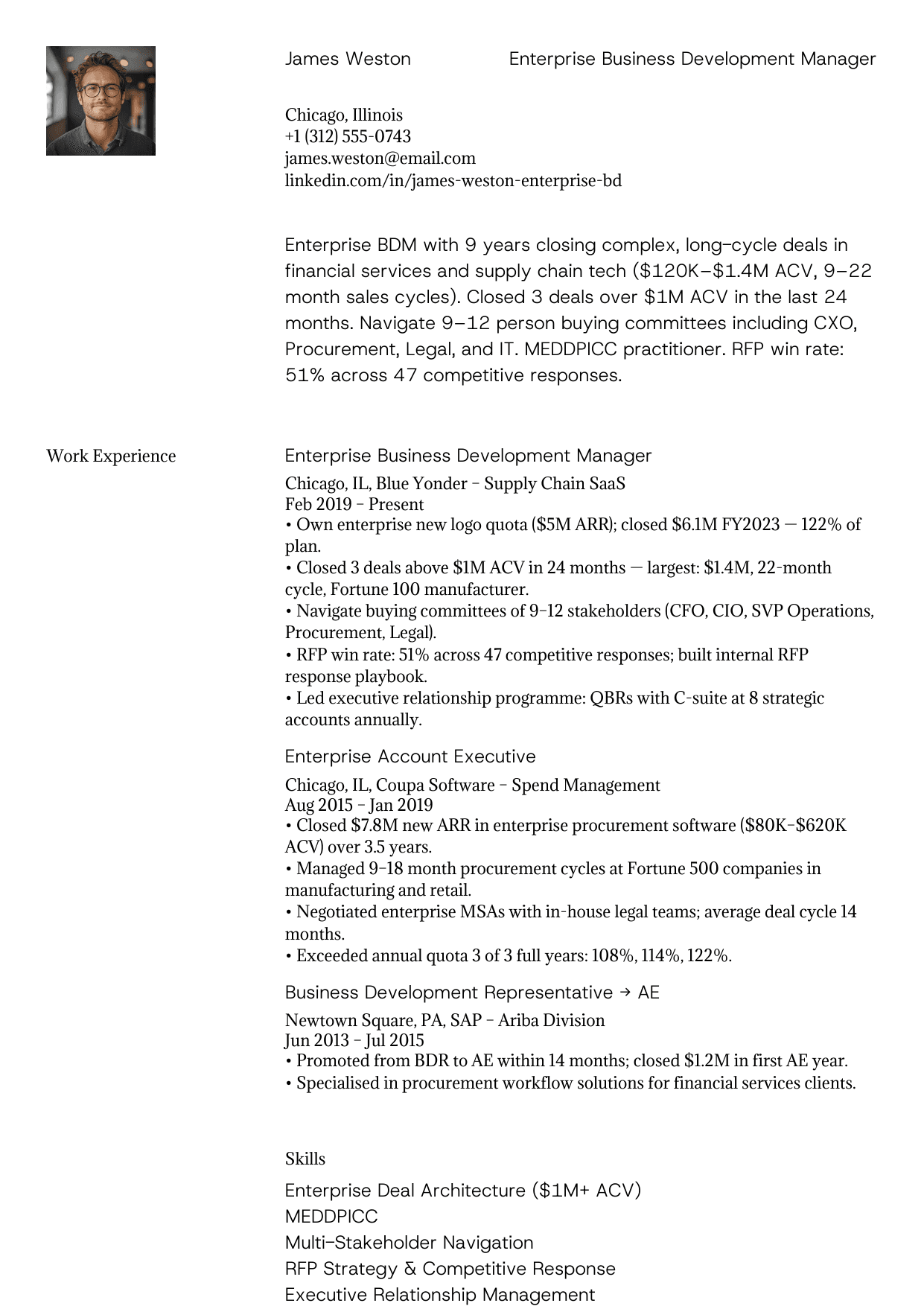
Enterprise Business Development Manager Resume

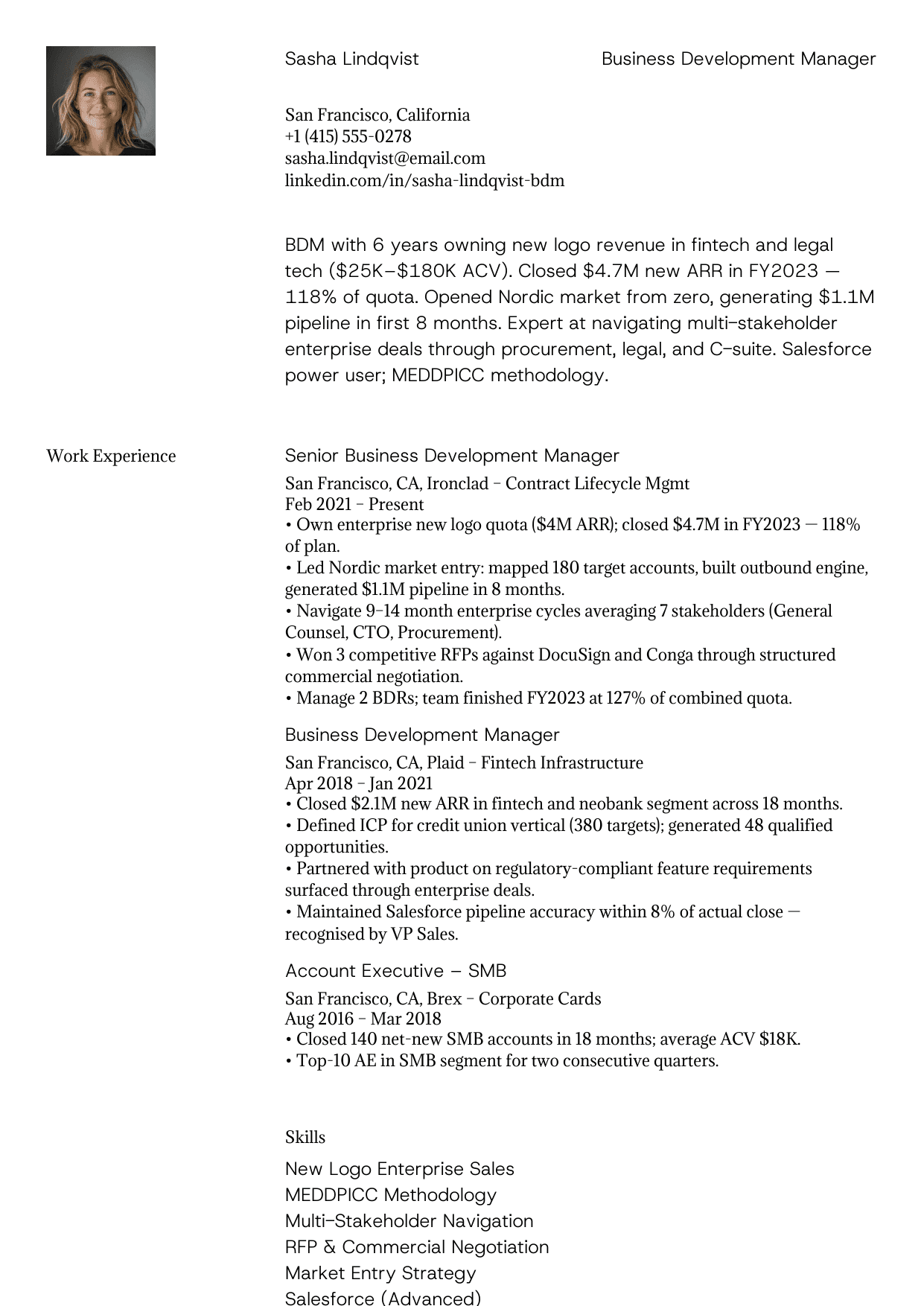
Enterprise BDM resumes are won or lost on deal complexity signals. This example leads with ACV range, sales cycle length, and the number of stakeholders navigated per deal — because enterprise hiring managers are screening for candidates who can manage 9-18 month procurement processes, not just close fast-moving mid-market deals. RFP response experience, commercial negotiation outcomes, and C-suite relationship management all appear as explicit competencies with scope and outcome attached.

The skills section leads with enterprise-specific signals: MEDDIC or MEDDPICC methodology, account mapping tools, procurement and legal negotiation experience, and executive relationship programme management. These vocabulary signals distinguish genuine enterprise BDMs from mid-market candidates who've had occasional large-deal exposure.

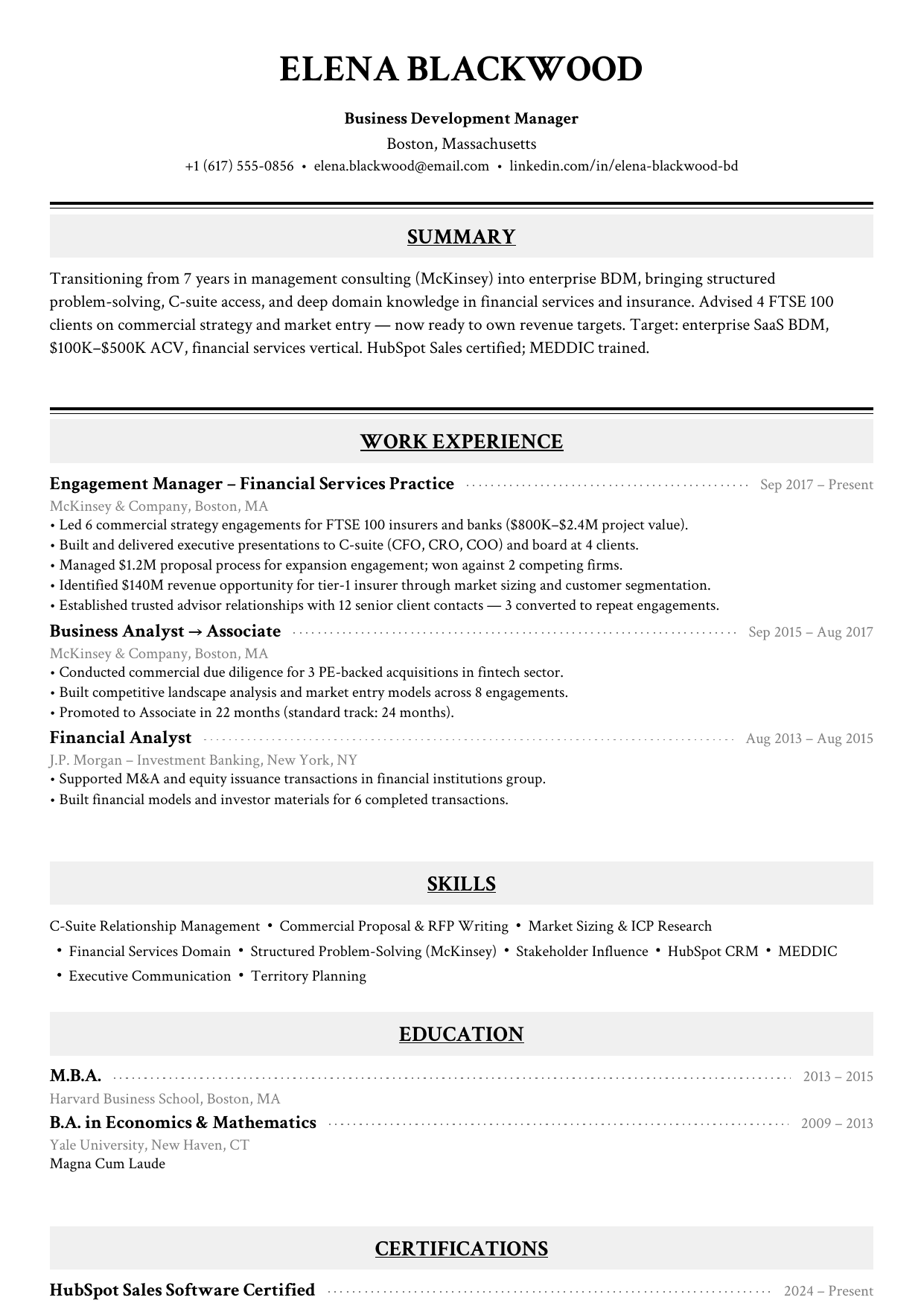
Career Change into Business Development Resume

Built for candidates transitioning from consulting, finance, engineering, or account management into a dedicated BDM role. Uses a combination layout — relevant commercial skills and achievements front-loaded before chronological experience — to bridge domain expertise with BD-specific capability. The summary explicitly names the transition: "Transitioning from 6 years in management consulting into enterprise BDM, bringing structured problem-solving, C-suite access, and sector knowledge in financial services." Transferable signals — proposal writing, stakeholder influence, commercial analysis — are mapped to BD competencies throughout.

Entry-Level Business Development Manager Resume

Built for SDRs and BDRs stepping into their first BDM role. Front-loads outbound activity metrics (calls, sequences, meetings booked) alongside early pipeline ownership data. A focused summary names the target sector and a standout result from the previous role — framed as strategic decision-making, not just activity volume. CRM proficiency (Salesforce, HubSpot) appears prominently in a dedicated tools section.

Mid-Level Business Development Manager Resume

A well-rounded example for BDMs with 4-7 years owning new business quotas, building outbound systems, and closing mid-market to enterprise deals. The summary leads with sector, deal complexity, and a top-line commercial outcome. Experience bullets follow the decision-first structure throughout: what market insight or strategic choice drove the result, not just what the result was.

  • Shows ICP definition and pipeline qualification methodology alongside closed revenue

  • Demonstrates CRM ownership: Salesforce pipeline hygiene, forecasting accuracy, and deal stage discipline

  • Includes any vertical expansion or new market entry work — the most differentiating BDM signal at this level

Senior Business Development Manager Resume

For BDMs with 8-12 years who have owned significant revenue targets, opened new markets, and begun influencing commercial strategy. The resume shifts from "I closed" to "I architected" — partner programmes built, verticals opened, outbound systems designed that outlasted the individual's tenure. Any team leadership — BDRs or junior BDMs managed — is documented with performance outcomes, not just headcount.

The summary at this level names a specialization that sets the candidate apart: "Specialize in opening regulated-industry verticals for Series B-to-D SaaS companies" is a positioning statement that immediately narrows the field against candidates with broader but shallower track records.

Director of Business Development Resume

The director-level BDM resume pivots from individual revenue contribution to commercial function leadership. This example leads with organizational scope: BD team built, total pipeline owned, revenue targets set vs achieved, and strategic initiatives designed. Every bullet proves a decision at organizational scale — not an account won, but a market entered, a partner model launched, or a BD function restructured.

At director level, the resume answers: how big was the commercial engine you built, what did it produce, and what kind of company needs that engine next?

SaaS Business Development Manager Resume

SaaS BDM resumes operate on ARR-denominated metrics — and this example uses them correctly. Every revenue bullet names the ARR tier (not just dollar figure), the sales motion (PLG, sales-led, enterprise), and the deal economics (ACV, expansion revenue, NRR contribution). Product-led growth familiarity and the ability to convert free/trial users to paid accounts appears as a distinct competency where held — it's a rare BDM skill that SaaS-native companies specifically filter for.

Partnerships Business Development Manager Resume

Partnership-focused BDM resumes need to prove ecosystem thinking, not just deal-making. This example separates partner-sourced pipeline from direct new business, names partner types (GSIs, VARs, technology alliances, referral networks), and shows both the activation metrics (partners onboarded, enablement completed) and the commercial outcomes (co-sell revenue, pipeline influenced, customer introductions converted). MDF management and joint GTM planning experience appear as distinct competencies.

Enterprise Business Development Manager Resume

Enterprise BDM resumes are won or lost on deal complexity signals. This example leads with ACV range, sales cycle length, and the number of stakeholders navigated per deal — because enterprise hiring managers are screening for candidates who can manage 9-18 month procurement processes, not just close fast-moving mid-market deals. RFP response experience, commercial negotiation outcomes, and C-suite relationship management all appear as explicit competencies with scope and outcome attached.

The skills section leads with enterprise-specific signals: MEDDIC or MEDDPICC methodology, account mapping tools, procurement and legal negotiation experience, and executive relationship programme management. These vocabulary signals distinguish genuine enterprise BDMs from mid-market candidates who've had occasional large-deal exposure.

Career Change into Business Development Resume

Built for candidates transitioning from consulting, finance, engineering, or account management into a dedicated BDM role. Uses a combination layout — relevant commercial skills and achievements front-loaded before chronological experience — to bridge domain expertise with BD-specific capability. The summary explicitly names the transition: "Transitioning from 6 years in management consulting into enterprise BDM, bringing structured problem-solving, C-suite access, and sector knowledge in financial services." Transferable signals — proposal writing, stakeholder influence, commercial analysis — are mapped to BD competencies throughout.

How to Write BDM Bullets That Show Strategy, Not Just Activity

The most common BDM resume mistake: bullets that prove you were busy, not that you were effective. Every bullet needs to answer: what decision did you make, and what did it produce?

Activity-Based (Weak)

Strategy-Based (Strong)

"Prospected and qualified new enterprise accounts"

"Built ICP scoring model filtering 400+ inbound leads to 60 qualified accounts — closed 14, generating $1.8M ARR in first 9 months"

"Managed partnerships with technology vendors"

"Identified and activated 6 channel partners in underserved verticals; partner-sourced pipeline grew from 8% to 31% of total new business within 12 months"

"Exceeded annual sales quota by 118%"

"Exceeded quota 118% by shifting focus from SMB to mid-market — average deal size grew from $28K to $74K, reducing sales cycle 3 weeks"

"Developed and executed go-to-market strategy for new vertical"

"Opened healthcare vertical from zero: 4 discovery calls → 2 pilots → 1 $420K anchor client in 6 months, establishing proof point for company's Q1 vertical expansion"

The pattern in every strong version: a decision or system first, then the outcome it produced. Not just what happened — why it happened and what it means for the next company that hires you.

Pro tip: For every revenue bullet, ask yourself: "Could a lucky sales rep have done the same?" If yes, add the strategic layer — the ICP you defined, the vertical you chose, the partner model you built — that turned luck into a repeatable process.

For more on building achievement-based experience sections, see our guide on top resume mistakes to avoid. The sales representative resume examples show how the adjacent role handles similar quantification challenges.

ATS Keywords for Business Development Manager Resumes

BDM is one of the most keyword-variable job titles in ATS systems — the same role gets posted as "Business Development Manager," "Growth Manager," "Strategic Partnerships Manager," and "Sales Development Lead" by different companies. Matching your keyword layer to the exact posting language is more important here than in most other roles.

By specialization

BDM Type

Key ATS Terms

Revenue / New Business

pipeline generation, new logo acquisition, ARR, quota attainment, outbound prospecting, deal cycle, win rate, Salesforce, HubSpot

Strategic Partnerships

channel partnerships, co-sell, ecosystem, partner-sourced revenue, MDF, reseller, GSI, technology alliances, partner enablement

Market Expansion

go-to-market, market entry, vertical expansion, territory development, new market penetration, ICP definition, competitive analysis

Enterprise / B2B

enterprise accounts, C-suite engagement, RFP, multi-stakeholder, contract negotiation, account mapping, executive relationships, procurement

Cross-cutting terms that appear in nearly every BDM posting

  • CRM proficiency — Salesforce is named in over 65% of BDM postings. Name it explicitly.

  • Stakeholder management and cross-functional collaboration — signal that you operate beyond individual contributor scope.

  • Revenue forecasting and pipeline management — indicate commercial maturity beyond closing deals.

Pro tip: Mirror the exact verb tense and phrasing from the job description. If the posting says "drive new business development," use that phrase — not "generate new revenue" or "develop new accounts." ATS parsers weight exact matches more than synonyms.

For a full walkthrough of ATS optimization, read our ATS resume tips guide and our resume skills section guide for how to structure the skills block on a BDM resume.

The BDM Resume Summary: Positioning Over Personality

BDM summaries are uniquely prone to personality-led openers: "charismatic," "relationship-driven," "results-oriented," "tenacious." These are characteristics, not credentials. Hiring managers expect them and skip them.

What doesn't work

"Dynamic business development manager with 8+ years building relationships and driving strategic growth across multiple industries."

Every BDM on the market could write this. It positions nothing.

What works

"Enterprise SaaS BDM with 8 years opening new markets and building channel ecosystems — most recently grew partner-sourced pipeline from 9% to 34% of total ARR at a Series C logistics platform. Specialize in complex, multi-stakeholder deals with 6-12 month sales cycles."

This names a domain, a specialization, a company stage, a specific outcome, and a deal-type expertise. It tells a hiring manager immediately whether you're the right fit — and that clarity is the point.

Pro tip: Avoid adjectives you can't prove. "Charismatic" and "tenacious" are claims. "Opened 3 new verticals in 18 months" is evidence. Let the bullets prove the personality — the summary should prove the positioning.

See how the marketing manager resume examples handle the adjacent commercial positioning problem — useful if your BDM role sits closer to the GTM/marketing boundary. For format decisions, our resume format guide covers when a combination layout outperforms reverse-chronological for career-changing BDM candidates.

Business Development Manager Resume FAQs

How long should a BDM resume be?

One page for under 6 years of experience. Two pages for senior BDMs, heads of BD, and candidates with multi-industry or multi-geography track records worth documenting. Every line on page two needs to add signal — not pad a resume that would be stronger at one tight page.

What's the difference between a BDM resume and a sales manager resume?

Sales managers lead teams and manage existing pipelines. BDMs create new ones — new markets, new partnerships, new revenue streams. If your resume reads like a sales manager's, you're competing in the wrong pool. Lead with what you built, not what you managed.

Should I include CRM tools on a BDM resume?

Always. Salesforce appears in over 65% of BDM job postings — list it explicitly, along with any other tools: HubSpot, Outreach, ZoomInfo, LinkedIn Sales Navigator, Apollo. Name them in a dedicated tools section, not buried in a paragraph.

How do I show BDM impact without revealing confidential pipeline data?

Use percentages instead of absolutes: "grew partner pipeline 3.4x" without disclosing dollar figures. Use ratios: "22% qualified opportunity close rate against industry average of 12%." Use rankings: "#1 new business contributor out of 8 BDMs for two consecutive years." All meaningful. None sensitive.
Recruiter Approved

Build a Resume That Works. Literally.

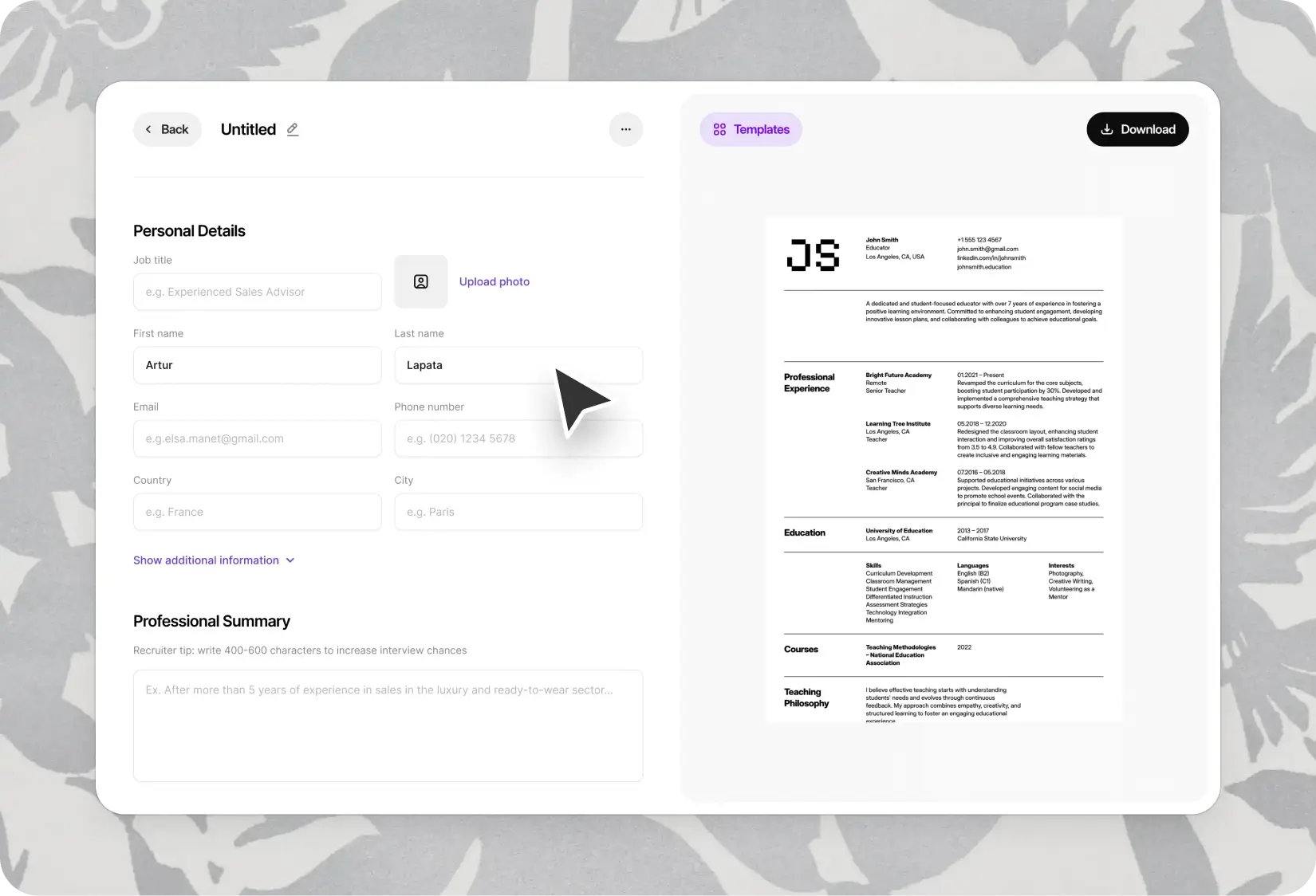
Resume builder interface showing personal details and professional summary fields, with a sample resume preview.

© 2026 Wensa. All right reserved.

Inspired by best practices from certified resume experts.

© 2026 Wensa. All right reserved.

Inspired by best practices from certified resume experts.