Frontend Developer

Frontend Developer Resume Examples That Go Beyond the Framework List

8 frontend developer resume examples from junior to lead. See how strong frontend devs prove engineering judgment — not just framework familiarity — in 2026.

Updated Aug 5, 2026

Written by Artur Lopato

Frontend developer resume example on a clean textured background

Most frontend developer resumes look identical. React. TypeScript. CSS. Vue. Tailwind. Webpack. Git. Every candidate lists the same tools, in roughly the same order, with roughly the same claim of proficiency.

The problem isn't the skills — it's that a skill list proves you've used a tool, not that you've used it well. A hiring manager who sees "React" on 200 resumes can't tell from that word whether you've built production components that handle millions of users or completed a Udemy course last month. The framework list is the floor, not the ceiling. The ceiling is engineering judgment.

What frontend hiring actually looks for in 2026

The framework wars are over. Hiring teams have moved on from debating React vs Vue vs Angular and are now screening for a different set of signals entirely:

  • Core Web Vitals and performance ownership — candidates who can point to measurable improvements in LCP, CLS, FID/INP, and Time to Interactive. "Improved Largest Contentful Paint from 4.2s to 1.1s by lazy-loading images and deferring non-critical JS" proves something "proficient in performance optimization" doesn't.

  • Accessibility as engineering practice — not just "familiar with WCAG" but "reduced accessibility violations from 47 to 3 across the component library, achieving WCAG 2.1 AA compliance." In 2026, accessibility is increasingly a legal requirement and a hiring filter, especially for public sector and enterprise roles.

  • Design system contribution or ownership — building or maintaining a component library used by multiple teams signals maturity that framework knowledge alone doesn't. Name the scale: components built, teams consuming the library, adoption rate across the product surface.

  • Business outcomes tied to technical decisions — the frontend work that moved a product metric. "Rebuilt checkout flow in React, reducing form abandonment 28% and contributing $1.8M additional annual revenue" connects frontend engineering to the business in a way that pure technical descriptions don't.

Browse Wensa's 8 frontend developer examples to see how each level and specialization demonstrates engineering judgment — not just tool familiarity. Start with an ATS-compatible developer resume template already structured for technical roles, and read our resume writing guide before tailoring for your specific stack.

Should your portfolio or GitHub link replace your resume?

No — but it should work alongside it. Your resume gets you through ATS and past the initial recruiter screen. Your portfolio or GitHub then lets you prove the skills the resume claims. They serve different moments in the same process.

A strong GitHub profile with well-documented repos — clear READMEs, meaningful commit histories, projects that solve real problems — adds real credibility for mid-level and senior roles. Include the link in your header. But never let the GitHub link substitute for achievement-led bullets. Recruiters don't explore repos before shortlisting — they read the resume first, and only open the link if the resume already convinced them.

Frontend Developer Resume Examples by Level and Specialization

Junior Frontend Developer Resume

Built for bootcamp graduates and CS graduates stepping into their first frontend role. Rather than hiding limited professional experience, this resume leads with a projects section formatted like real work history — project name, tech stack, what was built, and a measurable outcome or metric. GitHub and portfolio links appear in the header. Core stack (HTML5, CSS3, JavaScript, React) is listed in a skills block above the projects, positioned for ATS keyword scanning.

Mid-Level Frontend Developer Resume

A two-page example for frontend developers with 3-6 years of production experience across multiple products and teams. Each role leads with a one-line company and stack descriptor before the bullets. Technical achievements use the engineering outcome structure throughout: what was built → at what scale → with what measurable result. Core Web Vitals improvements, component library contributions, and cross-team collaboration outcomes appear as distinct competencies beyond framework proficiency.

  • Shows performance optimization ownership: before/after PageSpeed scores or LCP measurements

  • Demonstrates cross-functional work: design system collaboration, backend API integration, product team alignment

  • Includes testing culture evidence: Jest, Cypress, or Playwright coverage added or maintained

Senior Frontend Developer Resume

For frontend developers with 7+ years who have owned significant product surfaces, mentored junior engineers, and made architectural decisions with lasting impact. The resume at this level shifts from "I implemented" to "I designed and owned" — architectural choices made, patterns established, standards introduced. Technical leadership signals appear throughout: RFC or ADR authorship, code review culture built, onboarding documentation created, engineering blog contributions.

Skills section at senior level leads with specialization signals (performance engineering, accessibility, design systems) before listing the standard framework stack — because senior hiring managers are buying engineering judgment, not framework familiarity.

Lead / Principal Frontend Developer Resume

The lead or principal frontend developer resume pivots from individual technical excellence to team and system-level influence. This example leads with: team size led or mentored, architectural scope owned, and the engineering outcomes that resulted from technical leadership decisions — not just from individual implementation. "Defined frontend architecture for a greenfield product now serving 800K users, adopted by 4 engineering squads" proves a different kind of value than any single component or performance improvement.

At lead level, the resume answers: what would the frontend engineering practice look like if you hadn't been there — and how is it different because you were?

React Developer Resume

A React-specialist resume that goes beyond listing "React" and proves depth through specificity. React version experience is named (hooks, context, concurrent features, React 18/19 transitions), alongside the ecosystem tools that signal production maturity: Next.js app router, React Query, Zustand or Redux Toolkit, React Testing Library, Storybook. Every role bullet names the React-specific architectural decision made and its performance or product outcome.

Design Systems Engineer Resume

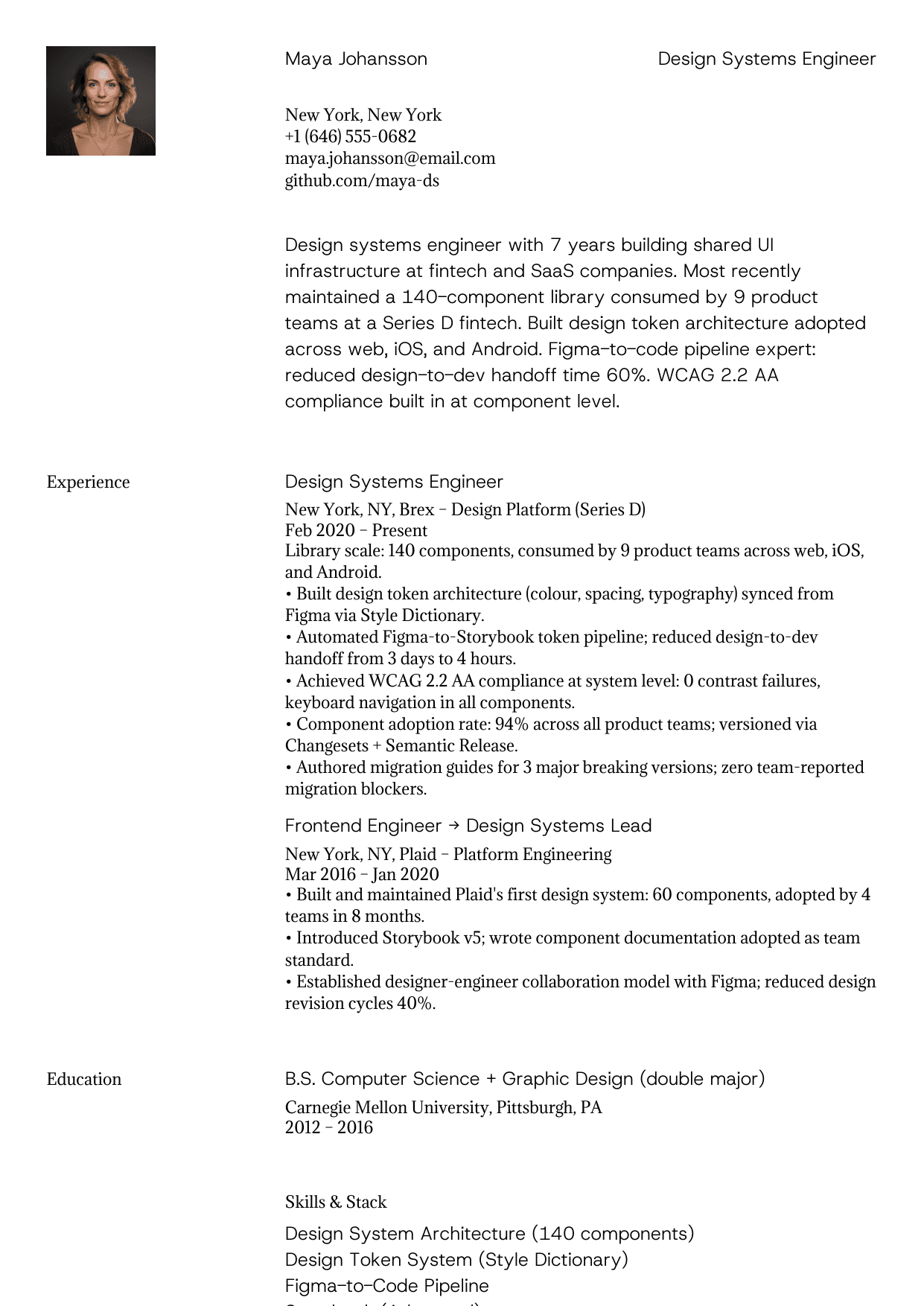
Design systems engineering is the fastest-growing frontend specialization at mid-to-large scale companies — and this resume reflects that it's a distinct discipline, not just "frontend + Storybook." Leads with: component library scale (components built, teams consuming), design token architecture, documentation quality, adoption metrics across product surfaces, and the designer-engineer collaboration model established. Figma integration, accessibility compliance built into the system level, and versioning/migration strategy experience all appear as explicit design systems competencies.

Frontend Performance Engineer Resume

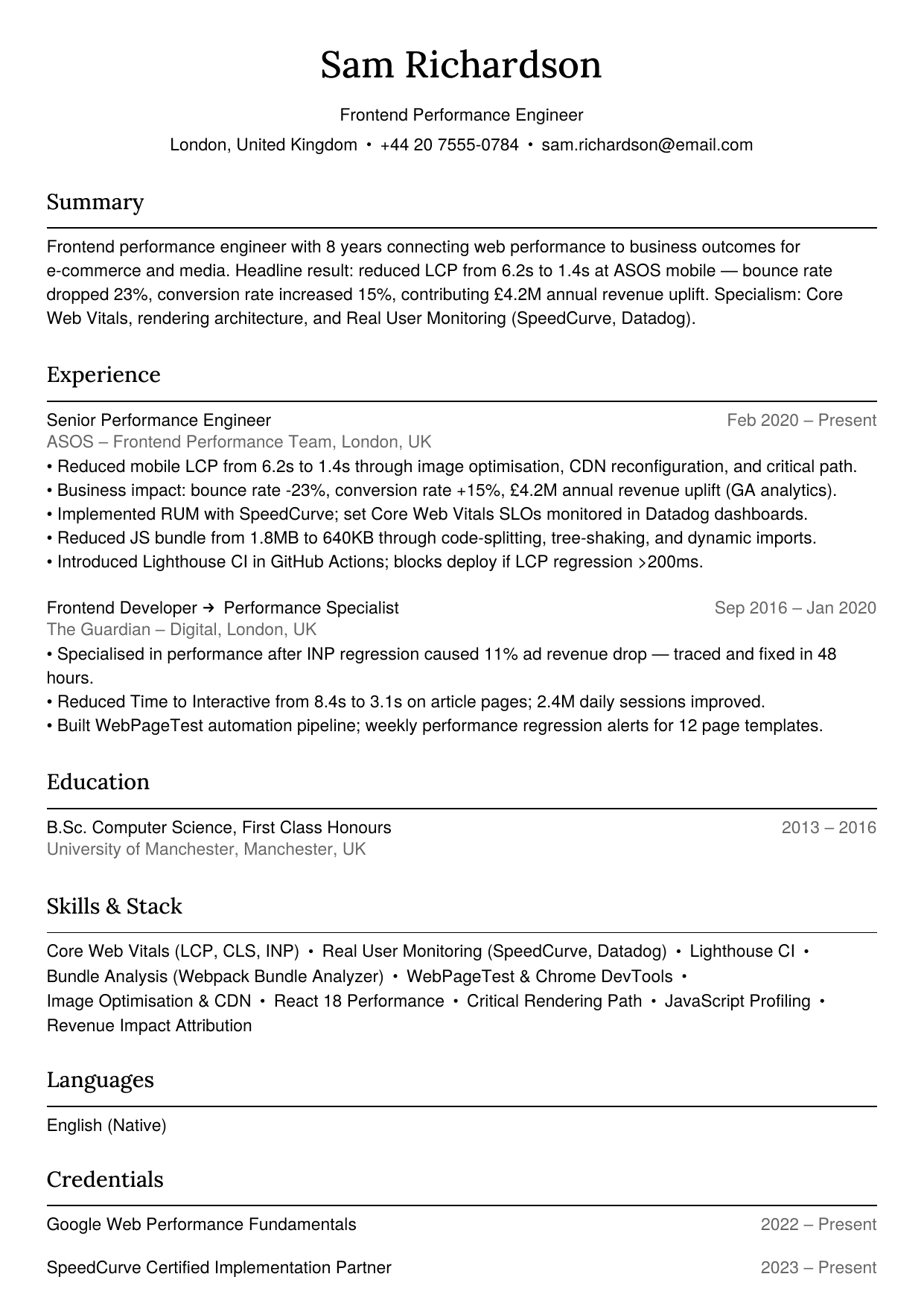
Performance engineering is where frontend work most directly connects to business outcomes — and this resume makes that connection explicit. Every achievement is framed in both technical and business terms: "Reduced LCP from 6.2s to 1.4s through image optimization and CDN reconfiguration — bounce rate dropped 23%, directly contributing to a 15% increase in conversion rate." Core Web Vitals, Lighthouse, WebPageTest, and Real User Monitoring tools (Datadog, New Relic, SpeedCurve) all appear as explicit competencies alongside the standard frontend stack.

Frontend Accessibility Specialist Resume

Accessibility engineering is increasingly a compliance requirement, not just a best practice — and this resume positions it as such. Leads with WCAG compliance achievements and audit outcomes, then demonstrates the technical depth behind them: ARIA implementation, keyboard navigation engineering, screen reader testing methodology (NVDA, JAWS, VoiceOver), and automated testing integration (axe-core, Pa11y in CI/CD pipelines). Legal compliance context — ADA, Section 508, UK PSBAR, EU Web Accessibility Directive — appears for candidates with public sector or regulated industry experience.

Junior Frontend Developer Resume

Built for bootcamp graduates and CS graduates stepping into their first frontend role. Rather than hiding limited professional experience, this resume leads with a projects section formatted like real work history — project name, tech stack, what was built, and a measurable outcome or metric. GitHub and portfolio links appear in the header. Core stack (HTML5, CSS3, JavaScript, React) is listed in a skills block above the projects, positioned for ATS keyword scanning.

Mid-Level Frontend Developer Resume

A two-page example for frontend developers with 3-6 years of production experience across multiple products and teams. Each role leads with a one-line company and stack descriptor before the bullets. Technical achievements use the engineering outcome structure throughout: what was built → at what scale → with what measurable result. Core Web Vitals improvements, component library contributions, and cross-team collaboration outcomes appear as distinct competencies beyond framework proficiency.

  • Shows performance optimization ownership: before/after PageSpeed scores or LCP measurements

  • Demonstrates cross-functional work: design system collaboration, backend API integration, product team alignment

  • Includes testing culture evidence: Jest, Cypress, or Playwright coverage added or maintained

Senior Frontend Developer Resume

For frontend developers with 7+ years who have owned significant product surfaces, mentored junior engineers, and made architectural decisions with lasting impact. The resume at this level shifts from "I implemented" to "I designed and owned" — architectural choices made, patterns established, standards introduced. Technical leadership signals appear throughout: RFC or ADR authorship, code review culture built, onboarding documentation created, engineering blog contributions.

Skills section at senior level leads with specialization signals (performance engineering, accessibility, design systems) before listing the standard framework stack — because senior hiring managers are buying engineering judgment, not framework familiarity.

Lead / Principal Frontend Developer Resume

The lead or principal frontend developer resume pivots from individual technical excellence to team and system-level influence. This example leads with: team size led or mentored, architectural scope owned, and the engineering outcomes that resulted from technical leadership decisions — not just from individual implementation. "Defined frontend architecture for a greenfield product now serving 800K users, adopted by 4 engineering squads" proves a different kind of value than any single component or performance improvement.

At lead level, the resume answers: what would the frontend engineering practice look like if you hadn't been there — and how is it different because you were?

React Developer Resume

A React-specialist resume that goes beyond listing "React" and proves depth through specificity. React version experience is named (hooks, context, concurrent features, React 18/19 transitions), alongside the ecosystem tools that signal production maturity: Next.js app router, React Query, Zustand or Redux Toolkit, React Testing Library, Storybook. Every role bullet names the React-specific architectural decision made and its performance or product outcome.

Design Systems Engineer Resume

Design systems engineering is the fastest-growing frontend specialization at mid-to-large scale companies — and this resume reflects that it's a distinct discipline, not just "frontend + Storybook." Leads with: component library scale (components built, teams consuming), design token architecture, documentation quality, adoption metrics across product surfaces, and the designer-engineer collaboration model established. Figma integration, accessibility compliance built into the system level, and versioning/migration strategy experience all appear as explicit design systems competencies.

Frontend Performance Engineer Resume

Performance engineering is where frontend work most directly connects to business outcomes — and this resume makes that connection explicit. Every achievement is framed in both technical and business terms: "Reduced LCP from 6.2s to 1.4s through image optimization and CDN reconfiguration — bounce rate dropped 23%, directly contributing to a 15% increase in conversion rate." Core Web Vitals, Lighthouse, WebPageTest, and Real User Monitoring tools (Datadog, New Relic, SpeedCurve) all appear as explicit competencies alongside the standard frontend stack.

Frontend Accessibility Specialist Resume

Accessibility engineering is increasingly a compliance requirement, not just a best practice — and this resume positions it as such. Leads with WCAG compliance achievements and audit outcomes, then demonstrates the technical depth behind them: ARIA implementation, keyboard navigation engineering, screen reader testing methodology (NVDA, JAWS, VoiceOver), and automated testing integration (axe-core, Pa11y in CI/CD pipelines). Legal compliance context — ADA, Section 508, UK PSBAR, EU Web Accessibility Directive — appears for candidates with public sector or regulated industry experience.

Writing Frontend Developer Bullets That Prove Engineering Judgment

The shift from tool description to engineering outcome is the single most valuable edit you can make to a frontend resume. Here's what it looks like in practice:

Tool Description (Weak)

Engineering Outcome (Strong)

"Built UI components using React and TypeScript"

"Built 40+ accessible React components in TypeScript for a shared design system used across 6 product teams, reducing UI inconsistencies by 70% and cutting new feature dev time by 30%"

"Improved website performance"

"Reduced bundle size 58% through code splitting and tree shaking — LCP dropped from 5.8s to 1.6s, lifting Google PageSpeed score from 41 to 94"

"Worked closely with design team on UI implementation"

"Partnered with 3 designers to define component API contracts before implementation — reduced design-to-dev handoff cycles from 4 rounds to 1 across 2 major product launches"

"Developed responsive web applications"

"Rebuilt mobile checkout flow as fully responsive React SPA — mobile conversion rate increased 34%, now accounts for 61% of total e-commerce revenue"

The structure that works: what you built → at what scale → using which specific approach → with what measurable outcome. Not every bullet needs a business metric — technical metrics (bundle size, test coverage, PageSpeed score) are meaningful and credible on their own for engineering roles.

Pro tip: Add a one-line company descriptor before your first bullet in each role. "B2B SaaS platform, 400K monthly active users, React/TypeScript/GraphQL stack" takes ten words and tells the hiring manager whether your experience is relevant before they read a single achievement.

For more on converting technical responsibilities into impact-led bullets, see our top resume mistakes guide. The software engineer resume examples show how full-stack and backend roles handle the same technical-to-business translation.

ATS Keywords for Frontend Developer Resumes in 2026

Frontend is one of the most keyword-dense categories in tech hiring — the framework and library landscape is wide, and ATS systems at larger companies filter on specific technology terms before any human reads the resume.

Core keywords every frontend resume needs

  • Languages: JavaScript, TypeScript, HTML5, CSS3 — spell them exactly as they appear in job postings. "JS" is not the same as "JavaScript" in most ATS parsers.

  • Frameworks and libraries: Name every major one you've used in production: React, Vue.js, Angular, Next.js, Nuxt, Svelte, Astro. Include version context where it signals depth: "React (hooks, context, concurrent features since v18)."

  • Styling and tooling: Tailwind CSS, CSS Modules, Styled Components, Sass/SCSS, Webpack, Vite, ESBuild, Rollup, npm, pnpm — name the build tools explicitly. Many postings filter on Vite or Webpack separately.

  • Testing: Jest, Vitest, React Testing Library, Cypress, Playwright, Storybook — test tooling is increasingly an ATS keyword, especially for senior roles where testing culture is assessed.

2026 differentiator keywords

  • Performance: Core Web Vitals, LCP, CLS, INP, Lighthouse, PageSpeed, code splitting, lazy loading, tree shaking, bundle optimization

  • Accessibility: WCAG 2.1, ARIA, screen reader, keyboard navigation, accessibility audit, axe-core, a11y

  • Design systems: component library, design tokens, Storybook, Figma, Radix UI, Headless UI, design system governance

  • AI-adjacent (emerging): AI-assisted development, Copilot, v0, Cursor, LLM integration, streaming UI — relevant for product companies building AI features in 2026

Pro tip: Put your tech stack in a dedicated "Skills" or "Technologies" section before your experience — not after. ATS systems parse skills sections separately, and recruiters glance at the tech stack before reading work history. Format it as categories, not a single comma-separated list: Languages / Frameworks / Testing / Tools.

For a comprehensive ATS optimization walkthrough, read our ATS resume tips guide and our resume skills section guide for how to structure the tech skills block specifically. The data science resume examples show how adjacent technical roles handle the same keyword density challenge.

Frontend Developer Resume FAQs

Should I include every framework I've touched?

Only include frameworks you'd be comfortable being interviewed on. "Familiar with Angular" when you completed one tutorial creates a credibility problem if the interviewer digs in. Tier your skills if needed: "Expert: React, TypeScript, Next.js — Proficient: Vue.js, GraphQL — Familiar: Angular, Svelte." Honesty in skill tiering impresses senior engineers more than a long list.

One page or two for a frontend developer resume?

One page for fewer than 5 years of experience. Two pages for senior and lead developers with multiple production systems, open source contributions, or conference talks worth documenting. Unlike non-technical roles, a projects section that adds real signal can justify the second page even at 3-4 years of experience.

How important is a portfolio for a frontend developer resume?

Important — but it lives in the header, not the resume body. Include your GitHub and/or portfolio URL at the top alongside LinkedIn. Then reference specific projects with links inline in your experience section where they're relevant. Don't dedicate half your resume to describing portfolio projects when a link does the showing for you.

How do I write a frontend resume without professional experience?

Lead with a projects section above your experience section. Format each project like a professional role: project name, tech stack, what you built, and a measurable outcome or metric. Contributions to open-source projects, hackathon wins, and bootcamp capstone projects all belong here with the same achievement-first structure as professional work. See our resume format guide for how to structure a combination layout that front-loads projects before experience.
Recruiter Approved

Build a Resume That Works. Literally.

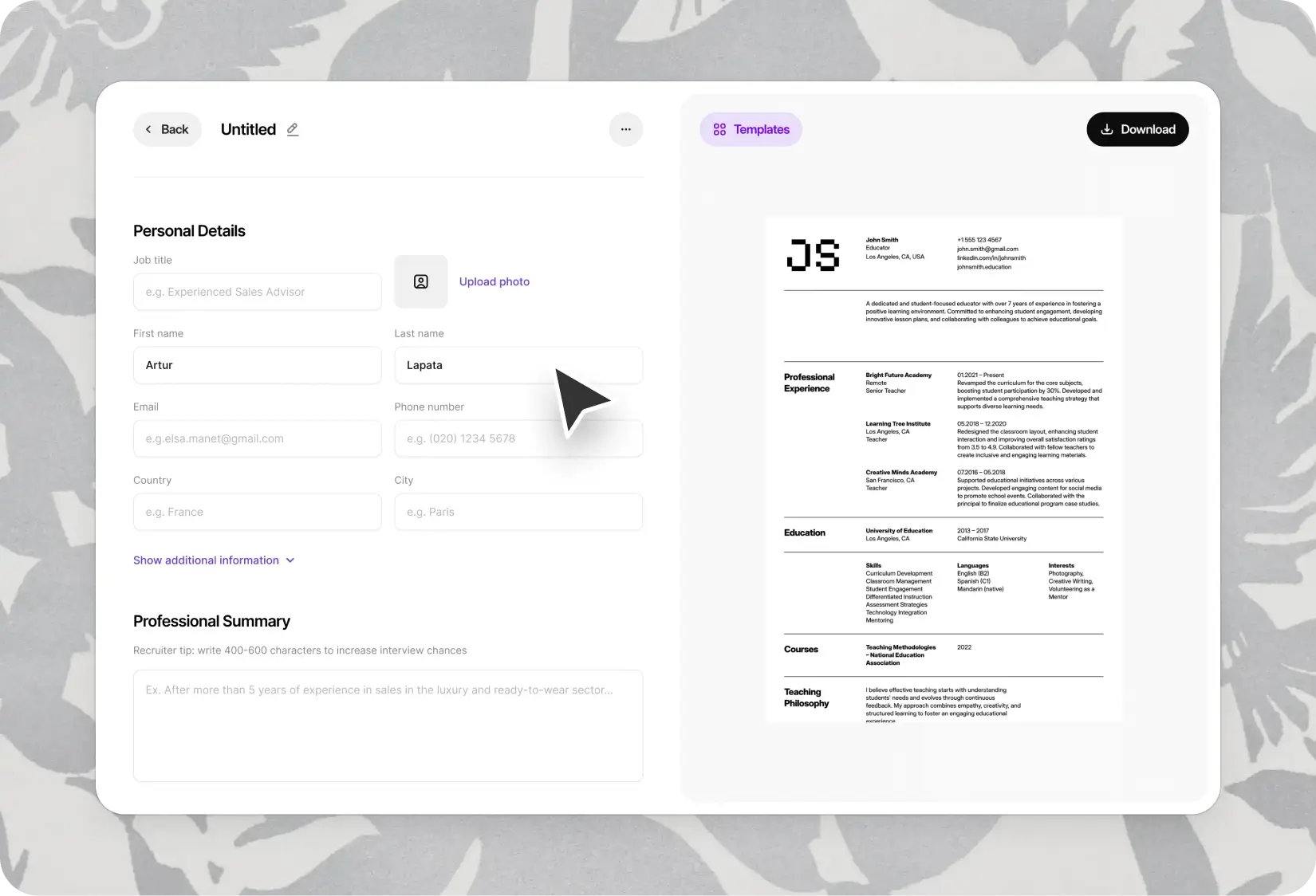
Resume builder interface showing personal details and professional summary fields, with a sample resume preview.

© 2026 Wensa. All right reserved.

Inspired by best practices from certified resume experts.

© 2026 Wensa. All right reserved.

Inspired by best practices from certified resume experts.