Backend Developer

Backend Developer Resume Examples — Describe the System, Not the Task

8 backend developer resume examples from junior to staff engineer. See how strong backend devs prove system design and scale thinking — not just language proficiency.

Updated Aug 7, 2026

Written by Artur Lopato

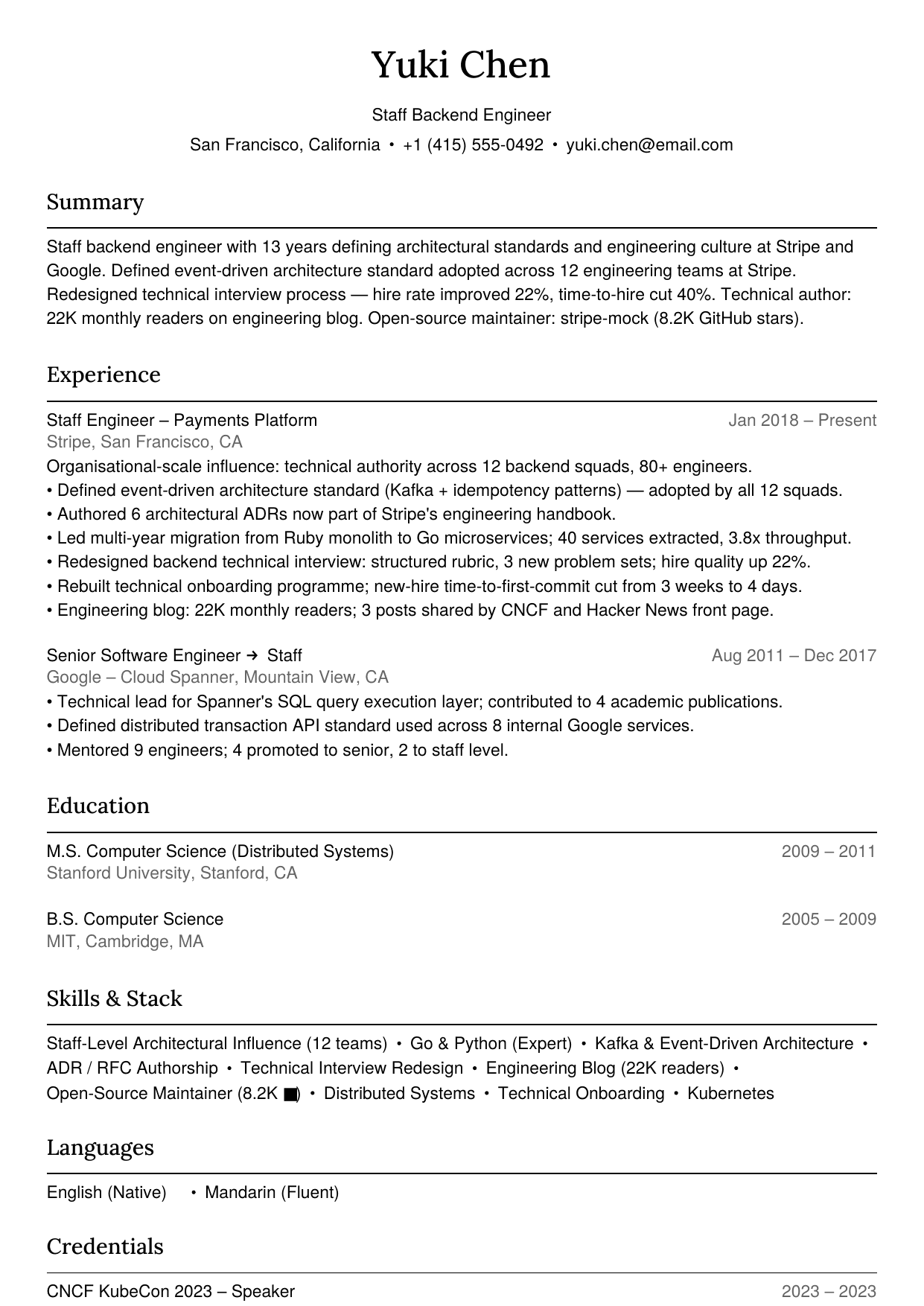
Backend developer resume example on a clean textured background

"Built REST APIs using Node.js and Express." This sentence appears on roughly 40% of all backend developer resumes. It tells a hiring manager two things: the language and the pattern. It tells them nothing about whether the API handles 100 requests a day or 100,000 — whether it's production-stable or a weekend project — whether it costs $50/month or $50,000.

Backend hiring in 2026 is defined by one question: can you build systems that scale without burning money? Cloud infrastructure costs have become a board-level concern. Engineering managers now look for candidates who understand cost-per-request as fluently as they understand latency. The resumes that land interviews describe systems, not tasks.

The three metrics that separate backend resumes in 2026

Every backend engineering achievement should be expressible in at least one of three dimensions. Most resumes only cover the first:

  • Throughput — requests per second, events processed per day, transactions handled, concurrent users supported. "Designed an order pipeline handling 12K requests/second" says something "built a backend service" doesn't.

  • Reliability — uptime percentage, mean time to recovery, error rate reduced, SLA achieved. "Achieved 99.97% uptime across 18 months of production" is a trust signal that throughput numbers alone don't provide.

  • Cost efficiency — infrastructure cost per unit, spend reduced after optimization, cloud cost as a percentage of revenue. "Reduced AWS spend 34% through right-sizing and spot instance migration with zero impact on SLA" proves commercial engineering judgment that purely technical metrics don't.

The strongest backend bullet combines two or three: "Redesigned event processing pipeline using Kafka — throughput increased from 8K to 45K events/second, P99 latency dropped from 420ms to 38ms, and infrastructure cost fell 28% through partition rebalancing."

The language split problem

Backend development is more language-fragmented than any other engineering discipline. Python, Java, Go, Rust, Node.js, Ruby, PHP, C# — each has its own ecosystem, interview culture, and keyword profile. A Python resume submitted to a Java shop fails ATS before a human reads it, even if the underlying engineering judgment is identical.

The fix: maintain language-specific resume variants that lead with the primary language and its ecosystem, while keeping your strongest system-level achievements consistent across versions. Your throughput numbers don't change. Your language framing does.

Browse Wensa's 8 backend developer examples across Python, Java, Go, Node.js, and platform engineering specializations. Start with an ATS-compatible backend developer template already structured for technical roles, and read our resume writing guide before tailoring for your specific stack and target company.

Backend Developer Resume Examples by Level and Specialization

Junior Backend Developer Resume

Built for bootcamp graduates and CS graduates entering backend engineering. Leads with a technical skills block and a projects section formatted with the system-description structure — not task lists, but problem context, technology used, and a concrete outcome. GitHub link appears in the header. Personal projects that demonstrate database design, API construction, and any deployment experience are prioritized over coursework listings.

Mid-Level Backend Developer Resume

A two-page example for backend developers with 3-6 years of production experience across multiple systems and teams. Each role leads with a one-line system descriptor before the bullets. Achievements span all three dimensions — throughput, reliability, and cost — showing engineering breadth beyond single-metric optimization. Cloud service experience is named with specific services, not just providers. Any CI/CD or infrastructure-as-code involvement appears explicitly as mid-level developers are increasingly expected to own their own deployment pipeline.

  • Shows database optimization depth: query performance, indexing decisions, schema design outcomes

  • Demonstrates API ownership: design decisions, versioning, documentation, consumer count

  • Includes observability tooling: Datadog, Prometheus, or CloudWatch with a meaningful outcome attached

Senior Backend Developer Resume

For backend engineers with 7+ years who have owned system architecture, driven technical decisions across teams, and built systems that outlasted their own direct involvement. The resume shifts emphasis from individual implementation to architectural ownership — "designed the data partitioning strategy adopted across 4 services," "defined the API versioning standard now used company-wide," "led the migration from monolith to microservices that became the architectural template for 3 subsequent product teams." Technical leadership signals appear alongside engineering credentials throughout.

Staff / Principal Backend Engineer Resume

At staff and principal level, the backend engineering resume documents organizational-scale technical influence — not individual system performance. "Defined the event-driven architecture standard adopted across 12 engineering teams" proves a different kind of impact than any single throughput number. Technical strategy documents authored, platform migrations led, and engineering culture contributions (interview process redesigned, technical onboarding rebuilt) all appear as explicit staff-level signals.

At principal level, the resume answers: what does the engineering organisation look like because of your decisions — not because of your code?

Python Backend Developer Resume

A Python-specialist resume that goes beyond listing "Python" and proves ecosystem depth through production context. Framework specificity (Django vs FastAPI vs Flask, and which async patterns used) signals genuine depth. Celery task queues, SQLAlchemy ORM decisions, Pydantic data validation, and Python packaging experience all appear where relevant — because mid-senior Python roles filter on these terms independently. Performance characteristics specific to Python (GIL management, async/await patterns, worker process architecture) appear where they prove engineering judgment.

Java Backend Developer Resume

Java backend resumes need to prove both framework depth and JVM-level understanding — because senior Java roles often involve performance tuning at a level that framework knowledge alone doesn't cover. Spring Boot version specificity (reactive vs servlet stack), JVM tuning experience (GC settings, heap analysis, thread dump analysis), and Java version progression (Java 11 to Java 21 features adopted) all signal genuine seniority in ways that framework listings don't. Maven and Gradle build tooling, along with any microservices decomposition leadership, appear as primary engineering depth signals.

Go Backend Developer Resume

Go developers are disproportionately hired for high-throughput, low-latency systems where the language's concurrency model and minimal footprint matter. This resume leads with the throughput credentials that Go is specifically chosen for: requests per second, goroutine concurrency patterns, and the comparison to predecessor system performance where available. gRPC and protocol buffer expertise appear prominently — Go and gRPC are increasingly paired in service mesh architectures where hiring managers specifically filter for both. Infrastructure ownership (Kubernetes, Helm, service mesh) appears alongside the language credentials, as Go developers are often expected to own their deployment environment.

API Platform Backend Engineer Resume

Platform and API engineering is the fastest-growing backend specialization at mid-to-large tech companies — the internal product that makes all other engineering faster. This resume leads with the developer experience metrics that platform teams are hired to improve: time to first API call reduced, onboarding time cut, internal adoption rate, documentation quality scores. API gateway configuration, developer portal ownership, authentication and authorization framework design, and rate limiting architecture all appear as distinct platform engineering competencies alongside the standard backend stack.

Junior Backend Developer Resume

Built for bootcamp graduates and CS graduates entering backend engineering. Leads with a technical skills block and a projects section formatted with the system-description structure — not task lists, but problem context, technology used, and a concrete outcome. GitHub link appears in the header. Personal projects that demonstrate database design, API construction, and any deployment experience are prioritized over coursework listings.

Mid-Level Backend Developer Resume

A two-page example for backend developers with 3-6 years of production experience across multiple systems and teams. Each role leads with a one-line system descriptor before the bullets. Achievements span all three dimensions — throughput, reliability, and cost — showing engineering breadth beyond single-metric optimization. Cloud service experience is named with specific services, not just providers. Any CI/CD or infrastructure-as-code involvement appears explicitly as mid-level developers are increasingly expected to own their own deployment pipeline.

  • Shows database optimization depth: query performance, indexing decisions, schema design outcomes

  • Demonstrates API ownership: design decisions, versioning, documentation, consumer count

  • Includes observability tooling: Datadog, Prometheus, or CloudWatch with a meaningful outcome attached

Senior Backend Developer Resume

For backend engineers with 7+ years who have owned system architecture, driven technical decisions across teams, and built systems that outlasted their own direct involvement. The resume shifts emphasis from individual implementation to architectural ownership — "designed the data partitioning strategy adopted across 4 services," "defined the API versioning standard now used company-wide," "led the migration from monolith to microservices that became the architectural template for 3 subsequent product teams." Technical leadership signals appear alongside engineering credentials throughout.

Staff / Principal Backend Engineer Resume

At staff and principal level, the backend engineering resume documents organizational-scale technical influence — not individual system performance. "Defined the event-driven architecture standard adopted across 12 engineering teams" proves a different kind of impact than any single throughput number. Technical strategy documents authored, platform migrations led, and engineering culture contributions (interview process redesigned, technical onboarding rebuilt) all appear as explicit staff-level signals.

At principal level, the resume answers: what does the engineering organisation look like because of your decisions — not because of your code?

Python Backend Developer Resume

A Python-specialist resume that goes beyond listing "Python" and proves ecosystem depth through production context. Framework specificity (Django vs FastAPI vs Flask, and which async patterns used) signals genuine depth. Celery task queues, SQLAlchemy ORM decisions, Pydantic data validation, and Python packaging experience all appear where relevant — because mid-senior Python roles filter on these terms independently. Performance characteristics specific to Python (GIL management, async/await patterns, worker process architecture) appear where they prove engineering judgment.

Java Backend Developer Resume

Java backend resumes need to prove both framework depth and JVM-level understanding — because senior Java roles often involve performance tuning at a level that framework knowledge alone doesn't cover. Spring Boot version specificity (reactive vs servlet stack), JVM tuning experience (GC settings, heap analysis, thread dump analysis), and Java version progression (Java 11 to Java 21 features adopted) all signal genuine seniority in ways that framework listings don't. Maven and Gradle build tooling, along with any microservices decomposition leadership, appear as primary engineering depth signals.

Go Backend Developer Resume

Go developers are disproportionately hired for high-throughput, low-latency systems where the language's concurrency model and minimal footprint matter. This resume leads with the throughput credentials that Go is specifically chosen for: requests per second, goroutine concurrency patterns, and the comparison to predecessor system performance where available. gRPC and protocol buffer expertise appear prominently — Go and gRPC are increasingly paired in service mesh architectures where hiring managers specifically filter for both. Infrastructure ownership (Kubernetes, Helm, service mesh) appears alongside the language credentials, as Go developers are often expected to own their deployment environment.

API Platform Backend Engineer Resume

Platform and API engineering is the fastest-growing backend specialization at mid-to-large tech companies — the internal product that makes all other engineering faster. This resume leads with the developer experience metrics that platform teams are hired to improve: time to first API call reduced, onboarding time cut, internal adoption rate, documentation quality scores. API gateway configuration, developer portal ownership, authentication and authorization framework design, and rate limiting architecture all appear as distinct platform engineering competencies alongside the standard backend stack.

Writing Backend Bullets That Describe Systems, Not Tasks

The shift from task description to system description is the highest-value edit you can make to a backend resume. Here's what it looks like in practice:

Task Description (Weak)

System Description (Strong)

"Built and maintained REST APIs using Node.js"

"Designed RESTful API serving 18K concurrent connections at peak; implemented rate limiting and circuit breakers that reduced downstream failures by 94%"

"Worked on database optimization"

"Identified N+1 query patterns across 12 endpoints using pg_stat_statements; query optimization reduced average response time from 840ms to 62ms and cut RDS costs 41%"

"Implemented microservices architecture"

"Decomposed 180K-line monolith into 9 domain services over 8 months — deployment frequency increased from monthly to daily, incident blast radius reduced 85%"

"Maintained CI/CD pipelines"

"Rebuilt CI/CD pipeline using GitHub Actions and ArgoCD — reduced build time from 22 minutes to 6, enabling same-day hotfix deployment that previously required 72-hour release cycles"

The structure that works: system or problem context → the specific engineering decision → measurable outcome in throughput, reliability, or cost terms.

Pro tip: Add a one-line system descriptor at the top of each role: "Python/Django monolith serving 2M monthly active users, AWS (ECS, RDS PostgreSQL, ElastiCache), team of 12 engineers." This context makes every achievement bullet that follows immediately legible to a senior engineer reviewer.

For the broader technical achievement framing, see our top resume mistakes guide. The software engineer resume examples show how full-stack roles handle the same system-description challenge. The data science resume examples show how adjacent data engineering roles document pipeline-scale work.

ATS Keywords for Backend Developer Resumes in 2026

Backend ATS profiles are the most language-fragmented in tech. Here's the keyword structure that works across all backend postings, plus the language-specific layer you need to add on top.

Universal backend keywords (all languages)

  • Architecture: REST API, microservices, event-driven architecture, message queue, Kafka, RabbitMQ, gRPC, GraphQL, WebSockets

  • Databases: PostgreSQL, MySQL, MongoDB, Redis, Elasticsearch, DynamoDB — name every database you've used in production, not just your primary one

  • Cloud and infra: AWS, GCP, Azure — then specific services: ECS, Lambda, S3, RDS, Cloud Run, Pub/Sub, AKS. Generic "AWS experience" is not the same as named service experience in ATS

  • DevOps adjacent: Docker, Kubernetes, CI/CD, Terraform, GitHub Actions, infrastructure-as-code — now standard for mid-level and above

  • Observability: Datadog, Prometheus, Grafana, OpenTelemetry, distributed tracing — a fast-growing ATS keyword category in 2026

Language-specific keywords to layer on top

Primary Language

Key Ecosystem Terms

Python

Django, FastAPI, Flask, SQLAlchemy, Celery, asyncio, Pydantic

Java

Spring Boot, Spring Cloud, Hibernate, Maven, Gradle, JVM tuning, JPA

Go

Goroutines, channels, gRPC, Go modules, concurrency primitives, Gin, Echo

Node.js

Express.js, NestJS, TypeScript, async/await, event loop, npm, Prisma

C# / .NET

.NET Core, ASP.NET, Entity Framework, Azure Functions, SignalR

Pro tip: Check whether the job posting uses "backend" or "back-end" — some ATS parsers treat these as separate terms. Use whichever the posting uses, then add the alternative in parentheses once in your summary: "backend (back-end) systems engineer." Small, but eliminates a trivial filter risk.

For a full ATS optimization walkthrough, read our ATS resume tips guide and our resume skills section guide. The frontend developer resume examples show how the adjacent client-side role handles the same keyword fragmentation challenge.

Backend Developer Resume FAQs

How long should a backend developer resume be?

One page for fewer than 5 years of experience. Two pages for mid-to-senior developers with meaningful production system history, open source contributions, or architecture work worth documenting. Unlike non-technical roles, a backend developer with strong system design credentials can justify the second page even at 4 years of experience if every line adds signal.

Should I include side projects and open source on my backend resume?

Yes — but with discipline. Include projects that demonstrate system-level thinking: something you built that handles real load, solves a genuine problem, or demonstrates architectural judgment. A GitHub repo with 200 stars carries more weight than a tutorial project labeled as "personal project." Include the GitHub link in your header; reference specific projects inline where they're relevant to the role.

How do I show backend experience without production metrics?

Shift to design and complexity metrics. "Designed an event-driven architecture for a real-time notification system supporting 50K concurrent WebSocket connections" is a system description even without uptime figures. Document the problem scale, the architectural decision, and the technical approach — the "why" of the design proves engineering judgment even when production data isn't available.

What format works best for a backend developer resume?

Reverse-chronological with a technical skills section placed prominently before or alongside the experience section — not at the bottom. Career ladders in backend engineering are well-defined, and hiring managers look for clear progression from implementation work to system design to technical leadership. Read our resume format guide for when a combination layout outperforms standard reverse-chronological for career-changing backend developers.
Recruiter Approved

Build a Resume That Works. Literally.

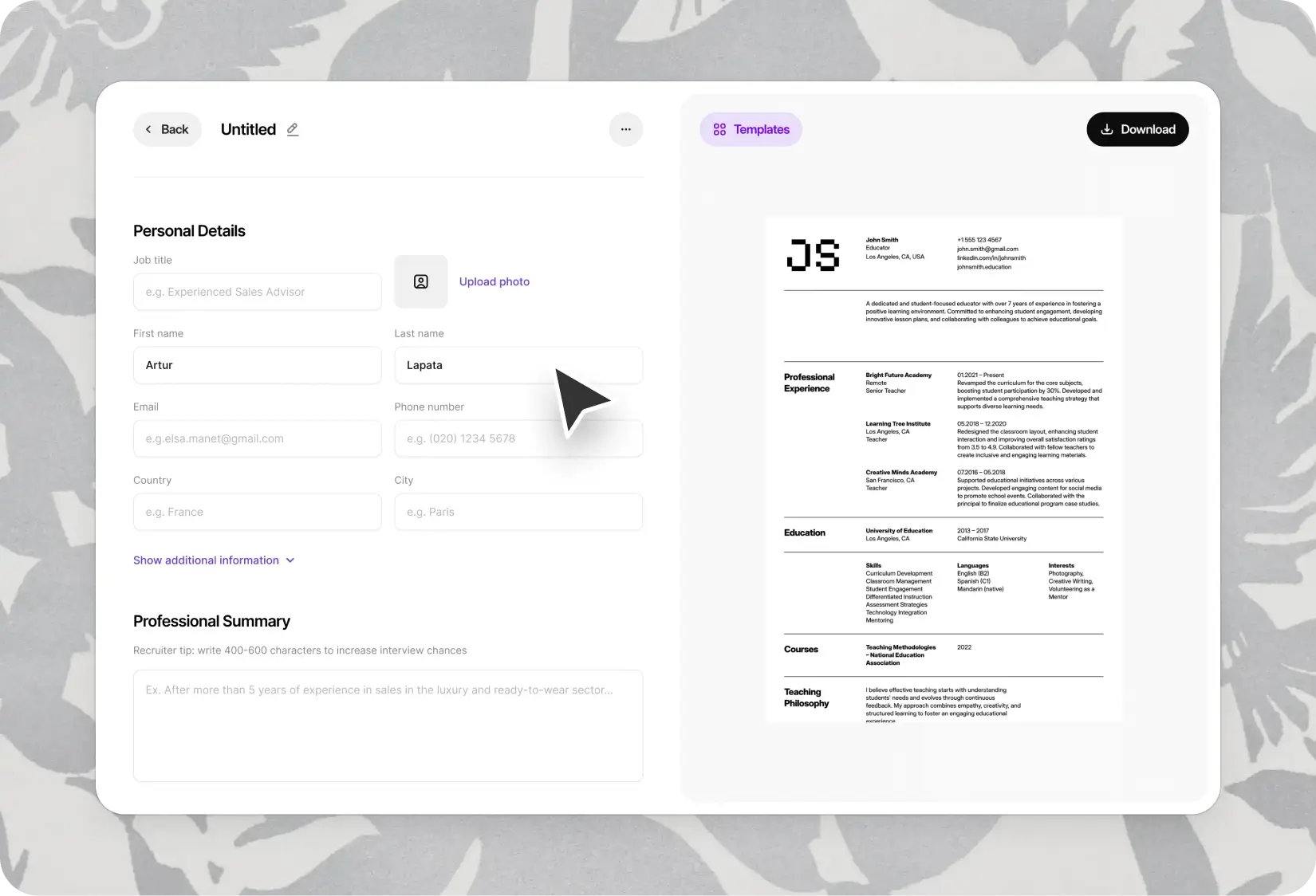
Resume builder interface showing personal details and professional summary fields, with a sample resume preview.

© 2026 Wensa. All right reserved.

Inspired by best practices from certified resume experts.

© 2026 Wensa. All right reserved.

Inspired by best practices from certified resume experts.