CEO and Executive Resume Examples — What Boards Actually Look For
8 executive resume examples from first-time C-suite to multi-company CEO. See how top executives position value creation — not just tenure and titles.
Updated May 20, 2026
Written by Artur Lopato
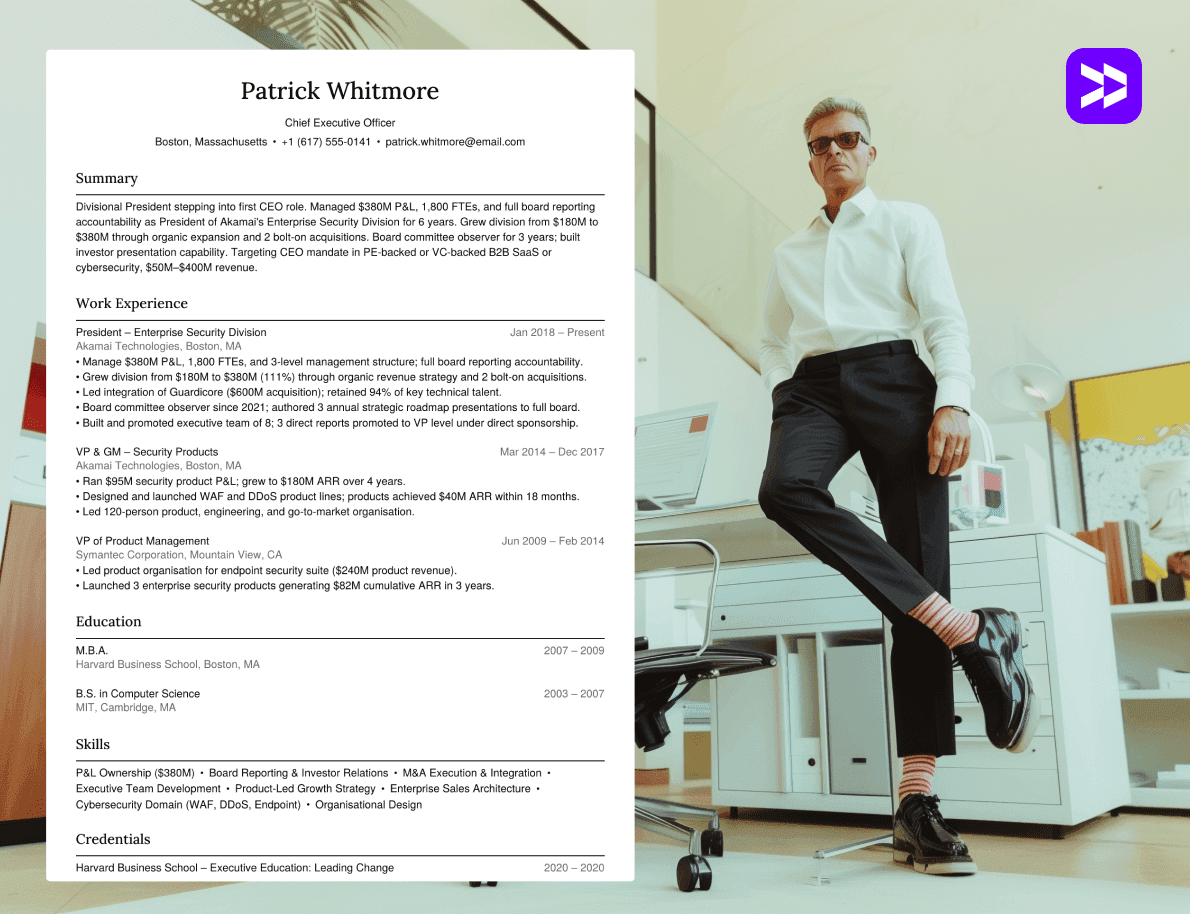
At every other career level, a resume is an application. At CEO and executive level, it's something different: a strategic positioning document that search firms use to brief boards, that investors read before backing a leadership team, and that governance committees assess before nominating candidates.
The implication is significant. Most of the advice written about executive resumes — "use action verbs," "optimize for ATS," "keep it to one page" — is written for roles where HR screens hundreds of applications. At C-suite level, 80% of positions are never posted publicly. They're filled through search firms like Korn Ferry, Spencer Stuart, and Russell Reynolds. Your resume doesn't need to beat an algorithm. It needs to answer one question in the first 30 seconds: what kind of executive are you, and what mandate are you the right answer to?
The four executive archetypes — and why they require different resumes
Boards don't hire generic executives. They hire for a specific mandate — and each mandate requires a different executive archetype. Before writing a word, identify which archetype you are and which you're targeting:
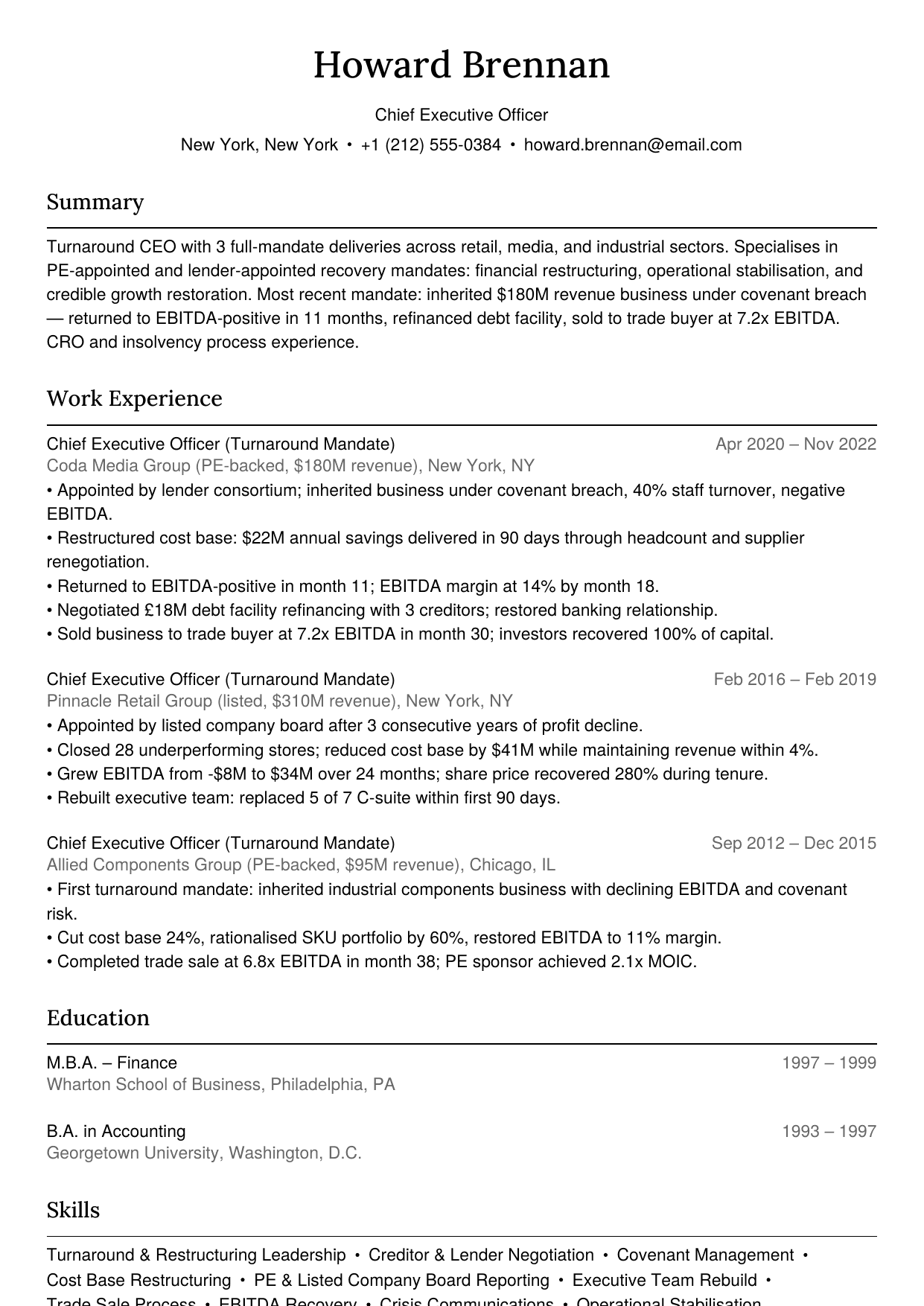
Turnaround executive — hired to diagnose and fix a struggling business. Resume leads with: underperforming situation inherited, diagnostic speed, cost structure reshaped, and recovery timeline. EBITDA recovery and cash position improvement are the headline metrics.
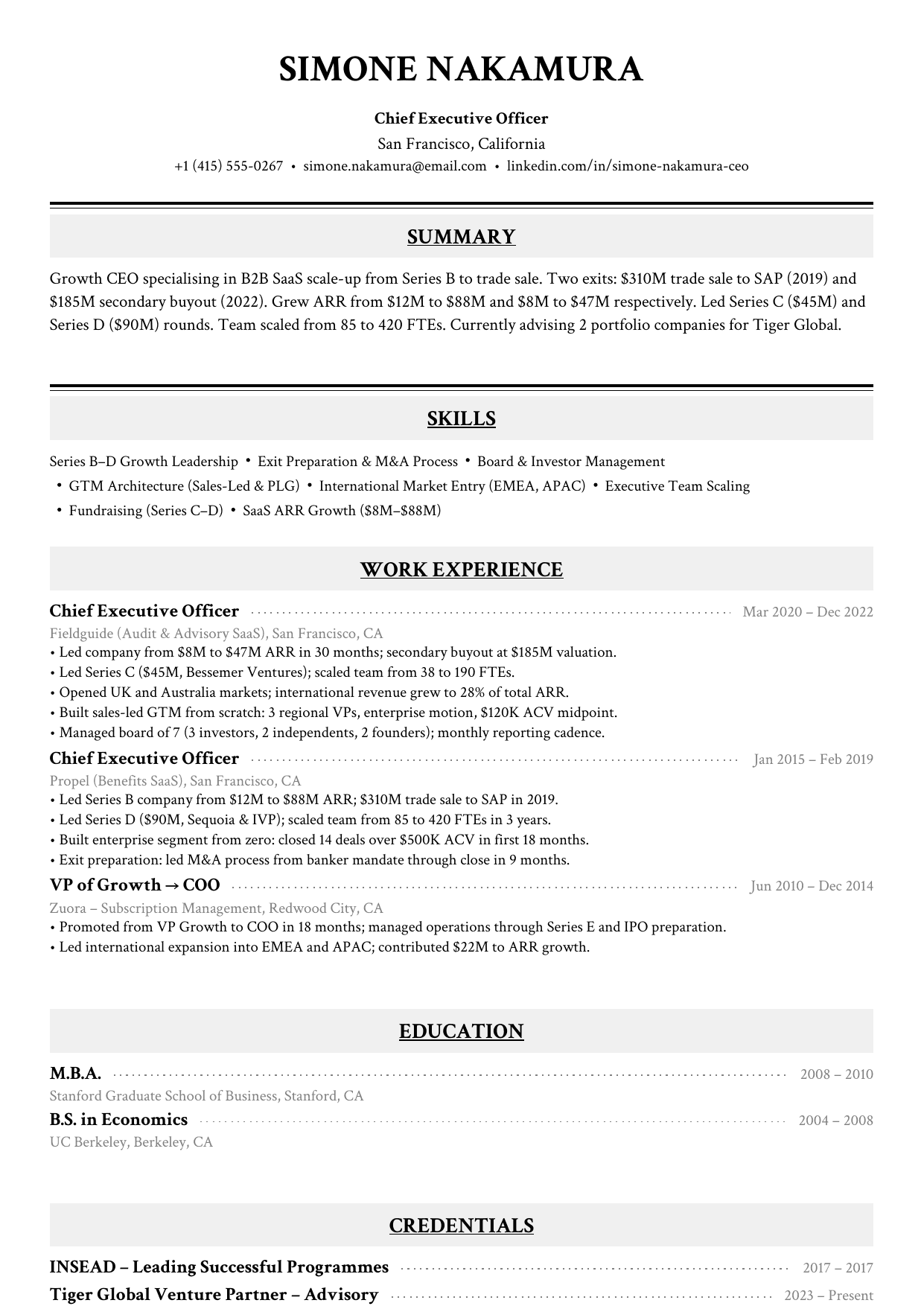
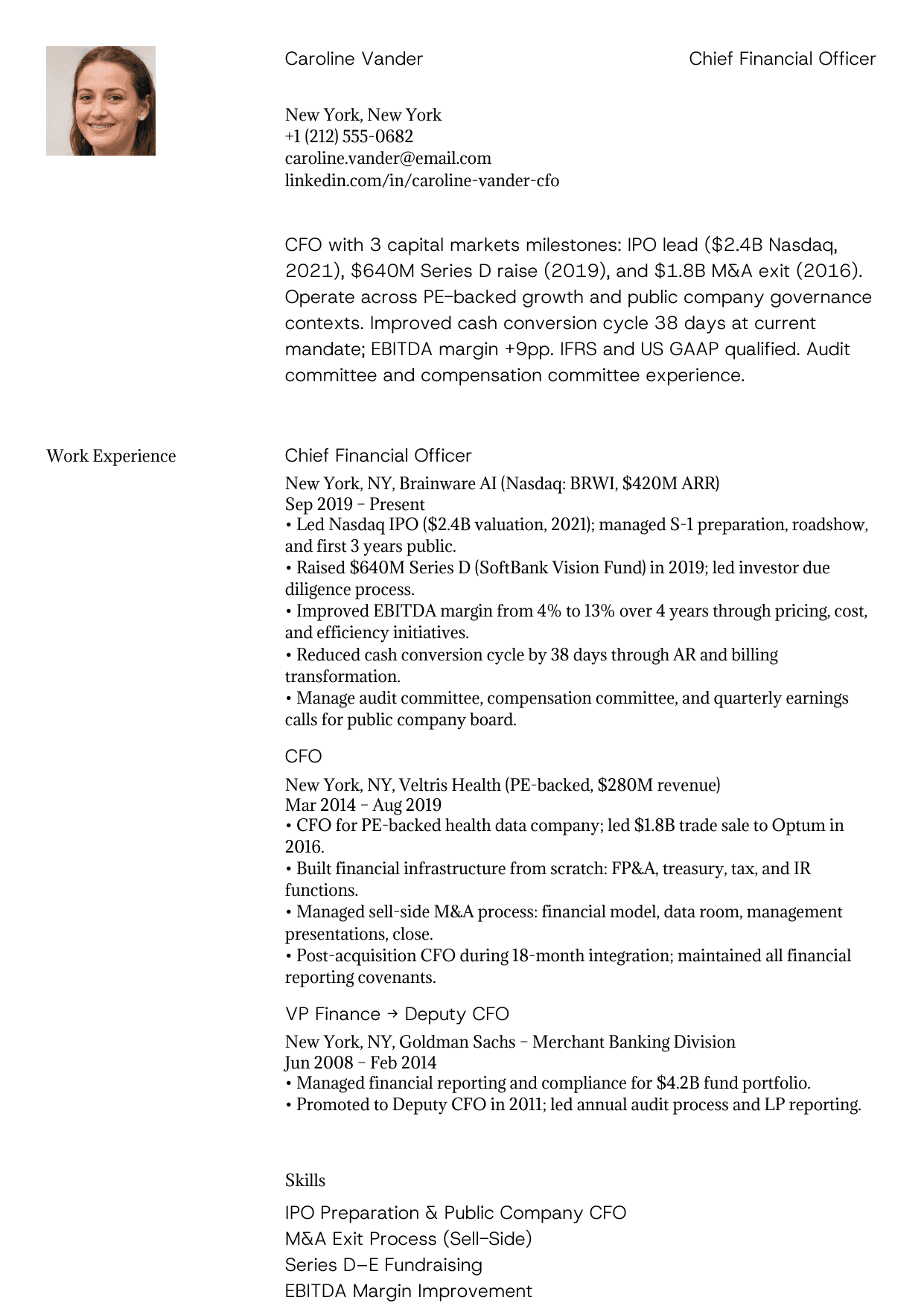
Growth / scale-up CEO — hired to take a proven model from traction to scale. Resume leads with: ARR growth, market expansion, team built from X to Y, and funding raised or capital deployed. Series B to D and PE-backed growth mandates look for this profile.
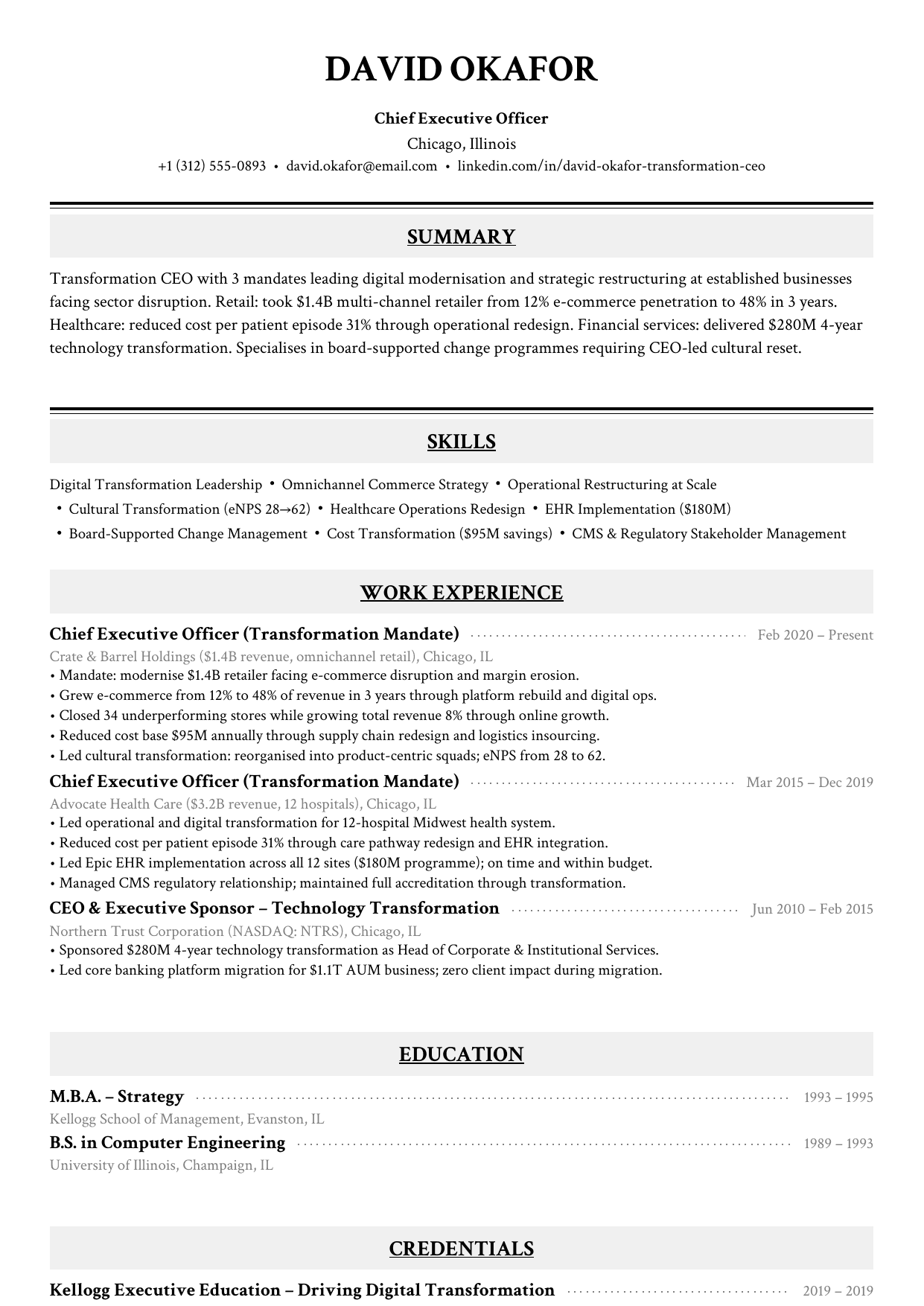
Transformation executive — hired to modernize an established business facing structural disruption. Resume leads with: digital strategy defined, legacy cost base reduced, new revenue streams built, and organisational capability rebuilt. Large enterprise, listed company, and public sector mandates.
Steady-state / operational CEO — hired to sustain and optimize a well-run business. Resume leads with: margin improvement, shareholder returns, governance record, and people strategy. Less common at headline level, but dominant in owner-managed and family business contexts.
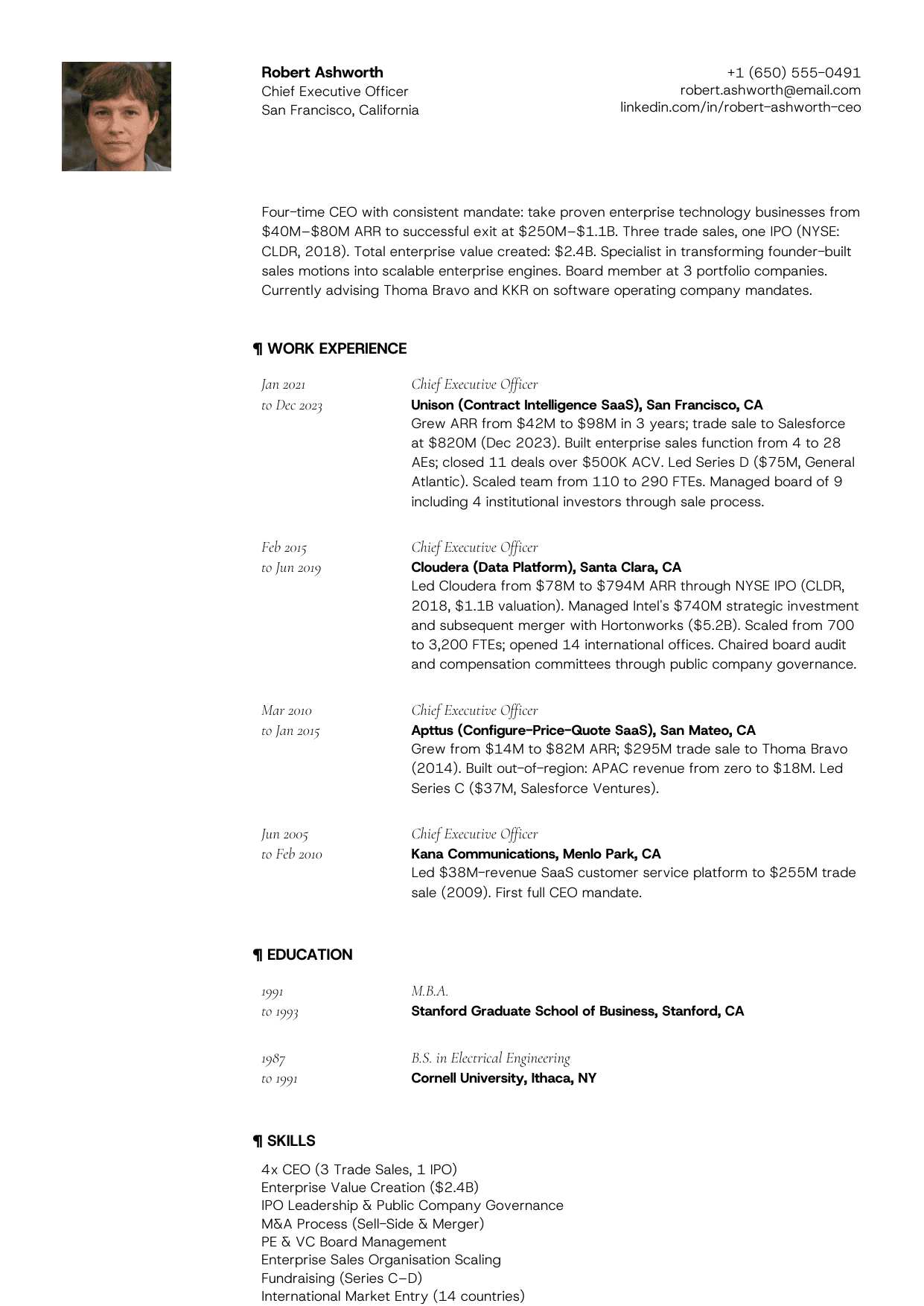
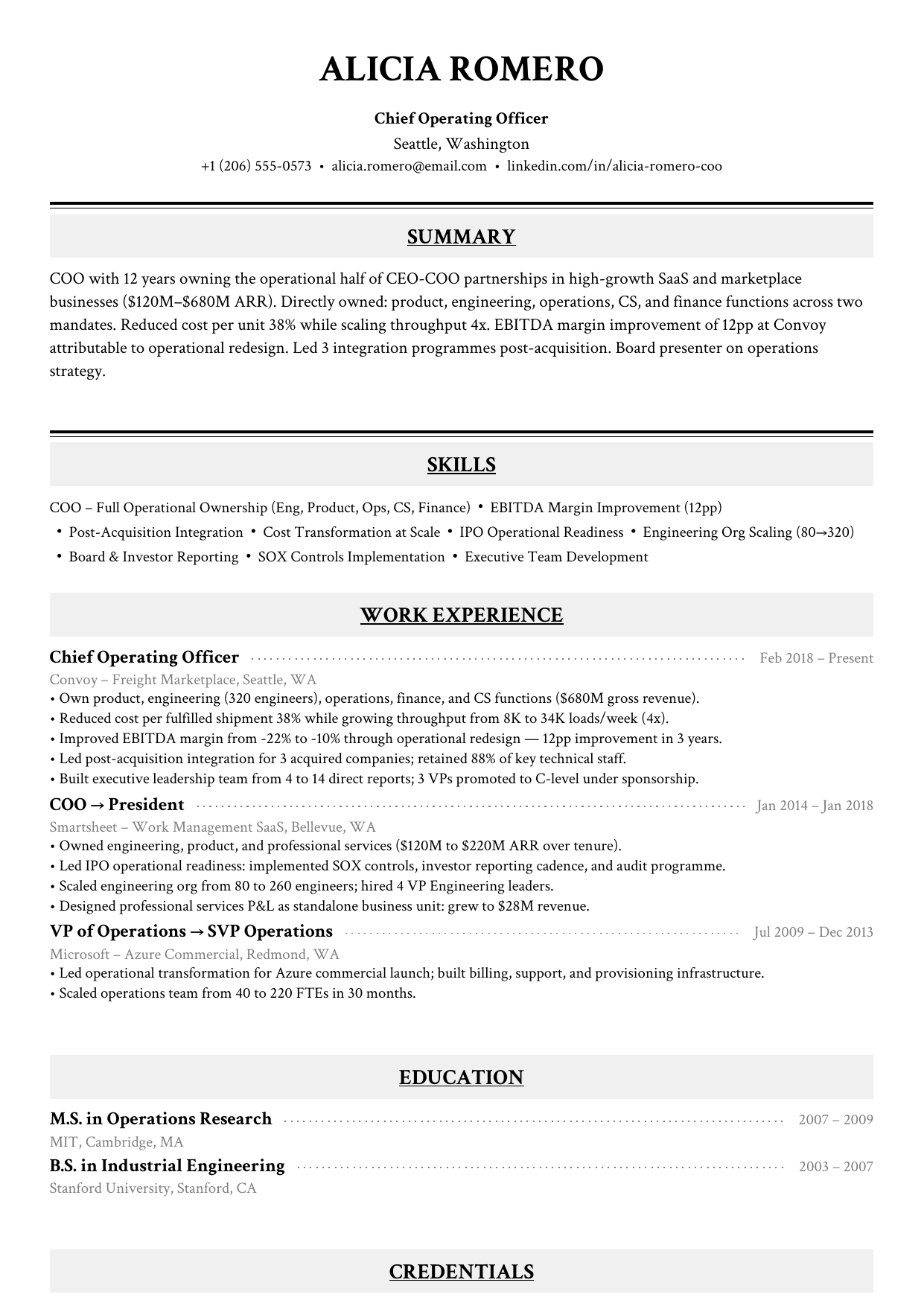
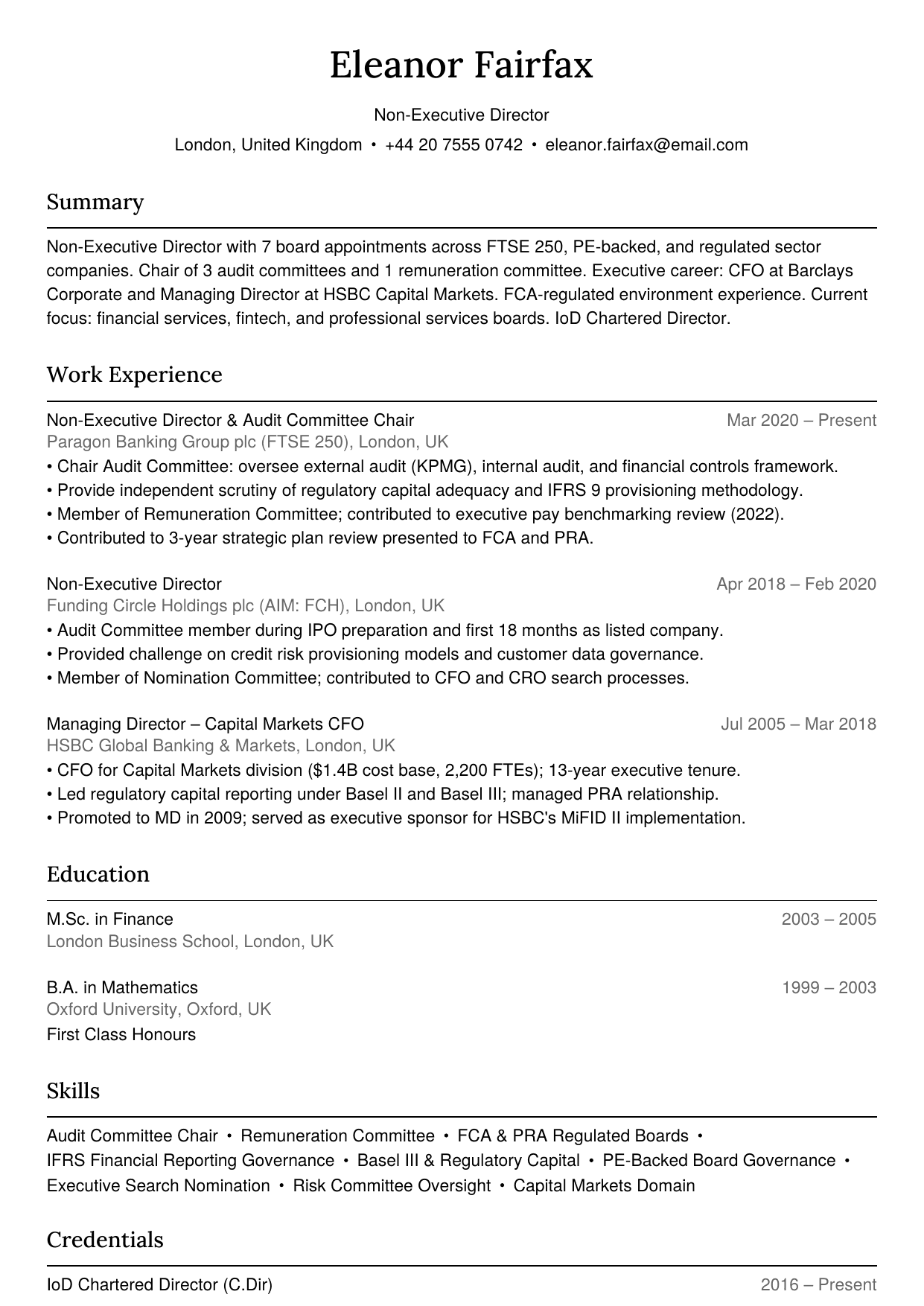
A resume that blurs all four archetypes positions you as a competent generalist — which is not what boards pay C-suite multiples for. Browse Wensa's 8 executive examples to see how each archetype is framed across company stages and sectors. Use a professional executive resume template as your starting point, and read our resume writing guide for the foundational structure before you adapt for executive level.
The NDA problem: how to prove impact without revealing confidential data
Most executives operate under significant confidentiality constraints. Revenue figures, acquisition prices, restructuring costs, and headcount reductions are often commercially sensitive or legally restricted.
The solution isn't vagueness — it's translation. Replace absolute figures with percentage changes, relative outcomes ("top-quartile EBITDA margin for the sector"), and capital allocation decisions ("declined 8 low-fit acquisitions, redirecting capital to organic R&D that doubled pipeline velocity"). The strategic discipline is visible even when the numbers aren't.
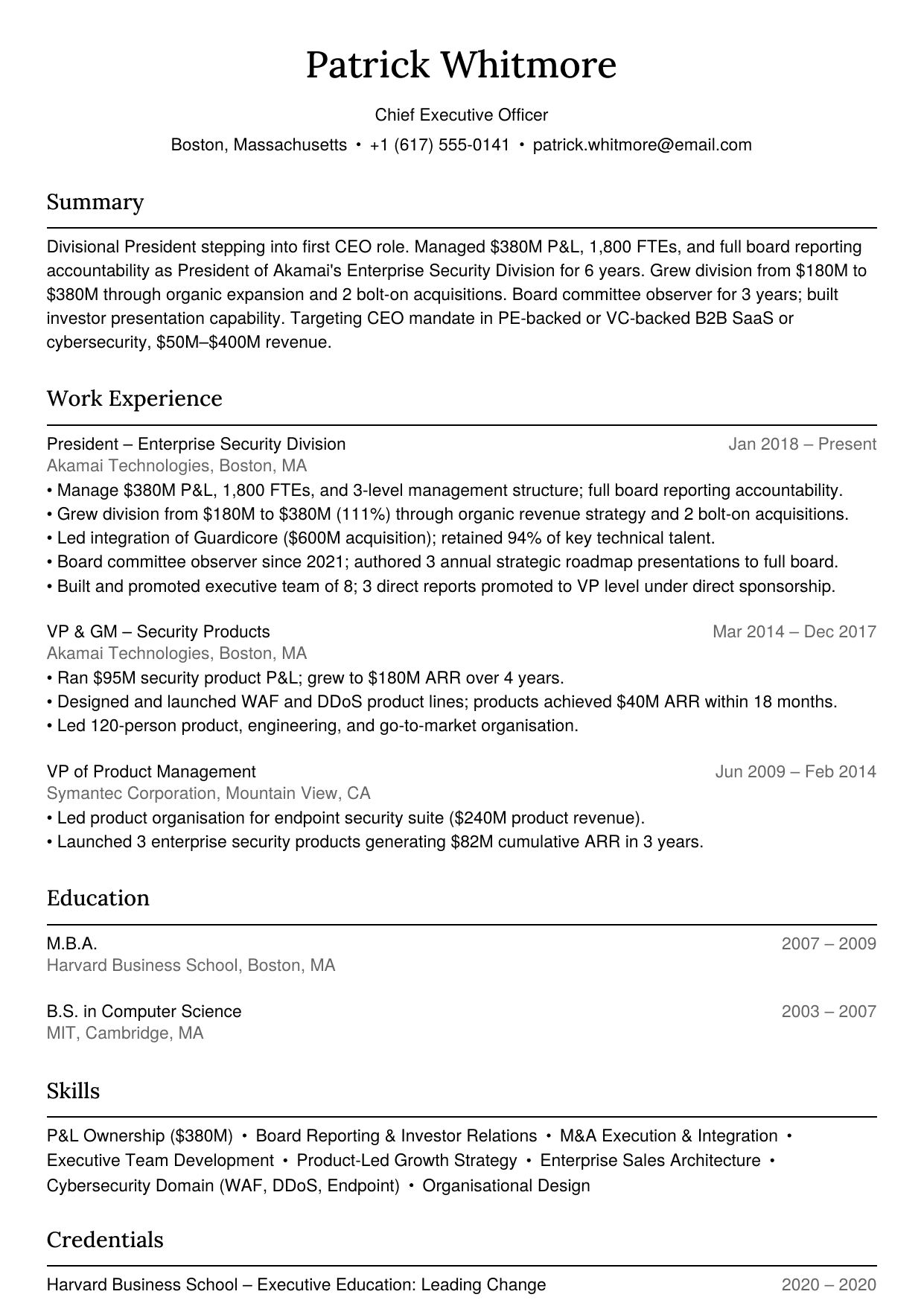
CEO and Executive Resume Examples by Archetype and Level
What Boards and Search Firms Actually Read First
Executive search consultants spend approximately 90 seconds on initial resume assessment. Here's what they're scanning for — and in what order:
What They're Scanning | What Signals It |
|---|---|
Company quality and stage | The calibre of organisations you've led — sector, revenue scale, ownership structure (PE-backed, listed, founder-led). Brand recognition helps; context is essential if the name is unfamiliar. |
Executive archetype match | Does your track record match the mandate? A turnaround track record won't land a growth CEO role, and a growth CEO profile won't land a turnaround. Your summary needs to make the archetype explicit. |
Value creation at each role | Not what you managed — what you changed. EBITDA improvement, revenue trajectory shift, market position gained, or capital returned to shareholders. One headline metric per role minimum. |
Board and governance credentials | Board reporting experience, NED roles held, investor relations managed, audit or remuneration committee involvement. These signal governance maturity, not just operational competence. |
Career progression logic | Does the CV show increasing scope and complexity at each step? Search firms are as interested in the arc of your career as in any individual role. |
Pro tip: Add a "Career Highlights" section between your summary and your experience — 3-4 one-line achievements that represent your career's peak commercial outcomes. Search consultants use this to brief boards before the full CV is shared. Make it the single most compelling paragraph in the document.
For how the adjacent senior management layer handles similar positioning, see the project manager resume examples and marketing manager resume examples — useful for executives transitioning from functional leadership to P&L ownership. For a broader view on resume structure, our resume format guide covers when and why executives should use a different layout to functional managers.
How to Write an Executive Summary That Positions, Not Just Describes
The executive summary is the single most important paragraph in a CEO or C-suite resume. It's also the most commonly wasted.
What doesn't work
"Dynamic, results-driven CEO with 20 years of experience leading global organisations through growth and transformation. Proven ability to inspire teams, build cultures, and deliver shareholder value."
This describes every candidate on the search firm's longlist. It positions nothing and proves nothing.
What works
"PE-backed growth CEO with three consecutive scale-up mandates — most recently took a £45M ARR B2B SaaS business to £180M over 4 years, culminating in a £620M trade sale. Specialize in the Series C to exit phase: building enterprise sales motion, internationalising into EMEA, and preparing businesses for strategic M&A processes."
This version names the archetype (PE-backed growth CEO), the mandate type (Series C to exit), a specific outcome with a timeline (£45M to £180M ARR), and the functional specialisation that makes the candidate distinctive (enterprise sales motion, internationalisation, M&A readiness). A search consultant can brief a board from this paragraph alone.
Pro tip: Write your summary as if a headhunter needs to describe you to a board in two sentences at a cocktail party. If they couldn't do it from your current summary — rewrite it.
For the formatting and visual dimension of executive-level documents, our resume fonts and design guide covers what works at senior level — where restraint and legibility matter more than visual creativity. And if you're preparing a cover letter alongside your resume, our cover letter tips cover the executive approach, which differs significantly from functional-level applications.
CEO and Executive Resume FAQs
How long should a CEO resume be?
Two to three pages. One page undersells the depth of a C-suite career. More than three pages suggests an inability to prioritise — which is not the signal you want to send at this level. Each role should have a scope line (company type, revenue, headcount) and 3-4 outcome-led bullets maximum. Older roles can be compressed to two lines.
Should I include board memberships and NED roles?
Always — and give them their own section, not a footnote. Board experience signals governance maturity, fiduciary accountability, and the ability to manage relationships with investors and ownership structures. For PE-backed executive roles, this is often a primary filter.
Do executive resumes need to be ATS-optimised?
Less so than at other career levels — the majority of senior executive roles are filled through search firms, not public job postings. That said, for roles that are posted (typically public sector, FTSE-listed, and some US corporate roles), standard keyword hygiene still matters. Read our ATS resume tips guide for the foundational approach — then apply it selectively.
What format should an executive resume be submitted in?
PDF for direct submissions — it preserves formatting across all systems. Word for search firm submissions — many search firms edit and reformat executive CVs before presenting them to clients, and they need an editable document. Our PDF vs Word guide covers the format decision in full.