COO Resume Examples — Prove You Built the Engine, Not Just Drove It
8 COO resume examples from first-time to PE-backed and turnaround. See how chief operating officers prove operational depth and strategic credibility on the same page.
Updated Jul 29, 2026
Written by Artur Lopato

The COO sits in a uniquely difficult position on paper. The CEO gets credited for strategy. The CFO gets credited for financial outcomes. And the COO — whose job is to make all of it actually happen — often gets nothing but a title that reads like "senior operations manager" to anyone who doesn't already know what a real COO does.
This is the attribution gap. A COO who built the logistics infrastructure that enabled 3x revenue growth isn't always visible in the revenue number — the CEO announces that. A COO who rebuilt the management team and created the accountability structures that turned around a struggling business isn't always visible in the EBITDA improvement — that goes on the CFO's slide deck.
The COO resume's job is to close that gap — to show explicitly what you built, designed, or fixed that made the headline numbers possible.
The two-axis credibility problem
Every board and search firm screening a COO candidate is solving the same two-axis problem:
Strategic axis — Can this person operate at board level? Do they think in terms of commercial architecture, not just operational execution? Can they represent the company externally and challenge the CEO constructively?
Operational axis — Do they have the depth to actually run the business? Have they managed real P&L, complex teams, supply chains, technology systems? Or are they an executive figurehead who delegates everything meaningful?
Most COO resumes prove one axis and imply the other. The ones that get interviews prove both — explicitly, and in that order. Lead with strategic scope (board engagement, CEO partnership, commercial outcomes), then prove operational depth (function size, system built, team led, cost or efficiency outcome delivered).
COO archetype: define yours before you write
Like the CEO role, the COO mandate varies significantly by company stage and ownership structure. Identify your archetype before writing a word:
Scale-up COO — hired to build operational infrastructure fast enough to support aggressive growth. Resume leads with: systems built from scratch, team scaled, processes that didn't exist 18 months ago now running smoothly.
Turnaround COO — hired to stabilize and fix a struggling operation. Resume leads with: what was broken, diagnostic speed, restructuring executed, recovery timeline.
PE-backed COO — hired to drive EBITDA improvement toward an exit. Resume leads with: EBITDA contribution, operational initiatives that directly improved margin, and preparation for sale or integration.
Enterprise / corporate COO — hired to run a complex multi-function operation at scale. Resume leads with: organizational scope (headcount, P&L), cross-functional leadership, and governance record.
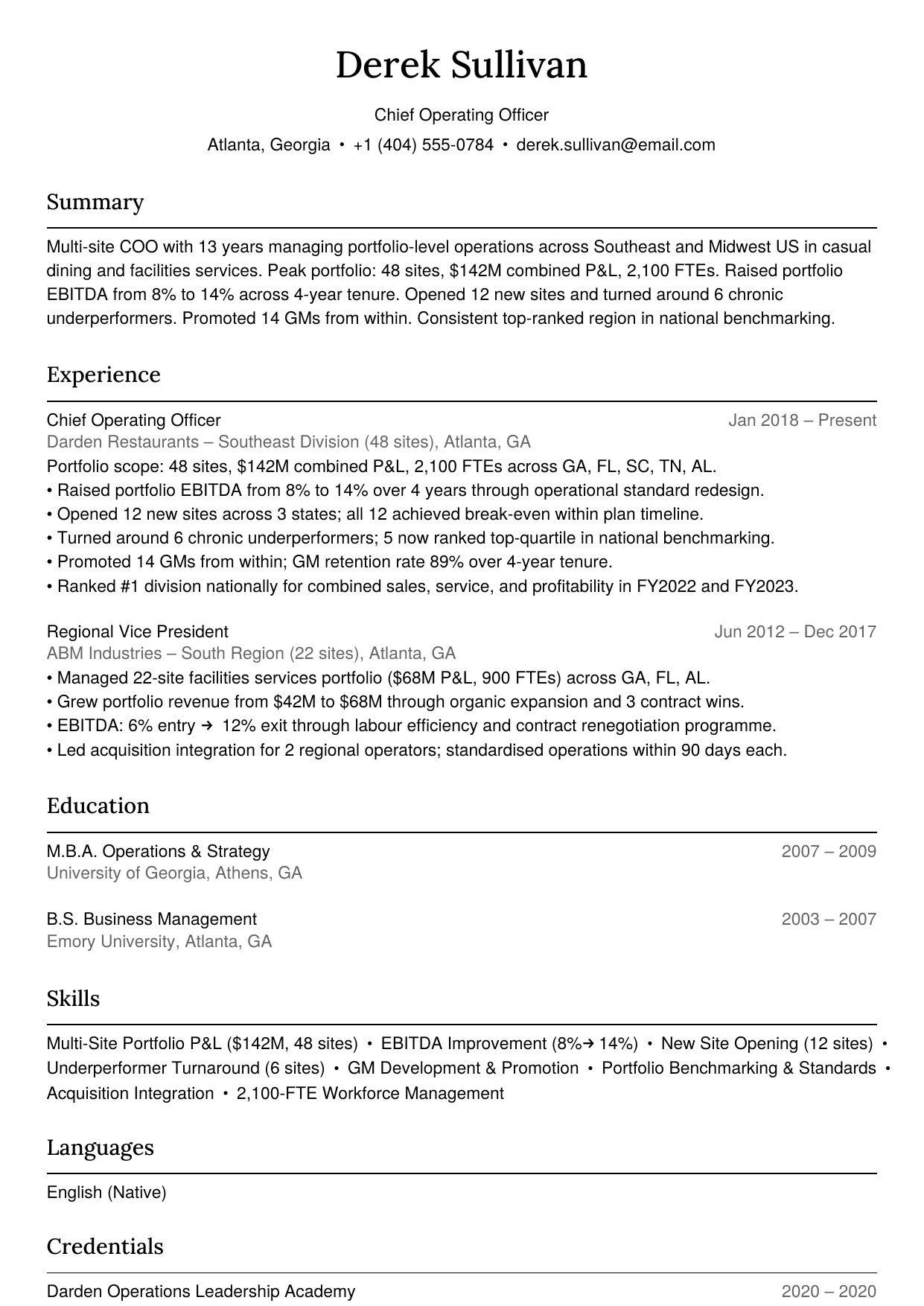
Wensa's 8 COO examples are each built around a specific archetype — because a scale-up COO resume and a PE-backed COO resume should look nothing alike. Start with a professional executive resume template and read our resume writing guide before tailoring for your mandate type.
COO Resume Examples by Archetype and Industry



Closing the Attribution Gap: COO Bullet Structure
Every COO bullet has to do something regular management bullets don't: prove that the outcome required your specific level of decision-making. Anyone can write "reduced costs by 18%." Only a COO writes the bullet that shows how the decision was made and at what organisational level it was taken.
Attribution-Weak | Attribution-Strong |
|---|---|
"Reduced operational costs by 18%" | "Redesigned 3-tier operational structure eliminating a middle management layer — delivered 18% cost reduction and improved decision velocity from 11 days to 3, enabling CEO to refocus on growth strategy" |
"Led cross-functional teams across the business" | "Built and chaired weekly Operating Committee across 6 functional heads — first formal governance structure in company's 12-year history, reducing escalations to CEO by 65%" |
"Oversaw technology modernization programme" | "Owned the commercial case and executive sponsorship for a £4.2M ERP migration — delivered on schedule, enabling the company to onboard 3 enterprise clients previously blocked by system limitations" |
The pattern: a structural or governance decision first, then the operational outcome, then the strategic consequence that proves board-level thinking.
Pro tip: For every bullet, ask: "Could an operations manager have made this decision?" If yes — rewrite to show the board-level dimension: the stakeholder you aligned, the trade-off you called, or the organisational change you owned that made it possible.
For the CEO-adjacent framing challenges at executive level, see the CEO and executive resume examples. For how the operational layer below COO handles similar attribution challenges, the general manager resume examples and operations manager resume examples are useful contrast. Our top resume mistakes guide covers the attribution gap in depth.
What the COO Resume Summary Must Prove
COO summaries fail in one of two directions. Either they read like a general manager summary with a fancier title, or they're so abstract and strategic that they prove no operational depth at all.
What doesn't work
"Dynamic COO with 15 years of experience driving operational excellence and leading high-performing teams across multiple industries."
This describes a senior manager. It proves no board-level scope, no commercial architecture, no specific mandate. Skipped.
What works
"PE-backed COO with three scale-up mandates across SaaS and logistics — most recently built the operational infrastructure for a £45M ARR business from 80 to 340 employees over 3 years, delivering EBITDA margin improvement from 8% to 23% ahead of a £180M exit. Specialize in the operational architecture that makes aggressive growth possible without the business breaking."
This names the archetype (PE-backed scale-up COO), the company stage (80 to 340 employees), the commercial outcome (EBITDA improvement toward exit), and the specialization — "operational architecture for aggressive growth" — that positions the candidate clearly for the next similar mandate.
Pro tip: The last sentence of your summary is the most powerful real estate. Use it to name your specialization in plain language — "Specialize in [X]" — not a list of skills, not a vague promise of value. A search consultant should be able to brief a board from that one sentence.
For the broader executive summary framework, see how it's approached in the business development manager resume examples. If you're also preparing a cover letter alongside your COO resume, our cover letter tips cover the executive-level approach — which differs significantly from functional-level applications. For format decisions at this seniority, our resume format guide covers when a career highlights block outperforms a standard summary.
ATS and Keyword Strategy for COO Resumes
Unlike most roles, senior COO positions are rarely filled through public postings — the majority go through executive search firms like Spencer Stuart, Korn Ferry, and Heidrick & Struggles. That said, mid-market and first-time COO roles are frequently posted, and ATS keyword hygiene still matters there.
High-weight COO keywords across all postings
Operational terms: P&L management, operational excellence, cross-functional leadership, KPI management, process improvement, scalability, organisational design
Commercial terms: EBITDA, revenue growth, cost reduction, budget accountability, margin improvement, business transformation
Governance terms: board reporting, executive committee, stakeholder management, investor relations, risk management, regulatory compliance
People terms: team leadership, talent development, organisational restructuring, succession planning, performance management, culture
Archetype-specific terms to add
Scale-up COO: hypergrowth, operational infrastructure, systems implementation, headcount scaling, Series B/C/D, venture-backed
PE-backed COO: EBITDA improvement, exit readiness, buy-and-build, due diligence, management information, portfolio company
Turnaround COO: restructuring, cost transformation, business recovery, cash management, creditor management, operational turnaround
Pro tip: If the posting uses both "COO" and "Chief Operating Officer" — use both terms. Some ATS parsers treat abbreviated and full titles as separate keywords. Include both in your title line and summary.
For a full ATS optimization walkthrough, read our ATS resume tips guide. For PDF vs Word submission decisions — which matters at executive level — see our PDF vs Word guide.
COO Resume FAQs
How long should a COO resume be?
Two pages for most COO candidates. One page undersells the depth of a C-suite career. Three pages is occasionally appropriate for candidates with multiple distinct mandates or extensive governance and board histories — but every line needs to earn its place. A tight two pages beats a padded three every time.
How do I separate my contribution from the CEO's on a resume?
Name the specific functions, systems, and decisions that reported to you — not the company-wide outcomes the CEO owns. "Owned and built the operations, technology, and people functions" is clearer than "led the company's transformation." The more specific the governance scope, the more credible the attribution.
Should a COO resume include board memberships?
Yes — any board reporting, committee involvement, or NED advisory role belongs in a dedicated section. Even if you've only presented to a board as an exec, note it: "Regular presenter to Board and Audit Committee on operational performance." It signals governance maturity that purely operational CVs lack.
What format should a COO resume use?
Reverse chronological with a strong executive summary at the top. For candidates with a strong commercial track record across multiple roles, adding a 3-4 line "Career Highlights" block between the summary and the experience section gives search consultants an immediate shortlistable signal before they read the full history.